Mor Nitzan: Learning Diffeomorphisms for Dynamical Prototype Matching in Biological Data
Keywords
Summary
123 words
Critical Evaluation
Value of the Information & Strength of the Argument
The talk presents a valuable contribution by introducing a flexible framework for dynamical prototype matching that can handle high-dimensional, noisy data. The argumentation is solid: the method is motivated by clear biological questions, grounded in dynamical systems theory, and validated on both synthetic and real datasets. The speaker demonstrates the utility of the approach through examples, including the identification of limit cycles in the repressilator and cell cycle in human cells. The use of normalizing flows ensures invertibility and differentiability, which is crucial for the loss function. The presentation is technically rigorous, though some details are glossed over due to time constraints.
Scientific Rigor, Source Quality, Title Accuracy
The talk is scientifically rigorous, with references to prior work (e.g., RNA velocity, optimal transport) and the speaker’s own published research. The main source is the arXiv preprint on SPE, which is mentioned. The title accurately reflects the content. The talk does not include a public advertisement segment. No comments were provided.
169 words
Title / Content Match
The title accurately reflects the content: the talk focuses on learning diffeomorphisms for dynamical prototype matching in biological data.
Quality & Reliability
8/10
The talk presents a novel computational framework (SPE) with clear mathematical formulation and validation on simulated and real biological data. The speaker is a recognized researcher, and the work is published on arXiv. However, the presentation is a seminar talk, not a peer-reviewed paper, and some technical details are omitted.
Key Moments
Markers derived by PSI from the transcript: the creator did not define chapters.
- Introduction to the challenge of characterizing dynamical systems from limited measurements.
- Discussion of single-cell RNA sequencing data and loss of spatial and temporal information.
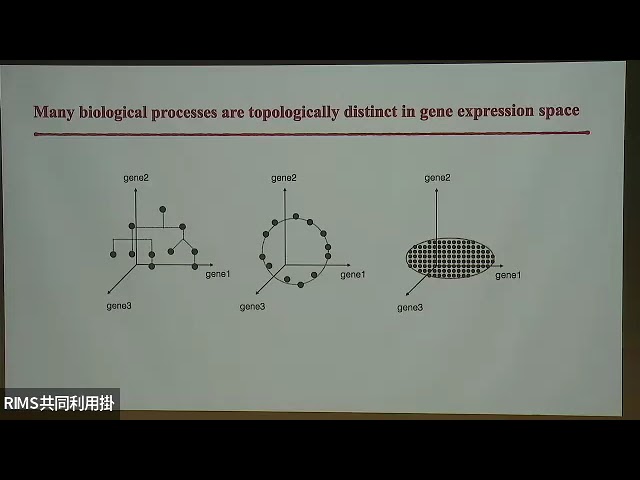
- Introduction of spectral signatures for topological processes in gene expression space.
- Presentation of SCPrisma for filtering and enhancing specific biological signals.
- Introduction of RNA velocity and local velocity information for cells.
- Explanation of the SPE framework: learning diffeomorphisms via normalizing flows.
- Application to simulated repressilator and real cell cycle data, showing identification of limit cycles.
Cited Sources
- Smooth Prototype Equivalences (arXiv preprint) — The main method presented in the talk.
- RNA velocity of single cells — Mentioned as a method to infer local velocities of cells.
Concurring Sources
- RNA velocity of single cells — Provides velocity information used in the SPE framework.
Contribution & Novelties
The talk introduces a novel framework (SPE) that leverages normalizing flows to learn diffeomorphisms between observed data and prototype dynamical systems, enabling classification and invariant set estimation in high-dimensional biological data. This approach is equation-free and robust to noise and sparsity, offering a new tool for analyzing single-cell dynamics.
Pour aller plus loin :
- Normalizing Flows — Background on the generative models used for invertible transformations.
- Dynamical Systems Theory — Foundational concepts for understanding limit cycles and invariant sets.
- Single-cell RNA sequencing — Technology generating the high-dimensional data used in the talk.
92 words
Radar Profile
The radar profile shows high scores in technical level and information quality, reflecting the advanced mathematical and computational nature of the talk. The lower score in quantity of information is due to the seminar format, which limits the depth of coverage. Overall, the talk is highly specialized and rigorous.