Anas Barakat: Multi-Agent Online Control with Adversarial Disturbances
Keywords
Summary
135 words
Critical Evaluation
Value of the Information & Strength of the Argument
The value of the information is high, as it addresses a novel intersection of online learning, control, and game theory. The argumentation is solid, with clear problem formulation, rigorous theoretical results, and illustrative simulations. The authors carefully position their work relative to existing literature and highlight the challenges of decentralization, scaling, and equilibrium behavior. The use of policy regret as a performance metric is appropriate, and the derivation of regret bounds under different information settings is convincing. The simulations, while simple, serve as sanity checks and demonstrate the expected behavior.
Scientific Rigor, Source Quality, Title Accuracy
The talk demonstrates scientific rigor through precise definitions, formal guarantees, and a clear presentation of assumptions. The sources cited are relevant and include foundational works in online control (e.g., Hazan and Singh) and multi-agent control. The title accurately reflects the content, and the talk stays focused on the stated topic. The presentation is well-structured, with a logical flow from motivation to results. The author acknowledges limitations and future work, which adds to the credibility. The description provides no external links, but the talk itself references key literature.
192 words
Title / Content Match
The title accurately reflects the content, which focuses on multi-agent online control with adversarial disturbances.
Quality & Reliability
8/10
The talk presents original research with rigorous theoretical guarantees, including regret bounds and equilibrium gap analysis. The methodology is clearly explained, and the results are supported by simulations. However, the presentation is concise and assumes prior knowledge, and the simulations are simple sanity checks rather than extensive empirical validation.
Key Moments
Markers derived by PSI from the transcript: the creator did not define chapters.
- Introduction and motivation with examples (energy grid, formation control, bio-resource management).
- Problem formulation: multi-agent linear dynamical systems with adversarial disturbances.
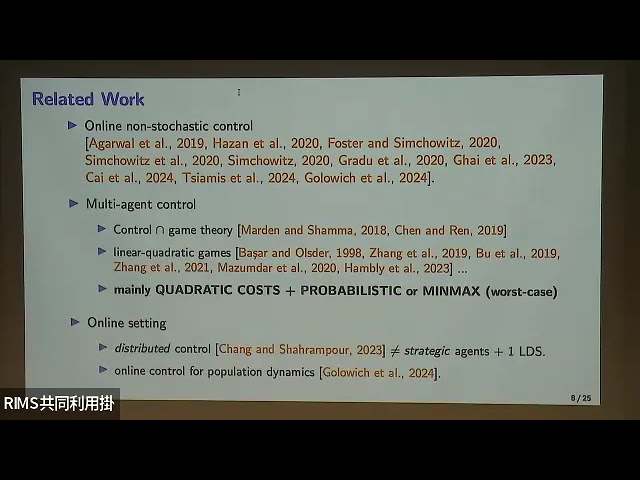
- Prior work and positioning at the intersection of control, online learning, and game theory.
- Single-agent online control background: policy regret and disturbance-action controllers.
- Multi-agent setting: independent learning vs. aggregated control information structures.
- Main results: regret bounds for independent learning and improved bounds with aggregated feedback.
- Equilibrium tracking guarantees for aligned objectives.
- Simulations and discussion of results.
- Conclusion and future work directions.
Cited Sources
- Hazan and Singh, Online Control and Learning, Cambridge University Press, 2025 — Referenced as the foundational work on online control, introducing policy regret and disturbance-action controllers.
Concurring Sources
- Hazan and Singh, Online Control and Learning, 2025 — The single-agent online control framework is directly extended to the multi-agent setting.
Contribution & Novelties
The talk contributes to the emerging field of online multi-agent control by providing the first regret guarantees for decentralized agents facing adversarial disturbances. It extends single-agent online control to a multi-agent setting, offering both individual and collective performance bounds. The distinction between independent learning and aggregated feedback is novel, and the analysis of equilibrium behavior under aligned objectives adds a game-theoretic perspective.
Pour aller plus loin :
- Online Convex Optimization — Foundational framework for regret minimization.
- Regret (decision theory) — Concept of regret used in online learning.
- Potential game — Relevant to the equilibrium analysis when objectives are aligned.
99 words
Radar Profile
The radar profile shows high scores in technical level and information quality, with slightly lower scores in information quantity and reliability, reflecting the theoretical focus and limited empirical validation.