On the Potential and Pitfalls of Flow Matching for Probabilistic Forecasting
Keywords
Summary
134 words
Critical Evaluation
Value of the Information & Strength of the Argument
The talk provides valuable insights into the application of flow matching for probabilistic forecasting, highlighting both its potential and pitfalls. The argumentation is solid, grounded in theoretical derivations from the Schrödinger bridge problem and supported by empirical results on standard benchmarks. The speaker clearly explains the sensitivity to probability path choice and offers a principled solution, which strengthens the value of the information presented.
Scientific Rigor, Source Quality, Title Accuracy
The presentation demonstrates scientific rigor through its theoretical foundations and empirical validation. The speaker references joint work with collaborators and builds on established concepts like flow matching and Schrödinger bridges. The title accurately reflects the content, and the talk maintains a high technical level. No external sources are explicitly cited in the description, but the content appears well-grounded in the research literature.
141 words
Title / Content Match
The title accurately reflects the content, which discusses both the potential and pitfalls of flow matching for probabilistic forecasting.
Quality & Reliability
8/10
Presentation by a researcher at KTH/Nordita, based on joint work with collaborators, covering both theoretical foundations and empirical results. The talk is technical and appears rigorous, but as a seminar it may not include full peer-reviewed details.
Key Moments
Markers derived by PSI from the transcript: the creator did not define chapters.
- Introduction to generative modeling and flow matching
- Explanation of dynamical measure transport and probability paths
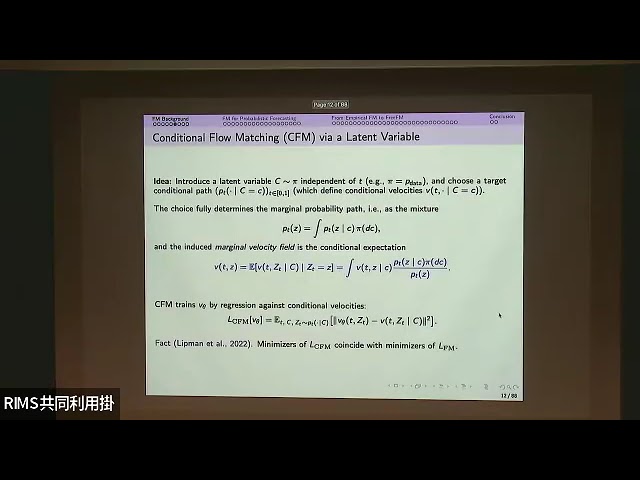
- Discussion on the sensitivity of flow matching to probability path choice
- Motivation for using Schrödinger bridge problem for principled path construction
- Derivation of optimal coefficients for Gaussian probability paths
- Empirical results on PDE forecasting benchmarks
- Analysis of empirical flow matching and velocity field structure
- Conclusions and future directions
Contribution & Novelties
The talk contributes a principled approach to selecting probability paths in flow matching for probabilistic forecasting, based on the Schrödinger bridge problem. It demonstrates improved performance on spatio-temporal benchmarks and provides theoretical analysis of empirical flow matching, revealing connections to memory effects and nonparametric dynamical systems.
Pour aller plus loin :
- Flow Matching for Generative Modeling — Foundational paper on flow matching.
- Schrödinger Bridge Problem — Overview of the problem and its applications.
- Rectified Flow — A related approach for efficient sampling.
82 words
Radar Profile
The radar profile shows high scores in technical level and information quality, indicating a dense, expert-level presentation. The lower score in information quantity reflects the relatively short duration and focused scope of the talk.