Toward an Algorithmic Theory of Machine Learning via Kernel Methods
Keywords
Summary
181 words
Critical Evaluation
Value of the Information & Strength of the Argument
The talk presents a highly original and ambitious research program that bridges two mature fields: algorithmic information theory and kernel methods. The value lies in proposing a concrete mathematical framework that could unify these areas, potentially leading to new insights and algorithms. The argumentation is logically structured, building from philosophical foundations to specific technical contributions. The speaker provides a clear narrative, connecting each part of the series to the overarching goal. However, the talk is more of a research vision than a fully validated theory; many claims are presented as work in progress, and the practical applicability is not yet demonstrated. The argumentation is persuasive for a specialized audience, but it relies heavily on the credibility of the speaker and the existence of the cited papers.
Scientific Rigor, Source Quality, Title Accuracy
The talk demonstrates strong scientific rigor, with references to a series of papers published in reputable venues (e.g., Physica D) and on ResearchGate. The sources are directly cited in the description, providing a clear trail for verification. The title accurately reflects the content, which is a high-level overview of a research program. The speaker is a recognized researcher, and the content is mathematically precise. However, the talk is a seminar presentation, not a peer-reviewed publication, so the claims should be considered as proposals rather than established results. The adequacy between title and content is high, as the talk indeed outlines a path toward an algorithmic theory of machine learning via kernel methods.
253 words
Title / Content Match
The title accurately reflects the content, which outlines a research program toward an algorithmic theory of machine learning using kernel methods.
Quality & Reliability
8/10
The talk presents a coherent theoretical framework linking algorithmic information theory and kernel methods, supported by a series of papers with formal results. The speaker is an established researcher, and the content is mathematically rigorous, though it remains a research proposal rather than a fully validated methodology.
Key Moments
Markers derived by PSI from the transcript: the creator did not define chapters.
- Introduction: speaker introduces the talk as an invitation to explore the interface between machine learning, dynamical systems, and algorithmic information theory.
- Overview of the research program: connecting machine learning, dynamical systems, and AIT, with kernel methods as the bridge.
- Central thesis: compression, learning, and inference are manifestations of the same principle, with kernels as the operator-theoretic bridge.
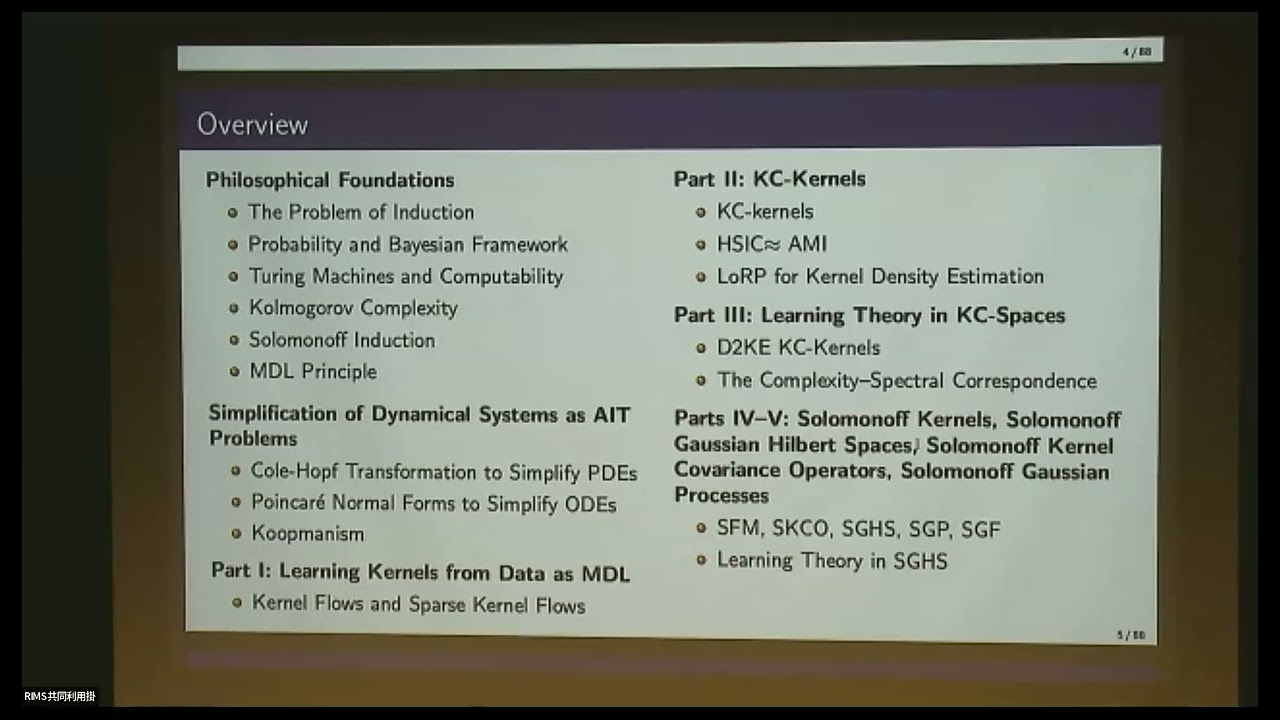
- Outline of the talk: six papers, starting with philosophical foundations and moving to technical contributions.
- Motivation from dynamical systems: simplification via Koopman operators, normal forms, and the question of what makes a good kernel.
- Part I: Learning kernels via MDL, replacing cross-validation with code length.
- Part II: Introduction of KC-kernels based on conditional Kolmogorov complexity, and their application to clustering and density estimation.
- Part III: Complexity-spectral correspondence, relating Kolmogorov complexity to RKHS geometry via Mercer spectra.
- Part IV: Solomonoff kernels and Gaussian processes, introducing the Solomonoff Feature Mixture and the fundamental law lambda_i ~ 2^{-l_i}.
- Part V: Learning theory in Solomonoff spaces, including minimax rates and spectral collapse.
Cited Sources
- Learning Theory from the Viewpoint of Algorithmic Information Theory: Kolmogorov Complexity Meets Kernel Methods — Part III of the series, establishing the complexity-spectral correspondence.
- Bridging Algorithmic Information Theory and Machine Learning Part IV: Solomonoff Gaussian Hilbert Spaces, Solomonoff Gaussian Processes and Solomonoff Gaussian Fields — Part IV, introducing Solomonoff kernels and Gaussian processes.
- Sparse Kernel Flows and Minimum Description Length — Part I, showing that learning a kernel via Sparse Kernel Flows is an MDL problem.
- Kolmogorov Complexity-based Kernels and Unsupervised Learning — Part II, introducing KC-kernels and their applications.
- Short video summary (generated by NotebookLM) — A short video summary of the talk generated by NotebookLM.
Concurring Sources
- Learning Theory from the Viewpoint of Algorithmic Information Theory: Kolmogorov Complexity Meets Kernel Methods — Directly supports the complexity-spectral correspondence.
- Bridging Algorithmic Information Theory and Machine Learning Part IV: Solomonoff Gaussian Hilbert Spaces, Solomonoff Gaussian Processes and Solomonoff Gaussian Fields — Directly supports the Solomonoff kernel framework.
- Sparse Kernel Flows and Minimum Description Length — Supports the MDL-based kernel learning approach.
- Kolmogorov Complexity-based Kernels and Unsupervised Learning — Supports the KC-kernels and their applications.
Contribution & Novelties
The talk presents a novel theoretical framework that unifies algorithmic information theory and kernel methods, proposing that compression and learning are two sides of the same coin. The key innovation is the introduction of Solomonoff kernels and the associated Gaussian processes, which provide a computable surrogate for universal induction. The framework offers a new perspective on learning theory, where compressibility replaces smoothness as the fundamental organizing principle. This could lead to new algorithms and insights, though practical validation is still needed.
Pour aller plus loin :
- Kolmogorov complexity — Foundational concept in algorithmic information theory.
- Solomonoff’s theory of inductive inference — The theoretical basis for the proposed framework.
- Reproducing kernel Hilbert space — Core mathematical structure used in kernel methods.
- Minimum description length — Principle used in Part I.
- Kernel methods — General overview of the field.
137 words
Radar Profile
The radar profile shows high scores in technical level and information quality, reflecting the advanced mathematical content and the depth of the research program. The lower score in information quantity is due to the talk being a high-level overview rather than a detailed exposition. Overall, the profile indicates a technically dense and rigorous presentation.