Learning Single and Multiple Chaotic Systems with Minimal Reservoir Computing
Keywords
Summary
179 words
Critical Evaluation
Value of the Information & Strength of the Argument
The value of the information is high, as it addresses a significant problem in reservoir computing: the reliance on random, hard-to-tune reservoirs. The speaker systematically compares deterministic topologies against random ones on a large benchmark (90+ attractors), providing strong evidence for the superiority of deterministic constructions. The argumentation is solid, with clear methodology and metrics (correlation dimension error, KL divergence). The speaker acknowledges limitations, such as outliers and the need for random input sign assignment, which adds credibility. The discussion of multifunctionality extends the work, showing practical applications. The presentation is well-structured and supported by examples and visualizations.
Scientific Rigor, Source Quality, Title Accuracy
The scientific rigor is good: the study uses a well-known dataset (Gilpin’s), follows established methods, and provides statistical analysis over multiple initial conditions. The speaker cites relevant literature (e.g., Rodan & Tino, Flynn, etc.) and mentions a review by Mantas. However, the talk does not provide full publication details, and some claims (e.g., hyperparameter transferability) could be further substantiated. The title accurately reflects the content, and the presentation is coherent. No comments were provided, so no analysis of public reception is included.
195 words
Title / Content Match
The title accurately reflects the content: the talk focuses on learning single and multiple chaotic systems using minimal reservoir computing, specifically deterministic reservoir topologies.
Quality & Reliability
8/10
The talk presents original research with a clear methodology, systematic comparison over 90+ attractors, and reproducible deterministic reservoir constructions. The speaker acknowledges limitations and discusses hyperparameter tuning issues. However, the presentation is a seminar talk without peer-reviewed publication details, and some metrics (e.g., correlation dimension error) have interpretative caveats.
Key Moments
Markers derived by PSI from the transcript: the creator did not define chapters.
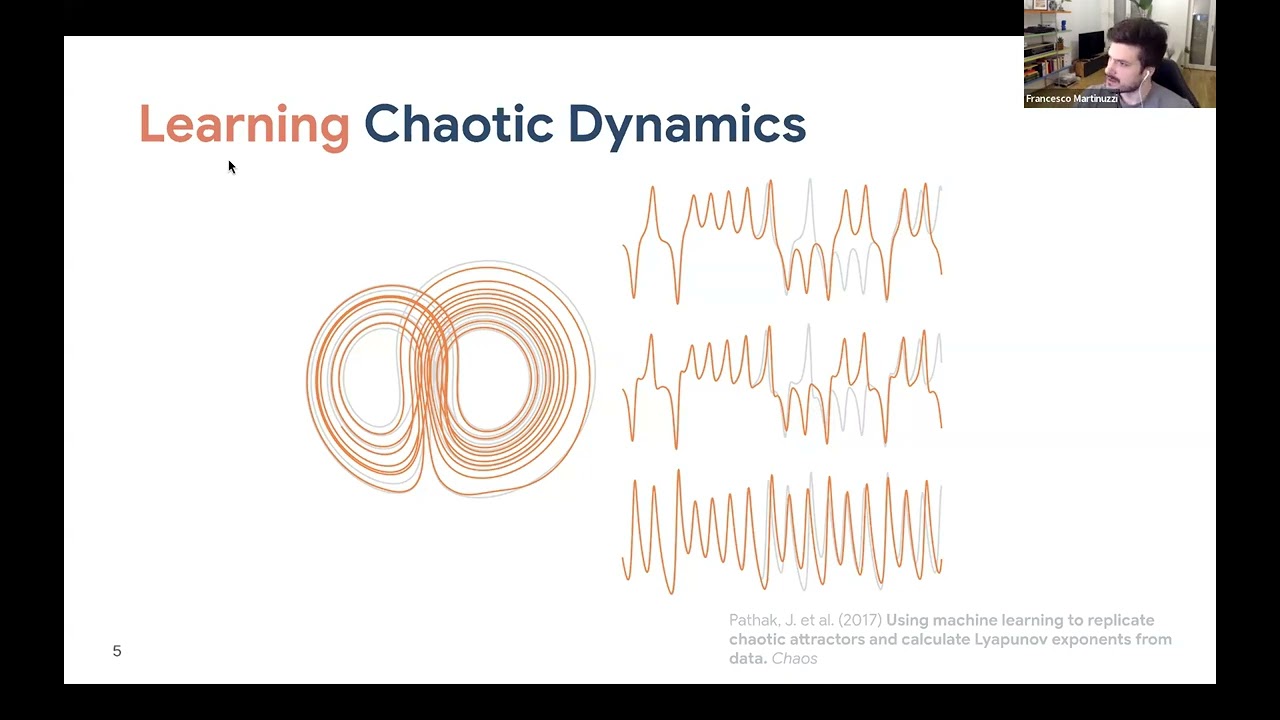
- Introduction to chaotic systems and motivation for data-driven modeling.
- Explanation of echo state networks and training via linear regression.
- Discussion of hyperparameter tuning challenges in random reservoirs.
- Introduction to deterministic reservoir topologies and their advantages.
- Description of experimental setup: 10 topologies, 90+ attractors, and metrics.
- Presentation of results: deterministic reservoirs outperform random ones in accuracy and variability.
- Discussion of hyperparameter transferability across systems.
- Introduction to multifunctionality and two techniques: blending and parameter-aware.
- Results on multifunctionality with minimal reservoirs.
- Conclusion and summary of findings.
Cited Sources
- Gilpin's chaotic systems dataset — Used as benchmark for testing reservoir topologies.
- Rodan & Tino (2010) paper on simple topologies — Introduced deterministic reservoir constructions.
- Flynn et al. on multifunctionality — Proposed blending technique for multifunctionality.
- Parameter-aware technique paper — Proposed adding a label to input for multifunctionality.
- Mantas review on reservoir computing — Discussed hyperparameter tuning heuristics.
Concurring Sources
- Rodan & Tino (2010) paper on simple topologies — Supports the use of deterministic reservoirs.
- Flynn et al. on multifunctionality — Supports the feasibility of multifunctionality in reservoirs.
Dissenting Sources
- Papers suggesting random reservoirs are necessary — Some literature argues that random complexity is essential for good performance, which the speaker challenges.
Contribution & Novelties
The talk provides original evidence that deterministic reservoir topologies can outperform random ones for chaotic system forecasting, reducing the need for extensive hyperparameter tuning. It also demonstrates that these minimal reservoirs can achieve multifunctionality, learning multiple systems simultaneously. This contributes to making reservoir computing more interpretable and practical.
Pour aller plus loin :
- Echo state networks — Overview of ESNs and their training.
- Reservoir computing — General framework including ESNs and liquid state machines.
- Chaos theory — Background on chaotic systems and their properties.
- Correlation dimension — Metric used to quantify attractor geometry.
- Kullback-Leibler divergence — Metric used for comparing probability distributions.
102 words
Radar Profile
The radar profile shows high scores in information quantity, quality, technical level, and reliability, indicating a well-rounded and rigorous presentation. The speaker effectively communicates complex concepts and provides substantial evidence, making it a valuable resource for researchers in reservoir computing.