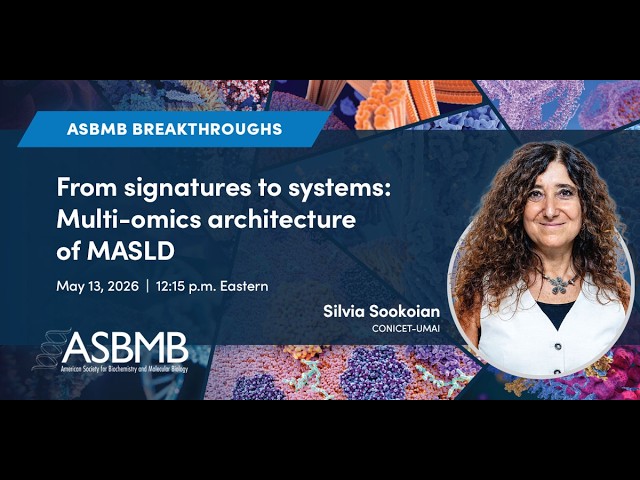
From signatures to systems: Multi-omics architecture of MASLD
Keywords
Summary
146 words
Critical Evaluation
Value of the Information & Strength of the Argument
The presentation provides a high-value synthesis of current multi-omics research in MASLD, offering a comprehensive overview of the field. The argumentation is solid, built on a logical progression from basic concepts to advanced integration. Dr. Sookoian effectively uses examples from her own research and landmark studies to illustrate key points, such as the translation of genetic findings into clinical trials for PNPLA3 and HSD17B13. The discussion of ADGRG1 as a liver-derived protein predicting extrahepatic complications is particularly compelling, demonstrating the power of integrating proteomics with clinical outcomes. The talk also critically addresses the heterogeneity of MASLD and the need for multi-omics approaches to capture this complexity. However, the argumentation could be strengthened by providing more detailed citations for specific claims, as some statements are presented without direct references.
Scientific Rigor, Source Quality, Title Accuracy
The scientific rigor is generally high, with the speaker referencing peer-reviewed studies and clinical trials. The quality of sources is good, including publications in journals like the Journal of Lipid Research and Journal of Hepatology. The title accurately reflects the content, which focuses on the multi-omics architecture of MASLD. The presentation is well-structured and the speaker demonstrates expertise in the field. However, as a webinar, it lacks the formal peer-review process, and some claims are made without explicit citations. The adéquation between title and content is excellent, with the talk directly addressing the integration of multiple omics layers.
241 words
Title / Content Match
The title accurately reflects the content, which focuses on integrating multiple omics layers to understand MASLD.
Quality & Reliability
8/10
The speaker is a recognized expert in hepatology and multi-omics research, presenting a synthesis of established and emerging findings. The content is well-structured, references key studies and clinical trials, and includes critical discussion of methodological approaches. However, it is a webinar presentation without peer review, and some claims are presented without detailed citation.
Key Moments
Markers derived by PSI from the transcript: the creator did not define chapters.
- Introduction to the webinar and speaker, Dr. Silvia Sookoian.
- Overview of multi-omics layers and the concept of integrating biological data.
- Discussion of MASLD definition, prevalence, and phenotypic complexity.
- Genomics: key genetic variants (PNPLA3, TM6SF2, HSD17B13) and their roles in disease.
- Translation of genetics to drug discovery: clinical trials targeting PNPLA3 and HSD17B13.
- Single-cell transcriptomics: cell-type-specific programs and integration with genetics.
- Proteomics: circulating proteome analysis and identification of ADGRG1 as a biomarker.
- Metagenomics: liver microbiome and its link to epigenetic modifications.
- Integration of multi-omics with machine learning for disease subtyping and future directions.
Cited Sources
- Journal of Lipid Research — Mentioned as the sponsor of the webinar and a journal where the speaker has published.
- Journal of Hepatology — Mentioned as the journal where results of a clinical trial on HSD17B13 were published.
Concurring Sources
- PNPLA3 I148M variant and NAFLD — Original GWAS identifying PNPLA3 as a major genetic determinant of hepatic fat.
- HSD17B13 variant and chronic liver disease — Study showing the protective effect of HSD17B13 splice variant.
Contribution & Novelties
The webinar provides a comprehensive and up-to-date synthesis of multi-omics approaches in MASLD, highlighting the integration of genomics, transcriptomics, proteomics, lipidomics, and metagenomics. It offers a unique perspective on how these layers converge to drive disease pathogenesis and heterogeneity. The discussion of translating genetic findings into clinical trials for targeted therapies is particularly novel, as is the identification of ADGRG1 as a liver-derived protein predicting extrahepatic complications. The talk also emphasizes the importance of considering the gut-liver axis and epigenetic modifications in disease progression. Overall, the presentation contributes to a systems-level understanding of MASLD and offers a roadmap for future research and therapeutic development.
Pour aller plus loin :
- MASLD (Wikipedia) — Overview of the disease and its nomenclature.
- PNPLA3 gene (Wikipedia) — Details on the gene and its role in liver disease.
- HSD17B13 gene (Wikipedia) — Information on the gene and its protective variant.
- Single-cell RNA sequencing (Wikipedia) — Explanation of the technology used to dissect cell-type-specific programs.
- Proteomics (Wikipedia) — Overview of the large-scale study of proteins.
169 words
Radar Profile
The radar profile shows a balanced high performance across all dimensions, with slightly lower scores in 'quantite_information' and 'niveau_technique' compared to 'qualite_information' and 'fiabilite_globale'. This indicates a well-rounded presentation with strong scientific content and reliability, though the technical depth could be enhanced for a more specialized audience.
💬 Sur les 0 commentaires analysés, aucune tendance n'est disponible.