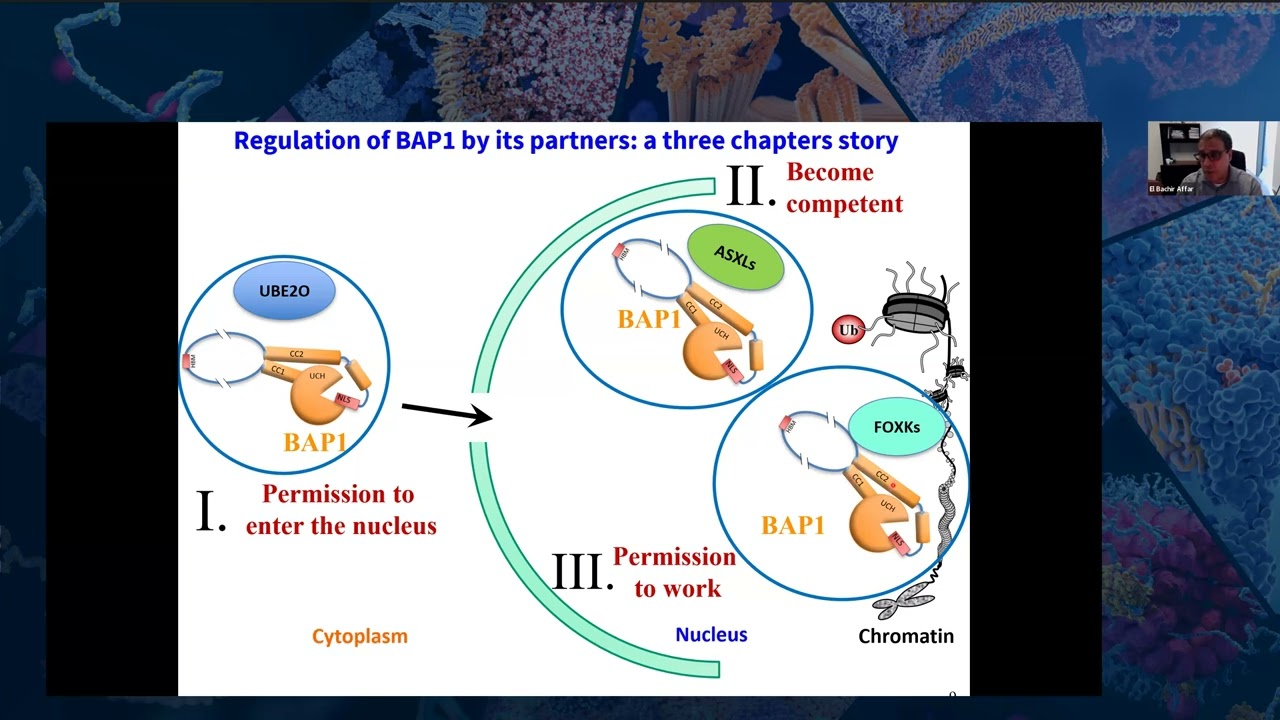
ASBMB Transcription Webinar: BAP1 deubiquitinase
Keywords
Summary
197 words
Critical Evaluation
Value of the Information & Strength of the Argument
The presentation provides valuable insights into the molecular mechanisms of BAP1 function, integrating genetic, biochemical, and cellular data. The argumentation is solid, built on a logical progression from initial discovery to detailed mechanistic studies. Affar supports his claims with experimental evidence, including mass spectrometry, mutagenesis, and in vivo studies in Drosophila and mice. He also acknowledges the complexity and nuances, such as the dual role of BAP1 as a tumor suppressor and potential oncogene. The talk is well-structured and persuasive, though some conclusions are based on unpublished or preliminary data.
Scientific Rigor, Source Quality, Title Accuracy
The speaker demonstrates scientific rigor by referencing published work and structural studies that support his models. He mentions key publications, such as the Nature paper by Dirk Müller on the PR-DUB complex, and his own published findings. The title accurately reflects the content, focusing on the BAP1 deubiquitinase and its role in epigenome regulation. The talk is a webinar, so it is not peer-reviewed, but the speaker’s expertise and the consistency of the presented data enhance its credibility. No comments were provided for analysis.
189 words
Title / Content Match
The title accurately reflects the content, focusing on the BAP1 deubiquitinase and its role in regulating the epigenome.
Quality & Reliability
8/10
The speaker is a recognized expert in the field, presenting a coherent summary of two decades of research, with references to published work and structural studies. However, the presentation is a webinar talk, not a peer-reviewed publication, and some claims lack detailed experimental evidence in this format.
Key Moments
Markers derived by PSI from the transcript: the creator did not define chapters.
- Introduction to the webinar and speaker
- Introduction to BAP1 and its role as a tumor suppressor
- Discovery of BAP1 complex and PR-DUB
- UBE2O-mediated ubiquitination of BAP1 and nuclear entry control
- Interaction with ASXL factors and activation of deubiquitinase activity
- Monoubiquitination of ASXL and its role in catalysis
- Recruitment to chromatin via FOXK1/2 and O-GlcNAcylation
- Conclusion and take-home messages
Cited Sources
- Nature paper by Dirk Müller on PR-DUB complex — Mentioned as the discovery of the PR-DUB complex in Drosophila, which is the ortholog of the BAP1 complex.
Concurring Sources
- BAP1 and cancer — Review on BAP1's role as a tumor suppressor.
- PR-DUB complex — Original paper describing the PR-DUB complex in Drosophila.
Dissenting Sources
- Potential oncogenic role of BAP1 — The speaker mentions that BAP1 can also act as an oncogene in some contexts, which contrasts with its established tumor suppressor role.
Contribution & Novelties
The talk provides a comprehensive synthesis of the speaker’s research on BAP1, offering novel insights into the regulation of its nuclear entry, its activation by ASXL factors, and its recruitment to chromatin. The presentation of a composite ubiquitin binding interface and the role of O-GlcNAcylation in linking metabolism to epigenome regulation are particularly innovative.
Pour aller plus loin :
- BAP1 protein — Overview of BAP1 gene and protein.
- Deubiquitinating enzyme — General information on deubiquitinases.
- Histone H2A — Background on histone H2A and its modifications.
- O-GlcNAc — Information on O-GlcNAcylation and its role in cellular regulation.
96 words
Radar Profile
The radar profile shows high scores across all dimensions, indicating a technically detailed and reliable presentation. The balance between information quantity, quality, and technical depth is strong, with a slight emphasis on technical level, reflecting the specialized nature of the webinar.