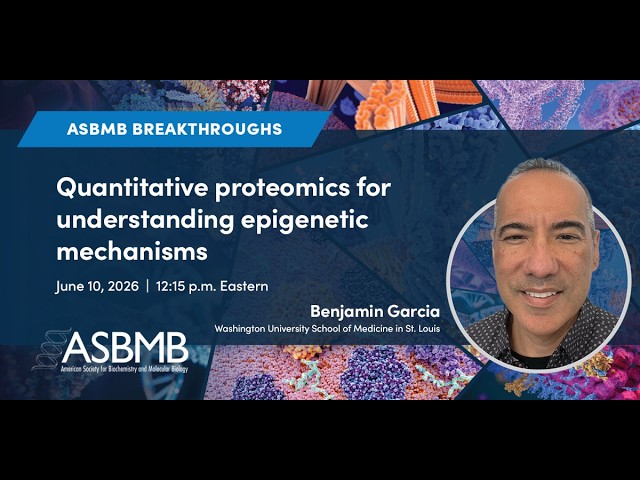
Quantitative proteomics for understanding epigenetic mechanisms
Keywords
Summary
187 words
Critical Evaluation
Value of the Information & Strength of the Argument
The presentation provides valuable insights into the application of quantitative proteomics to epigenetics. The speaker demonstrates the power of mass spectrometry in overcoming limitations of antibody-based methods, offering a more comprehensive and unbiased view of histone modifications. The argumentation is solid, supported by data from published studies and the speaker’s own research. He clearly explains the technical challenges and solutions, such as using fast gradients and EAD to distinguish isobaric modifications. The discussion of histone proteolysis as a potential regulatory mechanism is intriguing and well-supported by experimental evidence, including cathepsin knockdown experiments and chromatin immunoprecipitation (ChIP-seq) data. However, the talk is primarily a summary of the lab’s work rather than a critical evaluation of the field, and some claims could benefit from more detailed methodological context.
Scientific Rigor, Source Quality, Title Accuracy
The presentation is scientifically rigorous, with the speaker citing his own published work and that of others. The sources are primarily peer-reviewed articles, and the speaker is a recognized expert in the field. The title accurately reflects the content, which focuses on quantitative proteomics for epigenetic mechanisms. The talk is well-structured and provides a clear overview of the methods and findings. However, as a webinar, it lacks the formal citation style of a written review, and some references are mentioned only in passing. The speaker also promotes the new ASBMB journal, which is a minor conflict of interest but does not detract from the scientific content.
247 words
Title / Content Match
The title accurately reflects the content, which focuses on quantitative mass spectrometry-based proteomics applied to histone modifications and epigenetic mechanisms.
Quality & Reliability
8/10
The speaker is a distinguished professor with extensive publications and awards, and the presentation is based on peer-reviewed research from his lab. However, it is a webinar talk, not a formal peer-reviewed article, and some claims are presented without full methodological detail.
Key Moments
Markers derived by PSI from the transcript: the creator did not define chapters.
- Introduction and welcome by moderator Terrell Laughton
- Dr. Garcia introduces the topic and his lab's focus on quantitative proteomics for epigenetics
- Overview of histones and post-translational modifications, including the complexity of the histone code
- Discussion of antibody limitations and advantages of mass spectrometry for histone modification analysis
- Introduction of high-throughput platform using ZenoTOF 7600 and microflow gradients for rapid histone PTM quantification
- Use of electron-activated dissociation (EAD) to distinguish isobaric modifications, such as acetyl+methyl vs propionyl
- New project on histone proteolysis: identification of H2A cleavage sites and role of cathepsin during differentiation
- Cathepsin knockdown experiments and ChIP-seq analysis showing preservation of H2A modifications
- Conclusion and Q&A session
Cited Sources
- ASBMB Breakthroughs webinar series — Webinar series hosting this presentation
- Insights in Biochemistry and Molecular Biology (IBNB) — New ASBMB journal mentioned by the speaker
Concurring Sources
- Strahl, B.D., Allis, C.D. (2000). The language of covalent histone modifications. Nature. — Foundational paper on the histone code hypothesis.
- Garcia, B.A. et al. (2007). Organismal differences in post-translational modifications in histones H3 and H4. Journal of Proteome Research. — Early work on histone PTMs by the speaker.
Dissenting Sources
- Potential limitations of antibody-based methods — The speaker criticizes antibody-based methods for histone modification analysis, but some researchers argue that antibodies are still valuable for certain applications.
Contribution & Novelties
The talk presents recent advancements in quantitative proteomics for histone modification analysis, including a high-throughput platform using fast scanning mass spectrometry and microflow gradients, enabling quantification of 150-200 modifications in under 15 minutes. It also introduces a novel role for histone proteolysis, specifically cathepsin-mediated cleavage of H2A, as a potential epigenetic regulatory mechanism during differentiation. This work expands the understanding of how histone modifications are dynamically regulated.
Pour aller plus loin :
- Histone code — Overview of the histone code hypothesis.
- Mass spectrometry-based proteomics — General principles of proteomics.
- Chromatin immunoprecipitation (ChIP-seq) — Technique used to study DNA-protein interactions.
99 words
Radar Profile
The radar profile shows high scores across all dimensions, indicating a technically advanced and reliable presentation. The speaker demonstrates deep expertise and provides substantial information, though the focus is on his own research rather than a broad review.