LRD Seminar: Triglyceride Cycling in Adipocytes
Keywords
Summary
205 words
Critical Evaluation
Value of the Information & Strength of the Argument
The seminar provides valuable insights into the physiological role of triglyceride cycling, a process often considered futile. The use of a novel tracer method allows direct quantification of cycling rates, which is a significant methodological advance. The argumentation is solid, supported by data from multiple cell lines and mouse models. The speakers acknowledge limitations and open questions, such as the role of lipid droplet curvature. The discussion of adipocyte heterogeneity adds depth, linking molecular mechanisms to whole-body energy expenditure. Overall, the information is highly relevant for researchers in metabolism and adipose biology.
Scientific Rigor, Source Quality, Title Accuracy
The seminar is scientifically rigorous, with clear methodology and quantitative analysis. The speakers cite their own published and ongoing work, as well as studies from other labs (e.g., Kristoff Telle’s method, Spiegelman group). The title accurately reflects the content. The presentation is technical and assumes a specialized audience, but the logic is clear. The Q&A session demonstrates engagement with the scientific community. No commercial or promotional content is present.
176 words
Title / Content Match
The title accurately reflects the content: the seminar focuses on triglyceride cycling in adipocytes, covering both molecular machinery and energy expenditure aspects.
Quality & Reliability
8/10
The seminar presents original research data from peer-reviewed studies, with clear methodology and quantitative analysis. The speakers are established researchers (ETH Zurich, Weill Cornell). The content is technical and specific, with no obvious bias or unsupported claims. Minor limitations: some data not yet published (mentioned as 'almost accepted'), and the presentation is a seminar rather than a formal peer-reviewed article.
Key Moments
Markers derived by PSI from the transcript: the creator did not define chapters.
- Introduction by Shannon Reilly on the historical context of triglyceride cycling.
- Anand Sharma begins his talk on the molecular machinery of adipose lipid cycling.
- Explanation of futile cycles and the energetic cost of triglyceride recycling.
- Introduction of the alkyne-labeled tracer method to quantify lipid cycling.
- Data showing ATGL and DGAT1/2 as key enzymes in the futile cycle.
- Evidence for two distinct lipid droplet pools with different cycling rates.
- Discussion of adipocyte subpopulations (P2, H83) enriched in futile cycling.
- Q&A session: questions about curvature dependence and lipid droplet heterogeneity.
Cited Sources
- Method for quantifying lipid cycling using alkyne-labeled fatty acids (Kristoff Telle's lab) — Mentioned as a collaborative method published in 2023.
- Study on P2 adipocyte subpopulation in UCP1 knockout mice (led by Tong Tong) — Discussed as evidence for adipocyte heterogeneity in futile cycling.
- Spiegelman group paper on futile creatine cycle — Cited as supporting evidence for specialized cells enriched in futile cycles.
- Nature paper from Will Scott's group (Imperial College London) on adipocyte subpopulations after weight loss — Cited as evidence for re-esterification-enriched adipocytes in obesity.
Concurring Sources
- Spiegelman group paper on futile creatine cycle — Supports the existence of futile cycles in adipocytes.
- Nature paper from Will Scott's group — Supports the presence of re-esterification-enriched adipocytes after weight loss.
Contribution & Novelties
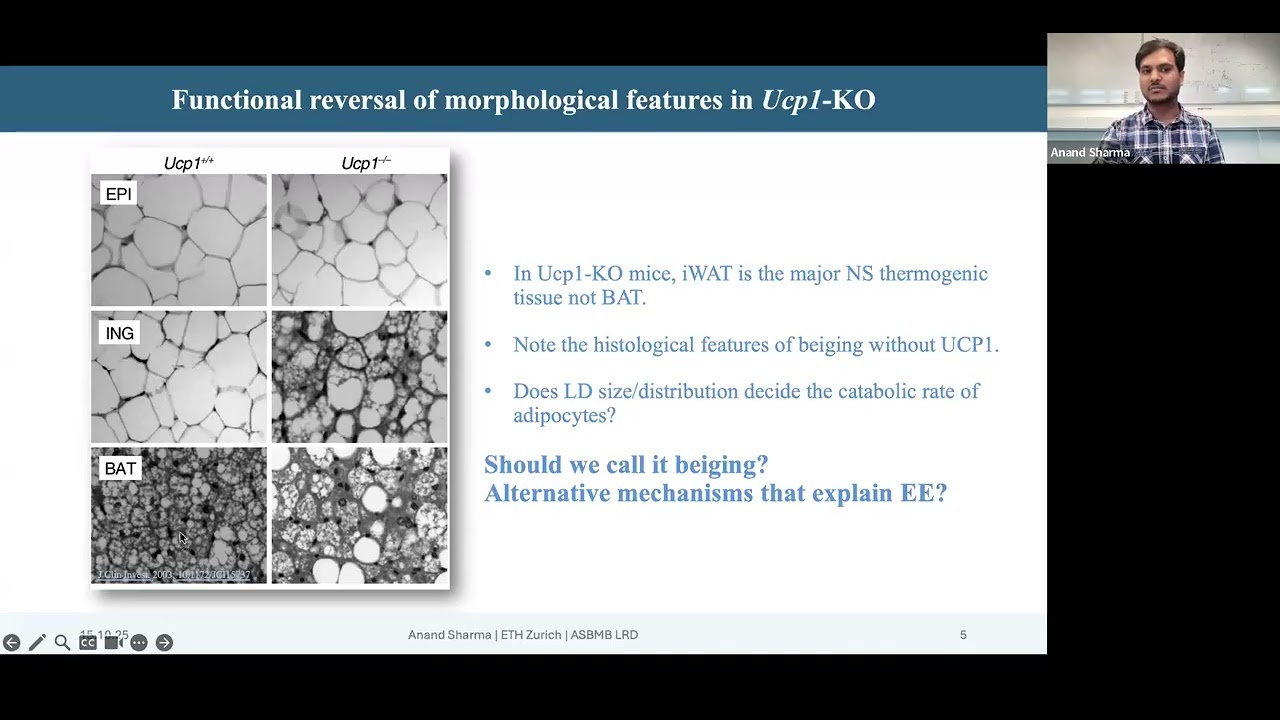
The seminar presents novel quantitative data on triglyceride cycling in adipocytes, using a recently developed tracer method. Key findings include the identification of two distinct lipid droplet pools with different cycling rates, the role of ATGL and DGAT1/2 in the futile cycle, and the existence of adipocyte subpopulations specialized in futile cycling. This advances understanding of adipose tissue dynamics and its link to energy expenditure.
Pour aller plus loin :
- Triglyceride cycle on Wikipedia — Background on triglyceride structure and metabolism.
- Futile cycle on Wikipedia — General concept of futile cycles in biochemistry.
- ATGL (PNPLA2) on NCBI — Gene information for adipose triglyceride lipase.
- DGAT1 on NCBI — Gene information for diacylglycerol acyltransferase 1.
- UCP1 on NCBI — Gene information for uncoupling protein 1.
124 words
Radar Profile
The radar profile shows high scores across all dimensions, indicating a technically strong and reliable seminar. The lowest score is in 'quantite_information' (8) but still high, reflecting the depth of content. The overall profile suggests a well-balanced, scientifically rigorous presentation.
💬 Sur les 0 commentaires analysés, aucune tendance n'est disponible.