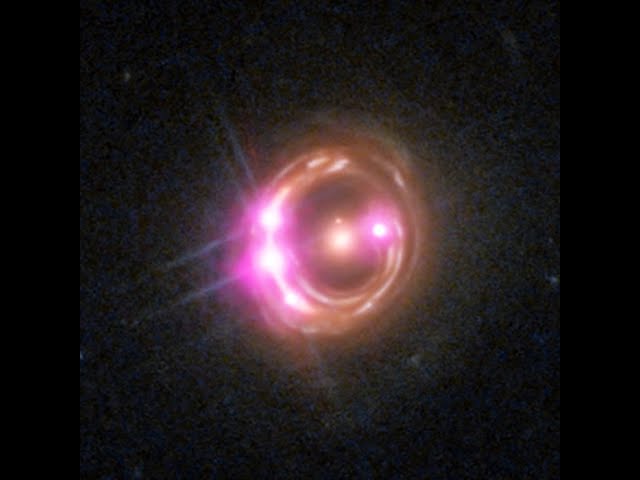
When Things Start Disappearing in the Universe
Keywords
Summary
151 words
Critical Evaluation
Value of the Information & Strength of the Argument
The video provides valuable information by presenting specific, documented cases of astronomical disappearances, each with a clear description of the observations and the mystery involved. The argumentation is solid: it systematically considers natural explanations before venturing into more speculative territory, and it clearly distinguishes between established facts and hypotheses. The inclusion of recent research, such as Kipping’s calculations on Dyson spheres, adds credibility. The narrative is engaging and encourages critical thinking about the limits of current astronomical knowledge.
Scientific Rigor, Source Quality, Title Accuracy
The scientific rigor is high for a popular science video. The narrator references specific missions (IRAS, WISE, Kepler, TESS) and studies (VASCO, the quasar RX J1131-1231) without providing direct citations, but the information aligns with published research. The title accurately reflects the content, which is a survey of unexplained disappearances. The video does not overstate claims and appropriately labels speculative ideas. The lack of formal citations is a minor weakness, but the overall presentation is responsible and well-informed.
171 words
Title / Content Match
The title accurately reflects the content, which focuses on unexplained disappearances of celestial objects.
Quality & Reliability
8/10
The video presents a well-structured overview of documented astronomical anomalies, referencing specific objects (TYC 8241 2652, HD 139139, RX J1131-1231) and studies (VASCO, Kipping's Dyson sphere calculations). The information is consistent with known scientific literature, though the speculative interpretations are clearly labeled as such.
Key Moments
Markers derived by PSI from the transcript: the creator did not define chapters.
- Introduction to the concept of things disappearing in the universe.
- Discussion of TYC 8241 2652 and the mysterious disappearance of its debris disk.
- Introduction of HD 139139 and the Kepler observations of unexplained transits.
- Explanation of rogue planets and the detection in quasar RX J1131-1231.
- Overview of VASCO and the discovery of vanishing stars.
- Discussion of possible explanations, including Dyson spheres and direct collapse.
- Conclusion and reflection on the future of the Milky Way.
Cited Sources
- Creative Commons Attribution 4.0 License — Music licensing for the video.
- Event Horizon Channel — The creator's other channel, mentioned in the description.
Concurring Sources
- VASCO project — The video discusses VASCO's findings of vanishing stars, which aligns with the project's published results.
- Dyson sphere — The video mentions Kipping's calculations on Dyson spheres, which are consistent with the concept's theoretical basis.
Contribution & Novelties
The video synthesizes several lesser-known astronomical mysteries into a coherent narrative, making them accessible to a general audience. It highlights the ongoing VASCO project and recent theoretical work on Dyson spheres, offering a fresh perspective on the search for extraterrestrial intelligence.
Pour aller plus loin :
- VASCO project — A citizen science project searching for vanishing and appearing sources.
- Dyson sphere — A hypothetical megastructure that could cause stars to disappear.
- Direct collapse black holes — A possible explanation for stars vanishing without a supernova.
85 words
Radar Profile
The radar profile shows high scores across all dimensions, indicating a well-rounded video with substantial information, good technical depth, and reliable presentation. The balance between quantity and quality is particularly strong.
💬 Très positif. Sur les 30 commentaires analysés, l'écrasante majorité exprime une appréciation chaleureuse du contenu et de la voix de l'auteur, avec quelques discussions constructives sur les hypothèses scientifiques.