A Detection of Life on Europa? And an Enceladus Update for 03/20/17
Keywords
Summary
187 words
Critical Evaluation
Value of the Information & Strength of the Argument
The video provides substantial value by synthesizing multiple peer-reviewed studies and presenting them in an accessible manner. It clearly distinguishes between confirmed findings (e.g., Enceladus’s heat anomalies) and speculative interpretations (e.g., the potential detection on Europa). The argumentation is generally solid, as the creator presents evidence for and against the biological hypothesis, including alternative explanations such as salts and sulfur compounds. However, the video occasionally leans toward speculation, especially regarding the origin of the staining, but it consistently acknowledges the need for further research. The inclusion of specific papers and data strengthens the credibility of the presentation.
Scientific Rigor, Source Quality, Title Accuracy
The video demonstrates strong scientific rigor by referencing specific peer-reviewed papers and providing links in the description. The creator accurately represents the findings of the cited studies, such as the Dalton paper on Europa’s non-ice material and the Le Gall et al. study on Enceladus’s thermal anomalies. The title accurately reflects the content, as the video indeed discusses a potential detection of life on Europa and an update on Enceladus. The video does not overstate the evidence, and it clearly labels speculative claims as such. The inclusion of multiple sources and the balanced discussion of alternative hypotheses enhance the overall reliability.
213 words
Title / Content Match
The title accurately reflects the content: the video discusses a potential detection of life on Europa and provides an update on Enceladus.
Quality & Reliability
8/10
The video presents a balanced synthesis of peer-reviewed research, clearly distinguishing between established findings and speculative hypotheses. The creator cites specific papers and provides links in the description, enhancing transparency. However, the speculative nature of the 'potential detection' is acknowledged, and the video does not include direct expert interviews or independent verification.
Key Moments
Markers derived by PSI from the transcript: the creator did not define chapters.
- Introduction: combination of news and addendum to previous video on potential detections of alien life.
- Enceladus update: microwave observations reveal warmer south pole, suggesting shallow subsurface ocean.
- Discussion of Enceladus's heat source and its relation to tidal deformation.
- Titan: potential for methanogenic life and the 2010 findings of missing hydrogen and acetylene.
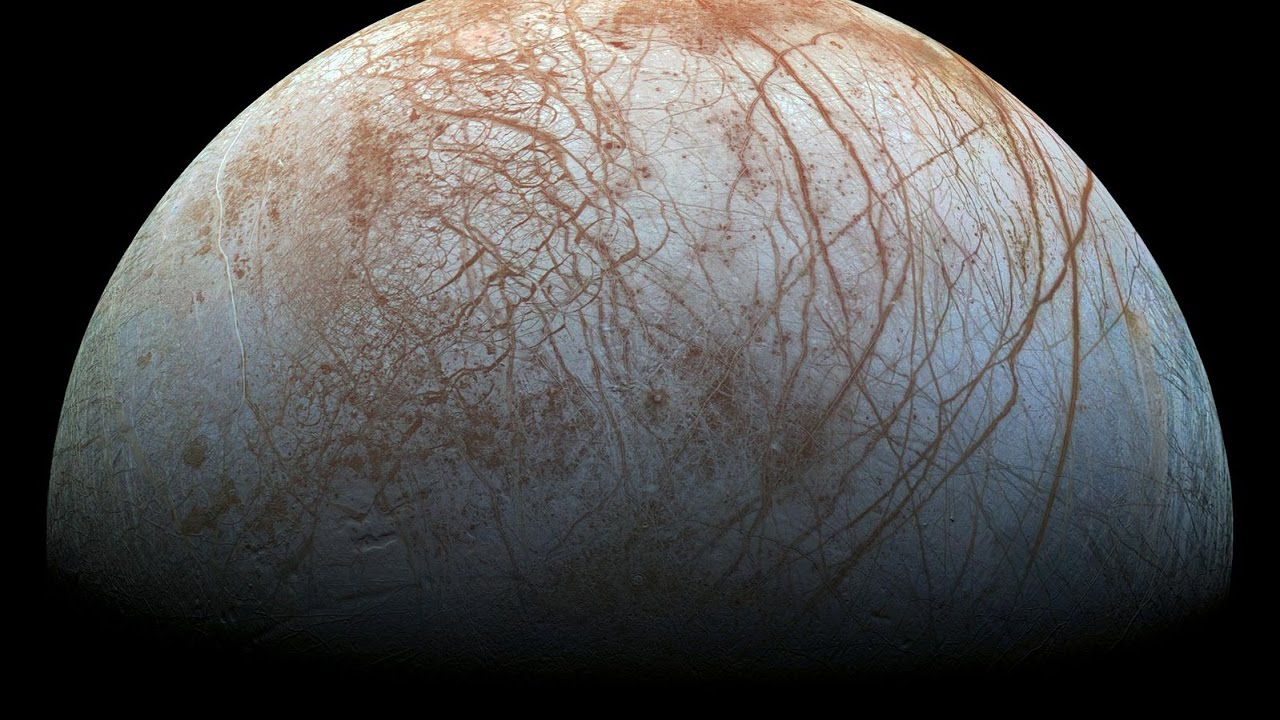
- Introduction of the potential detection on Europa: reddish staining around cracks.
- Brad Dalton's research: comparing infrared spectra of staining with extremophile bacteria.
- Discussion of Deinococcus radiodurans and its relevance to the Europa hypothesis.
- Alternative explanations: salts and sulfur compounds, and the issue of color.
- Europa Clipper mission and funding status, including the cancellation of the lander.
Cited Sources
- Linear mixture modeling of Europa’s non-ice material based on cryogenic laboratory spectroscopy — Dalton 2007 paper on Europa's non-ice material, used to analyze the staining.
- Near-infrared detection of potential evidence for microscopic organisms on Europa — Dalton et al. 2003 paper proposing potential evidence for microscopic organisms on Europa.
- Possibilities for methanogenic life in liquid methane on the surface of Titan — McKay and Smith 2005 paper predicting hydrogen and acetylene anomalies on Titan.
- Molecular hydrogen in Titan’s atmosphere: Implications of the measured tropospheric and thermospheric mole fractions — Strobel 2010 paper on hydrogen levels in Titan's atmosphere.
- Detection and mapping of hydrocarbon deposits on Titan — Clark et al. 2010 paper on hydrocarbon deposits on Titan.
- Thermally anomalous features in the subsurface of Enceladus’s south polar terrain — Le Gall et al. 2017 paper on thermal anomalies on Enceladus.
- Enceladus's internal ocean and ice shell constrained from Cassini gravity, shape, and libration data — Cadek et al. 2016 paper on Enceladus's internal structure.
Concurring Sources
- Europa Clipper - NASA — NASA's mission page for Europa Clipper, which is discussed in the video.
- Enceladus - NASA Solar System Exploration — NASA's page on Enceladus, providing background on the moon's features.
Dissenting Sources
- Sulfur on Europa: An alternative explanation for the reddish staining — The video mentions that sulfur compounds from Io or radiation could explain the staining, which would not be biological.
External References
Contribution & Novelties
The video provides a valuable synthesis of recent findings on ocean worlds, particularly the potential detection of life on Europa and the updated understanding of Enceladus’s subsurface ocean. It highlights the work of Brad Dalton and the intriguing spectral similarities between Europa’s staining and extremophile bacteria, while also discussing alternative explanations. The video also brings attention to the proposed Europa Clipper mission and its funding challenges, offering a timely update on the exploration of these moons.
Pour aller plus loin :
- Europa (moon) - Wikipedia — Overview of Europa’s characteristics and exploration.
- Enceladus - Wikipedia — Detailed information on Enceladus’s geology and plumes.
- Deinococcus radiodurans - Wikipedia — Information on the extremophile bacterium discussed in the video.
- Europa Clipper - NASA — Official mission page for the Europa Clipper.
- Astrobiology - Wikipedia — Overview of the field of astrobiology.
139 words
Radar Profile
The radar profile shows high scores in information quantity, quality, and reliability, with a slightly lower technical level. This indicates a well-researched and informative video that is accessible to a general audience while still providing depth. The balance between the scores suggests a strong overall presentation with minor limitations in technical depth.
💬 Très positif. Sur les 30 commentaires analysés, les spectateurs expriment une forte appréciation pour la profondeur de la recherche et la qualité de la présentation, avec plusieurs remerciements pour le travail de synthèse et la clarté des explications.