MLP Live session
Keywords
Summary
102 words
Critical Evaluation
Value of the Information & Strength of the Argument
The video provides a practical walkthrough of a regression modeling pipeline, which is valuable for beginners. The instructor explains the purpose of each step, such as imputation, scaling, and encoding, and justifies the choice of models. The argumentation is based on empirical results from the models’ performance, which is a solid approach. However, the explanations are sometimes superficial, and the session lacks depth in discussing theoretical underpinnings or alternative approaches.
Scientific Rigor, Source Quality, Title Accuracy
The session does not cite any external sources or references. The content is based on the instructor’s knowledge and practical experience. The title ‘MLP Live session’ is not very descriptive, but the content matches the channel’s focus on machine learning practice. The session is a live coding tutorial, so the rigor is limited by the informal nature and lack of citations.
146 words
Title / Content Match
The title 'MLP Live session' is vague but the content is a live coding session on regression models, which is consistent with the channel's focus.
Quality & Reliability
6/10
The session is a practical tutorial on regression modeling, but it is informal and lacks rigorous citations or references. The explanations are clear but sometimes imprecise, and the content is not peer-reviewed.
Key Moments
Markers derived by PSI from the transcript: the creator did not define chapters.
- Introduction and overview of the steps: loading data, feature engineering, splitting, model building, and hyperparameter tuning.
- Importing libraries and setting up preprocessing transformers (StandardScaler, OneHotEncoder, SimpleImputer).
- Discussion on the syllabus and exam weightage for preprocessing and model building.
- Loading the dataset and inspecting features, including numerical and categorical columns.
- Building the preprocessing pipeline with ColumnTransformer.
- Splitting data into training and test sets.
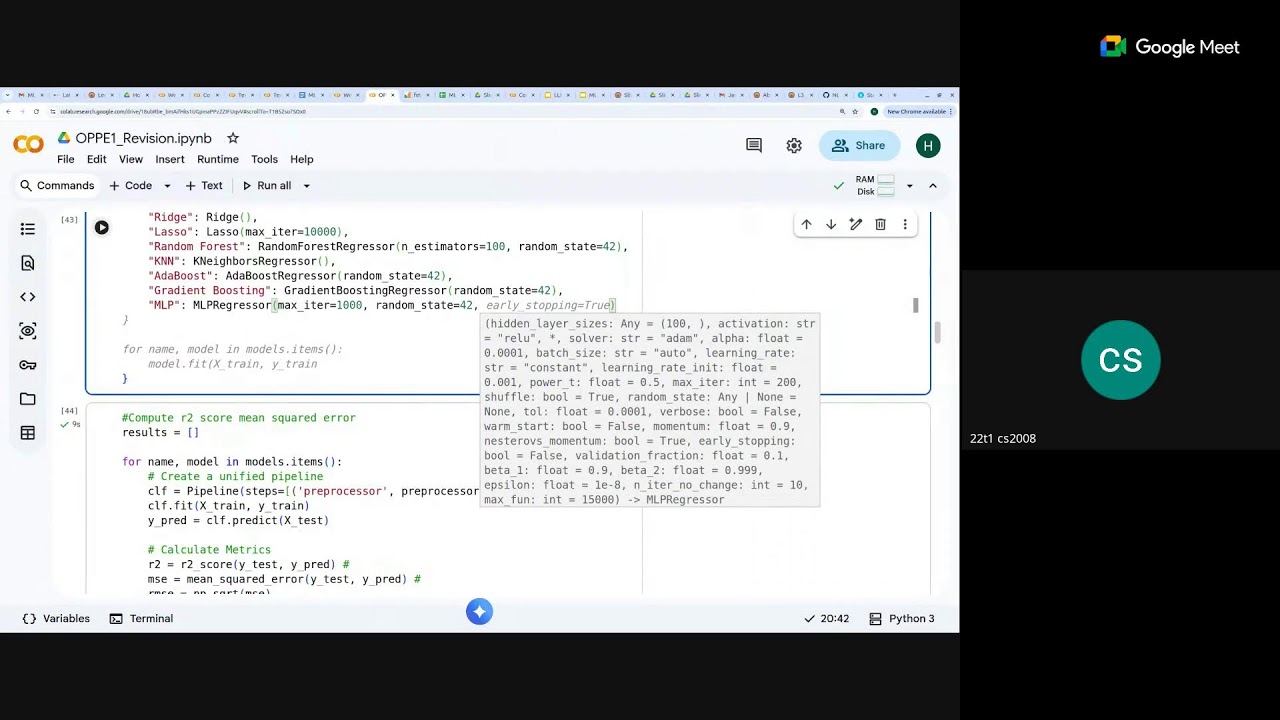
- Initializing multiple regression models and evaluating them with R2 and RMSE.
- Discussion on model performance, noting that random forest and gradient boosting perform best.
- Performing hyperparameter tuning with GridSearchCV on random forest and MLP regressor.
- Final remarks and conclusion of the session.
Contribution & Novelties
The video provides a practical, step-by-step demonstration of a regression modeling pipeline, which is useful for beginners. It emphasizes the importance of preprocessing and model evaluation. However, it does not introduce novel concepts or techniques.
Pour aller plus loin :
- Scikit-learn documentation on pipelines — Official documentation on building pipelines.
- GridSearchCV documentation — Official documentation on hyperparameter tuning.
- California housing dataset description — Reference for the dataset used.
68 words
Radar Profile
The radar profile shows moderate scores across all dimensions, indicating a balanced but not exceptional tutorial. The highest score is in quantity of information, while reliability is the lowest, reflecting the informal nature and lack of citations.
💬 No comments were provided for analysis.