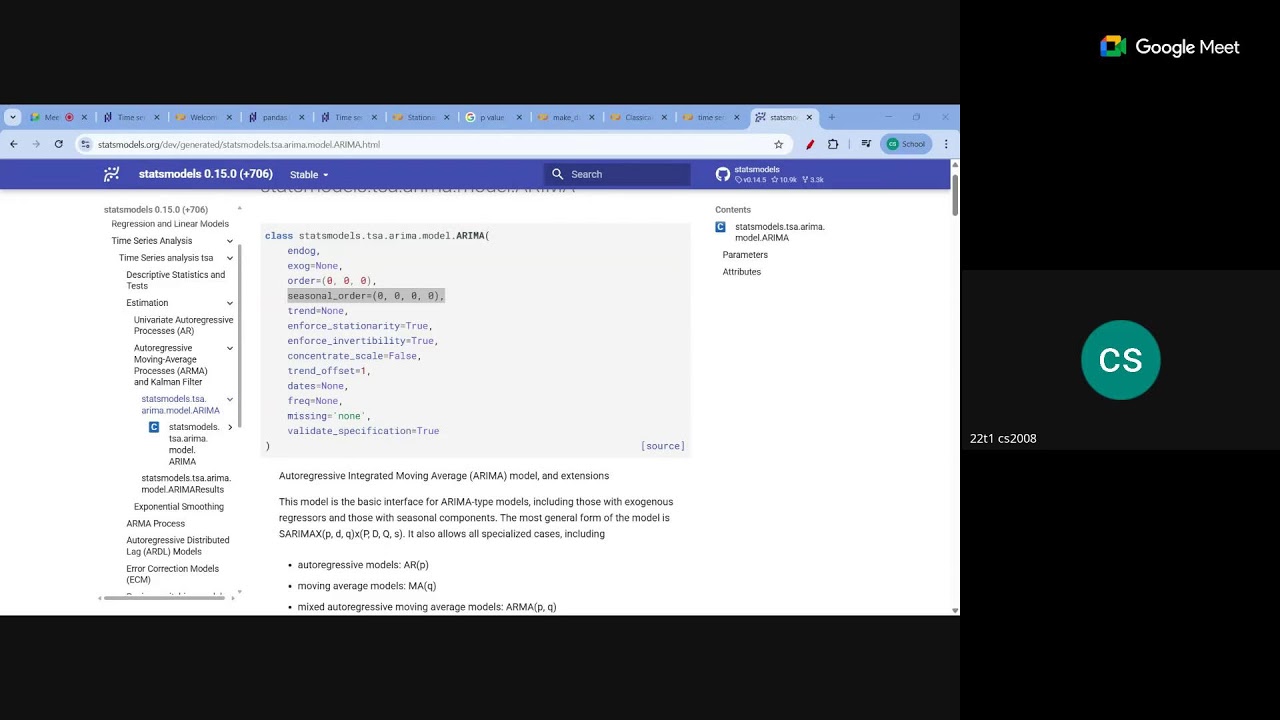
End Term | Doubt Clearing Session
Keywords
Summary
153 words
Critical Evaluation
Value of the Information & Strength of the Argument
The video provides valuable explanations of machine learning concepts, particularly RFECV and cross-validation techniques. The instructor’s arguments are clear and logically structured, using examples and visual aids to illustrate the processes. He effectively addresses student questions, reinforcing understanding. The session is practical and directly applicable to exam preparation, offering insights into how these methods work in practice.
Scientific Rigor, Source Quality, Title Accuracy
The scientific rigor is moderate; the instructor relies on standard machine learning knowledge and documentation, but no formal sources are cited. The title accurately reflects the content, which is a doubt-clearing session. The session is informal but technically sound, with no apparent misinformation. The lack of formal citations is typical for such tutorial sessions.
126 words
Title / Content Match
The title accurately reflects the content, which is a doubt-clearing session for end-term exam preparation.
Quality & Reliability
7/10
The session is an interactive doubt-clearing class led by an instructor, providing explanations of machine learning concepts such as RFECV, K-Fold, and Stratified K-Fold. The content is accurate and aligns with standard practices, but it is informal and lacks formal citations or references.
Key Moments
Markers derived by PSI from the transcript: the creator did not define chapters.
- Introduction and overview of topics to be covered: RFECV, K-Fold, Stratified K-Fold.
- Discussion on RFECV: explanation of recursive feature elimination and its parameters.
- Explanation of how RFECV uses cross-validation to determine optimal number of features.
- Clarification on the difference between coefficients and best hyperparameters.
- Review of K-Fold cross-validation: splitting data into folds and iterative training.
- Introduction to Stratified K-Fold and its importance for imbalanced datasets.
- Example of stratified splitting maintaining class proportions in train and test sets.
- Q&A session addressing student questions on cross-validation and feature selection.
- Further discussion on leave-one-out cross-validation and its differences from K-Fold.
- Wrap-up and final remarks on exam preparation.
Contribution & Novelties
The video provides a clear and interactive explanation of RFECV, K-Fold, and Stratified K-Fold, which are essential for feature selection and model validation. It clarifies common confusions, such as the difference between coefficients and hyperparameters, and emphasizes the importance of stratified sampling for imbalanced data. The session is particularly useful for students preparing for exams, as it directly addresses typical questions and misconceptions.
Pour aller plus loin :
- Recursive feature elimination - Wikipedia — Overview of recursive feature elimination and its variants.
- Cross-validation (statistics) - Wikipedia — Detailed explanation of cross-validation methods, including K-Fold and leave-one-out.
- Stratified sampling - Wikipedia — Concept of stratification and its application in data splitting.
110 words
Radar Profile
The radar profile shows balanced scores across all dimensions, with slightly higher scores in information quantity and quality, indicating a well-rounded educational session. The technical level is moderate, suitable for an intermediate audience, and the overall reliability is good, though lacking formal citations.