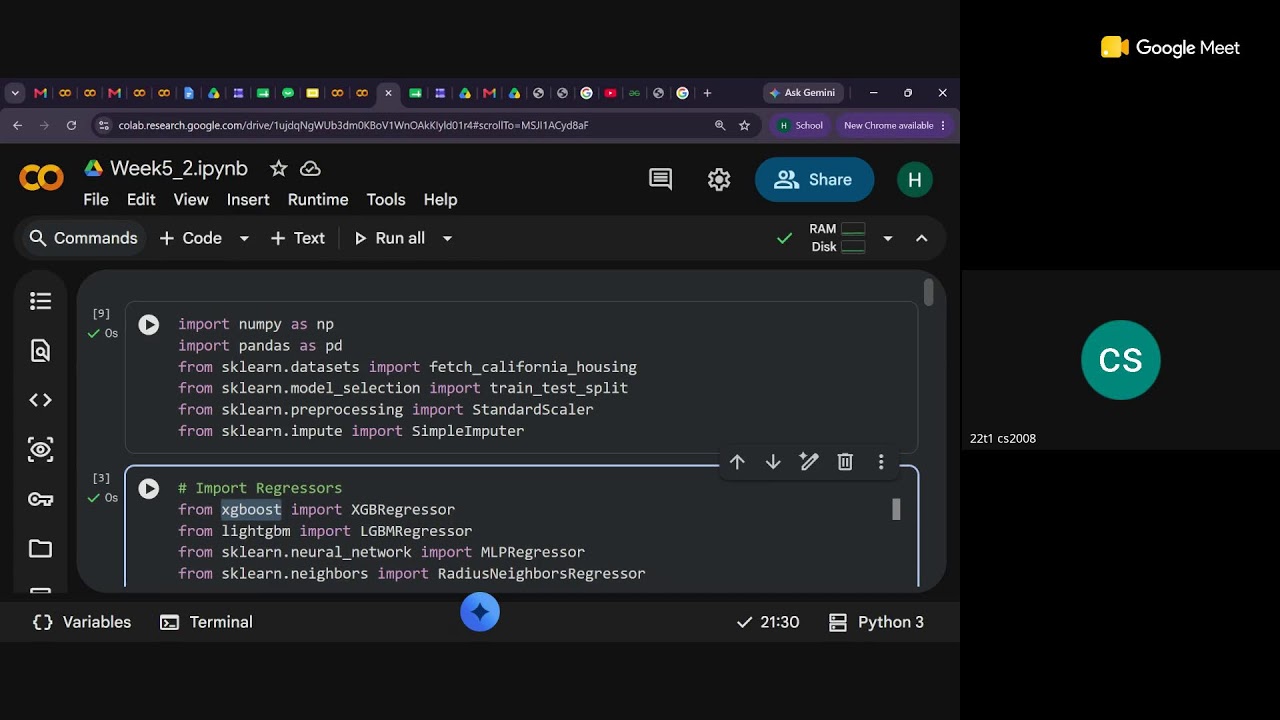
MLP Live session
Keywords
Summary
181 words
Critical Evaluation
Value of the Information & Strength of the Argument
The session provides a practical overview of several regression models, highlighting their strengths and weaknesses. The instructor explains the intuition behind each algorithm, such as the radius-based prediction of RadiusNeighborsRegressor and the regularization in XGBoost. The argumentation is coherent, with examples and analogies to clarify concepts. However, the explanations are sometimes superficial, and the session lacks rigorous mathematical depth. The Q&A segments add value by addressing student doubts, but the overall argumentation is more descriptive than analytical.
Scientific Rigor, Source Quality, Title Accuracy
The session does not cite external sources or references; it relies on the instructor’s knowledge and practical experience. The content is generally accurate but lacks formal citations. The title ‘MLP Live session’ is somewhat misleading as the session covers multiple models, not just MLP. The session is a live tutorial, so the lack of sources is expected, but for a scientific evaluation, the absence of references reduces the rigor. The Q&A interactions show engagement but also reveal some conceptual simplifications.
172 words
Title / Content Match
The title 'MLP Live session' is somewhat generic but accurately reflects the live tutorial format; the content covers MLP and other regression models.
Quality & Reliability
6/10
The session is an interactive tutorial with explanations of several regression models and hyperparameter tuning. The content is generally accurate but lacks depth and formal rigor; some explanations are simplified and the session is informal with Q&A.
Key Moments
Markers derived by PSI from the transcript: the creator did not define chapters.
- Introduction and agenda for the session.
- Discussion on parametric vs non-parametric models.
- Explanation of Radius Neighbors Regressor.
- Introduction to XGBoost and its regularization.
- Discussion on LightGBM and its efficiency techniques.
- Explanation of MLP Regressor and its strengths.
- Hyperparameter tuning for decision tree and MLP regressors.
- Introduction to GridSearchCV and RandomSearchCV.
Contribution & Novelties
The session provides a practical, interactive overview of several regression models and hyperparameter tuning, which is useful for beginners. It clarifies common misconceptions, such as the difference between parameters and hyperparameters, and explains the trade-offs of each model. The Q&A format allows for immediate clarification of doubts.
Pour aller plus loin :
- Scikit-learn documentation on RadiusNeighborsRegressor — Official documentation for the model.
- XGBoost documentation — Official documentation for XGBoost.
- LightGBM documentation — Official documentation for LightGBM.
- Scikit-learn documentation on MLPRegressor — Official documentation for MLPRegressor.
- GridSearchCV documentation — Official documentation for GridSearchCV.
92 words
Radar Profile
The radar profile shows moderate scores across all dimensions, indicating a balanced but not exceptional tutorial. The session provides useful information but lacks depth and formal rigor, making it suitable for beginners rather than advanced practitioners.