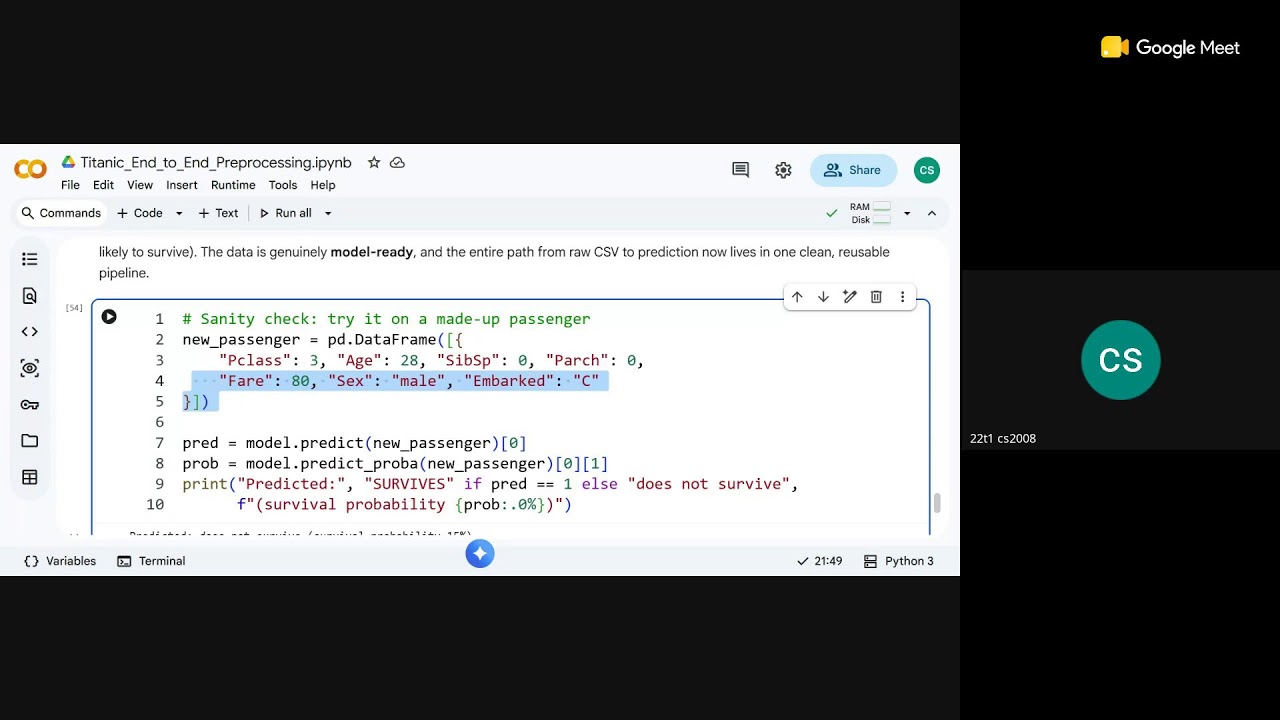
MLP Live session 29-06-2026
Keywords
Summary
166 words
Critical Evaluation
Value of the Information & Strength of the Argument
The session provides valuable, hands-on demonstrations of feature selection techniques and data exploration, which are directly applicable to real-world machine learning projects. The instructor explains the rationale behind each method, such as why wrapper methods are computationally intensive and how RFECV automatically determines the optimal number of features. The argumentation is clear and supported by live code execution, making it practical and credible. However, the session is interactive and occasionally digresses, which may dilute the focus. The instructor’s explanations are generally accurate, though some simplifications (e.g., the distinction between FeatureUnion and ColumnTransformer) could be more nuanced. Overall, the content is useful for learners seeking to understand and apply these techniques.
Scientific Rigor, Source Quality, Title Accuracy
The session does not cite external sources, but it relies on standard machine learning libraries (scikit-learn, pandas) and well-known practices. The instructor’s explanations align with established documentation and common usage. The title accurately describes the content as a live practice session. The session is not a formal scientific presentation, but it is technically sound. No comments were provided for analysis, so no public trends are discussed.
191 words
Title / Content Match
The title accurately reflects the content: a live practice session on machine learning.
Quality & Reliability
7/10
The session is a live tutorial demonstrating feature selection methods and a data preprocessing workflow on the Titanic dataset. The content is technically accurate and aligns with standard machine learning practices, but it is not peer-reviewed and relies on the instructor's expertise. The session is interactive, with some digressions and Q&A, which may affect the structure but not the core reliability.
Key Moments
Markers derived by PSI from the transcript: the creator did not define chapters.
- Introduction and agenda for the session.
- Explanation of wrapper-based feature selection methods.
- Demonstration of Recursive Feature Elimination (RFE) with logistic regression.
- Introduction to RFECV and its automatic feature selection.
- Explanation of SelectFromModel and Sequential Feature Selector.
- Discussion on FeatureUnion vs ColumnTransformer.
- Start of Titanic dataset exploration: loading data and head().
- Using info() and describe() to understand data types and statistics.
- Discussion on missing values and outliers in the dataset.
- Explaining the target variable 'Survived' and survival rate.
Cited Sources
- scikit-learn documentation — Referenced implicitly for feature selection methods and transformers.
- Titanic dataset — Used for the practical demonstration.
Concurring Sources
- scikit-learn documentation — The methods demonstrated are standard and well-documented.
Contribution & Novelties
The session provides a practical, step-by-step guide to feature selection and data preprocessing, which is valuable for beginners. It clarifies the differences between similar techniques (e.g., FeatureUnion vs ColumnTransformer) and demonstrates their application on a classic dataset. The interactive format allows for immediate clarification of doubts, enhancing understanding.
Pour aller plus loin :
- Recursive feature elimination — Overview of feature selection methods.
- ColumnTransformer documentation — Detailed explanation of ColumnTransformer.
- FeatureUnion documentation — Detailed explanation of FeatureUnion.
76 words
Radar Profile
The radar profile shows high scores in quantity of information and technical level, reflecting the session's depth and practical focus. The quality and reliability scores are moderate, as the content is instructional rather than peer-reviewed. The overall balance indicates a solid tutorial for learners.