MLP Live session
Keywords
Summary
179 words
Critical Evaluation
Value of the Information & Strength of the Argument
The value of the information is high for beginners in time series analysis, as it provides a clear, step-by-step explanation of stationarity and the common tests and transformations. The argumentation is solid, with the presenter logically explaining the rationale behind each step and demonstrating with code. However, the session lacks depth in explaining the underlying statistics, and the presenter does not cite any sources or references, which limits its scientific rigor. The practical focus is beneficial, but the lack of theoretical grounding may leave some questions unanswered.
Scientific Rigor, Source Quality, Title Accuracy
The scientific rigor is moderate. The presenter correctly explains the hypotheses of ADF and KPSS tests and the interpretation of p-values. However, there are minor inaccuracies, such as stating that a p-value less than 0.05 in ADF indicates non-stationarity, which is correct, but the phrasing could be clearer. The session does not cite any external sources, and the title is too generic, not reflecting the specific topic. The content is consistent with standard time series analysis practices, but the lack of references reduces its credibility as a scientific resource.
191 words
Title / Content Match
The title 'MLP Live session' is generic and does not reflect the specific content on time series analysis, but it is consistent with the channel's format.
Quality & Reliability
7/10
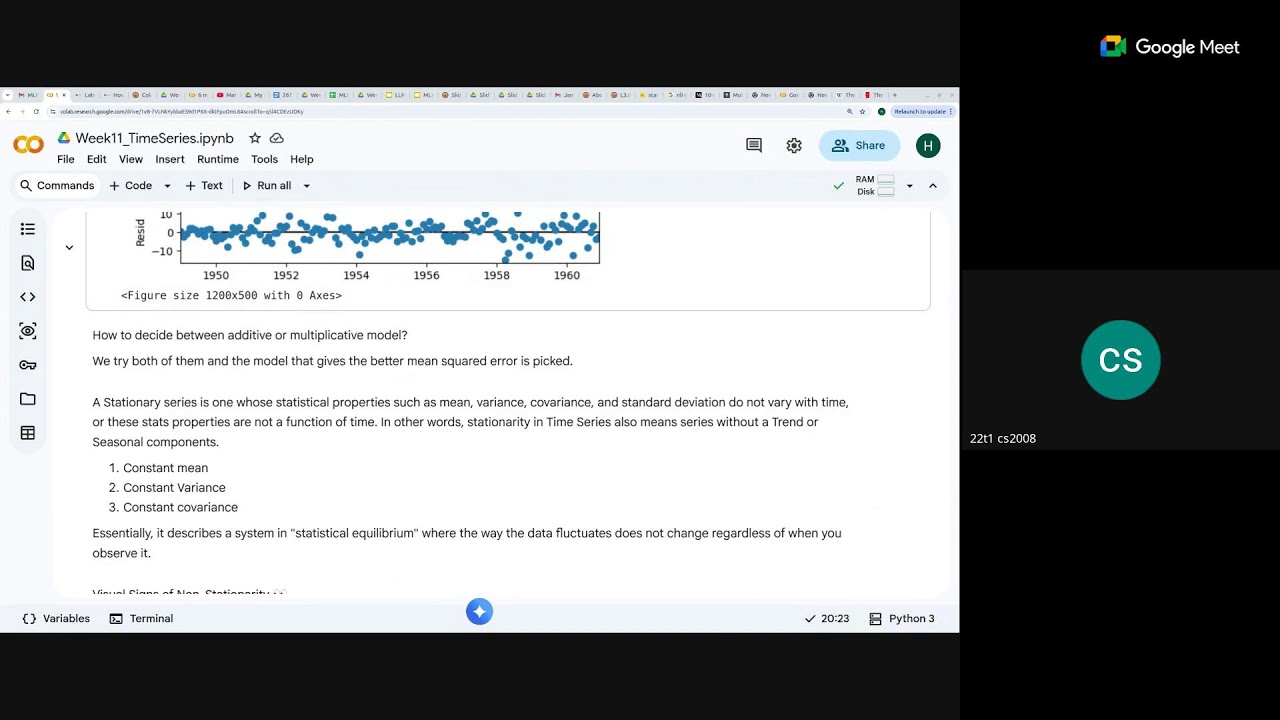
The session is a practical tutorial on time series stationarity, covering ADF and KPSS tests, differencing, detrending, and transformations. The explanations are clear and technically accurate, but the session is informal and lacks citations or references to external sources. The content is based on standard statistical concepts, and the presenter demonstrates hands-on application in a Colab notebook.
Key Moments
Markers derived by PSI from the transcript: the creator did not define chapters.
- Introduction and recap of previous session on time series data.
- Definition of stationary series and its importance.
- Visual signs of non-stationarity: trend, seasonality, variance.
- Introduction to ADF and KPSS tests, null hypotheses, and p-value interpretation.
- Explanation of four possible cases from ADF and KPSS results and corresponding actions.
- Demonstration of differencing on airline passengers data, showing p-value reduction.
- Discussion of double differencing and its effect.
- Introduction to transformations: log, square root, Box-Cox.
- Detrending methods: linear regression, moving average, and their application.
- Results of detrending with rolling window, achieving stationarity.
Contribution & Novelties
The session provides a practical, hands-on approach to making time series stationary, which is a fundamental step in time series modeling. It offers a clear decision framework based on ADF and KPSS test results, guiding whether to difference or detrend. The presenter also emphasizes the importance of experimentation and tuning, which is valuable for practitioners. However, the content is not novel, as these techniques are standard in time series analysis. The session’s contribution lies in its accessible explanation and demonstration.
Pour aller plus loin :
- Augmented Dickey-Fuller test — Provides detailed statistical background and implementation details.
- KPSS test — Explains the test’s hypothesis and usage.
- Box-Cox transformation — Discusses the transformation and its applications.
114 words
Radar Profile
The radar profile shows moderate scores across all dimensions, indicating a balanced but not exceptional tutorial. The highest scores are in information quantity and quality, reflecting the clear explanations and practical examples. The technical level is moderate, suitable for beginners. The overall reliability is good, but the lack of citations and informal style prevent a higher score.
💬 Sur les 2 commentaires analysés, les participants expriment leur gratitude et notent que les sessions sont utiles pour la compréhension, avec une mention de la possibilité de revoir les enregistrements.