MLP Live session | Week 2
Keywords
Summary
186 words
Critical Evaluation
Value of the Information & Strength of the Argument
The session provides practical value by walking through real code examples for loading and preprocessing data, which is essential for beginners. The instructor effectively explains the differences between loaders, fetchers, and generators, and clarifies the role of random_state in reproducibility. The argumentation is solid, as it relies on scikit-learn documentation and practical demonstrations. However, the session is introductory and does not delve into advanced preprocessing techniques or edge cases, limiting its depth for more experienced learners.
Scientific Rigor, Source Quality, Title Accuracy
The scientific rigor is adequate for an introductory tutorial. The instructor consistently references scikit-learn documentation and encourages students to consult it, which is a good practice. The sources cited are primarily the scikit-learn documentation and the datasets used (Iris, California housing). The title accurately reflects the content, as it is a live session for Week 2 of the course. No comments were provided, so no analysis of public feedback is possible.
162 words
Title / Content Match
The title accurately reflects the content: a live session for Week 2 of a machine learning practice course.
Quality & Reliability
7/10
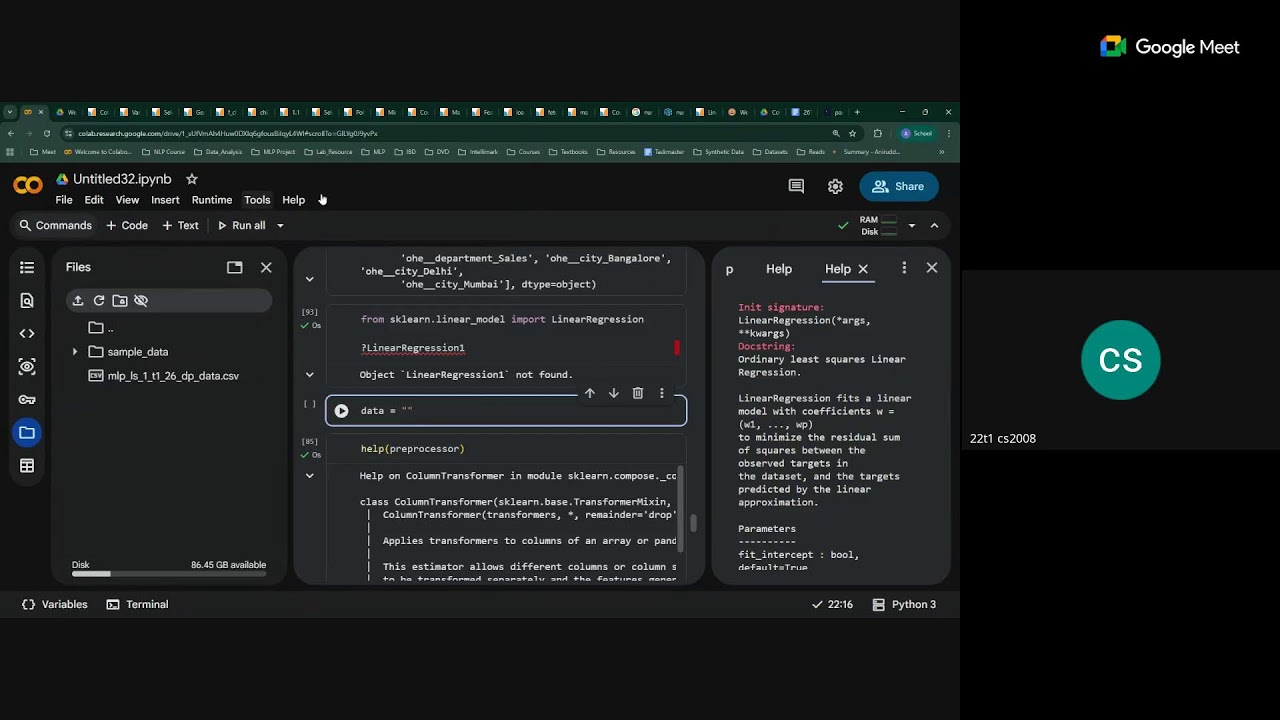
The session is a practical tutorial on using scikit-learn for data loading and preprocessing. It demonstrates correct usage of loaders, fetchers, and generators, and explains key concepts like random_state and imputation strategies. The content is accurate and aligns with scikit-learn documentation, though it is introductory and lacks depth in some areas.
Key Moments
Markers derived by PSI from the transcript: the creator did not define chapters.
- Introduction and overview of the session's goals.
- Loading the Iris dataset using load_iris and discussing bunch objects.
- Using as_frame and return_X_y parameters to get DataFrames.
- Introduction to fetchers with the California housing dataset.
- Generating synthetic data with make_regression and explaining random_state.
- Discussion on parameters vs hyperparameters.
- Feature extraction using DictVectorizer and FeatureHasher.
- Data cleaning and imputation with SimpleImputer.
- Explanation of fit, transform, and fit_transform.
- Wrap-up and next steps.
Cited Sources
- scikit-learn documentation: load_iris — Referenced when demonstrating how to load the Iris dataset and use parameters like as_frame and return_X_y.
- scikit-learn documentation: fetch_california_housing — Referenced when introducing the California housing dataset as an example of a fetcher.
- scikit-learn documentation: make_regression — Referenced when generating synthetic regression data and explaining random_state.
- scikit-learn documentation: DictVectorizer — Referenced when demonstrating feature extraction from dictionaries.
- scikit-learn documentation: FeatureHasher — Referenced when discussing feature hashing for speed and memory efficiency.
- scikit-learn documentation: SimpleImputer — Referenced when demonstrating imputation strategies for missing values.
Concurring Sources
- scikit-learn documentation: load_iris — Confirms the usage of as_frame and return_X_y parameters.
- scikit-learn documentation: SimpleImputer — Confirms the strategies available for imputation.
Contribution & Novelties
The session provides a practical, hands-on introduction to data loading and preprocessing in scikit-learn, which is valuable for beginners. It clarifies the differences between loaders, fetchers, and generators, and emphasizes the importance of random_state for reproducibility. The instructor also explains the fit/transform paradigm, which is fundamental to scikit-learn’s API. However, the content is not novel for experienced practitioners, as it covers standard techniques.
Pour aller plus loin :
- scikit-learn documentation: Preprocessing data — Comprehensive guide to preprocessing techniques.
- scikit-learn documentation: Imputation of missing values — Detailed explanation of imputation methods.
- scikit-learn documentation: Dataset loading utilities — Overview of loaders, fetchers, and generators.
102 words
Radar Profile
The radar profile shows balanced scores across quantity, quality, and reliability, with a lower score for technical level, indicating that the content is accessible to beginners but may not challenge advanced learners. The overall note of 4 reflects a solid introductory tutorial.