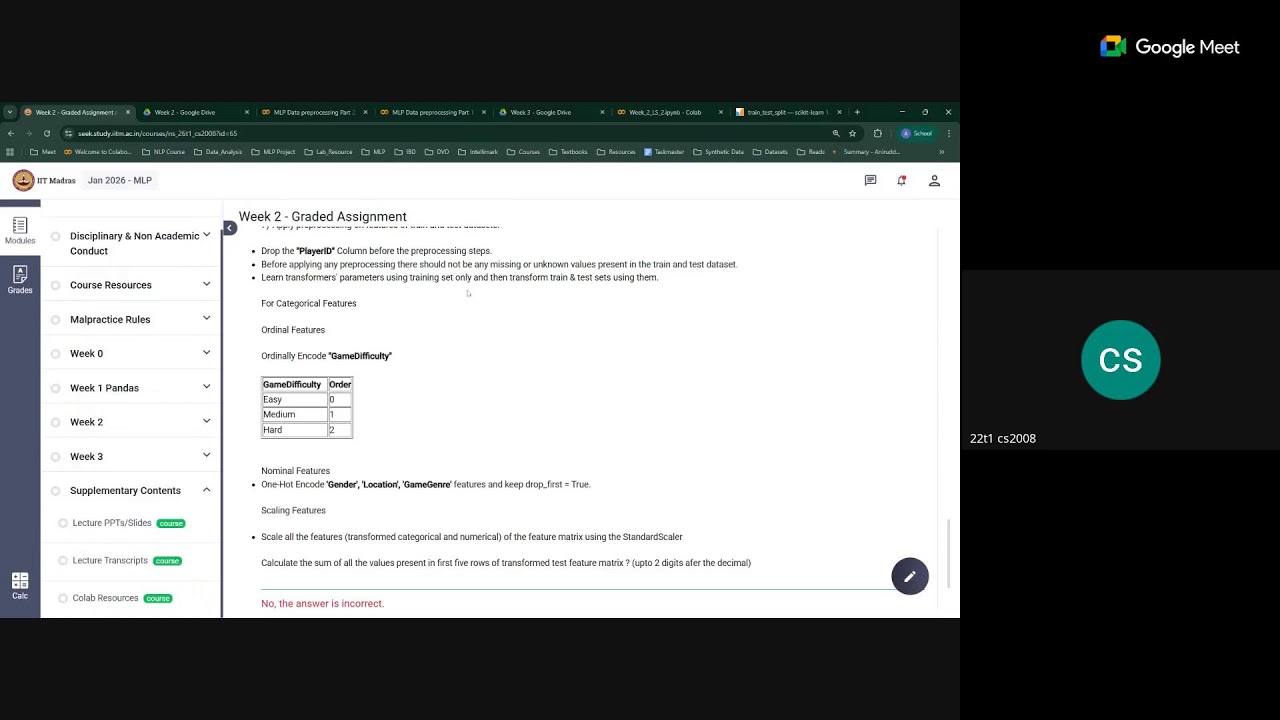
MLP Live session | Week 3
Keywords
Summary
170 words
Critical Evaluation
Value of the Information & Strength of the Argument
The session provides valuable practical guidance on using scikit-learn’s Pipeline and FeatureUnion for efficient and reproducible preprocessing. The instructor clearly explains the benefits of chaining transformers, such as reducing code duplication and ensuring consistency across train/test splits. He uses concrete examples and compares different scaling methods, highlighting their trade-offs. The argumentation is logical and grounded in common machine learning practices, though it relies on the instructor’s experience rather than formal citations. The Q&A segments add value by addressing specific student questions, such as when to use different scalers.
Scientific Rigor, Source Quality, Title Accuracy
The session demonstrates scientific rigor by referencing the official scikit-learn documentation and explaining the theoretical underpinnings of scaling methods. However, no external sources are cited beyond the documentation, and the content is based on the instructor’s expertise. The title accurately reflects the content, and the session is well-structured. The instructor encourages critical thinking by noting that the effectiveness of a method must be validated on test data. Overall, the sources are reliable but limited to the library documentation.
181 words
Title / Content Match
The title accurately reflects the content: a live session for week 3 of a machine learning practice course.
Quality & Reliability
7/10
The session is a live tutorial on scikit-learn pipelines and feature unions, with clear explanations and references to official documentation. However, it lacks formal citations and is based on the instructor's expertise.
Key Moments
Markers derived by PSI from the transcript: the creator did not define chapters.
- Introduction to Week 3 session, overview of topics.
- Recap of ColumnTransformer from Week 2.
- Explanation of scaling methods: StandardScaler, MinMaxScaler, RobustScaler.
- Introduction to chaining transformers and the need for Pipeline.
- Demonstration of Pipeline with imputation and scaling.
- Comparison of Pipeline and make_pipeline.
- Accessing and setting parameters in Pipeline.
- Introduction to FeatureUnion and its parallel processing.
- Q&A on scaling and preprocessing choices.
- Wrap-up and plan for next session.
Cited Sources
- scikit-learn documentation: Pipeline — Referenced for pipeline usage and parameter access.
- scikit-learn documentation: FeatureUnion — Referenced for feature union concept.
- scikit-learn documentation: ColumnTransformer — Referenced for column transformer recap.
Concurring Sources
- scikit-learn documentation: Pipeline — The session's explanation aligns with the official documentation.
- scikit-learn documentation: FeatureUnion — The session's explanation aligns with the official documentation.
Contribution & Novelties
The session provides a clear, practical tutorial on chaining transformers using scikit-learn’s Pipeline and FeatureUnion, emphasizing code efficiency and consistency. It offers a comparative analysis of scaling methods and their appropriate use cases, which is valuable for practitioners. The instructor’s emphasis on validating preprocessing choices on test data reinforces good machine learning practices.
Pour aller plus loin :
- scikit-learn Pipeline documentation — Official reference for pipeline usage.
- scikit-learn FeatureUnion documentation — Official reference for feature union.
- scikit-learn ColumnTransformer documentation — Official reference for column transformer.
- Cross-validation: evaluating estimator performance — Related to model evaluation and avoiding data leakage.
98 words
Radar Profile
The radar profile shows balanced scores across all dimensions, indicating a well-rounded tutorial with solid information quality, technical depth, and reliability. The session is particularly strong in practical applicability, though it could benefit from more formal citations.
💬 Sur les 0 commentaires analysés, aucune tendance n'est disponible.