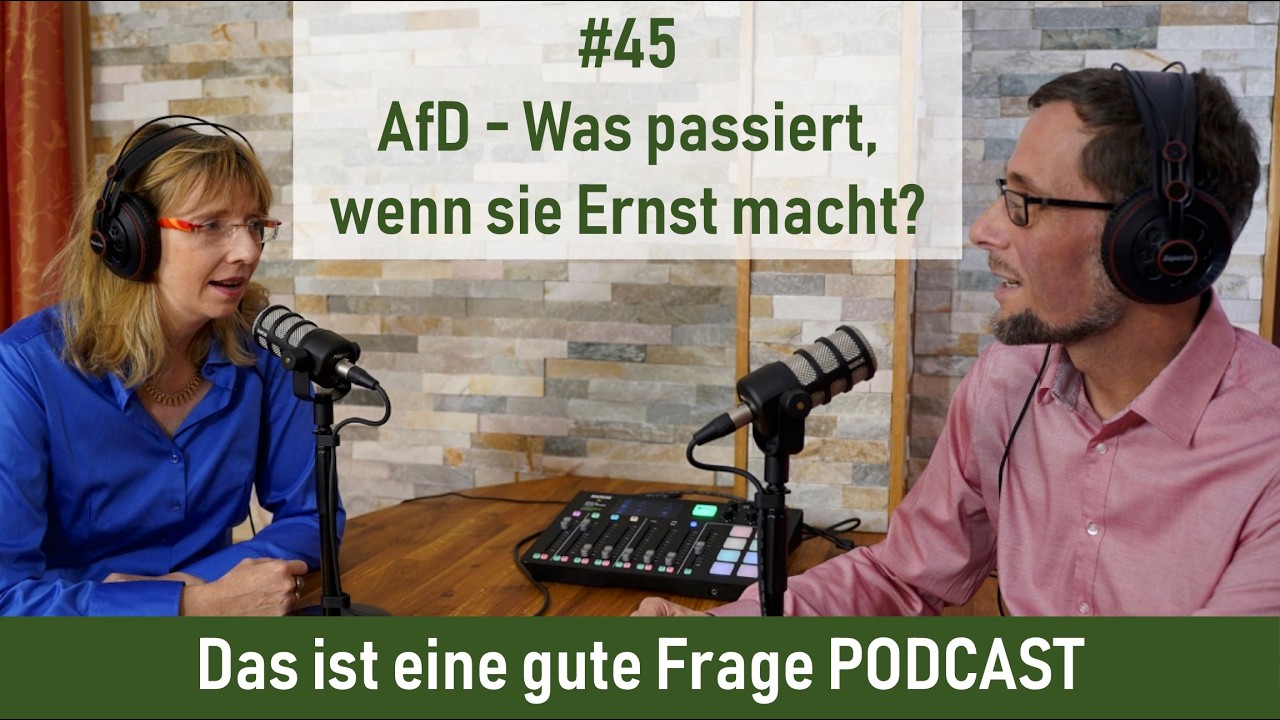
#45 AfD - Was passiert, wenn sie Ernst macht? | Das ist eine gute Frage PODCAST
Keywords
Summary
147 words
Critical Evaluation
Value of the Information & Strength of the Argument
The video provides a detailed and structured critique of AfD energy policies, systematically addressing each proposal (wind power, coal, gas, nuclear) and its economic and environmental consequences. The argumentation is coherent and supported by specific examples, such as the 2012 solar industry collapse and the current job numbers in the wind sector. The hosts effectively counter common populist narratives, such as the claim that wind power is harmful to birds, by comparing it to the impacts of fossil fuels. However, the analysis is clearly one-sided, presenting a strong pro-renewables viewpoint without engaging with potential counterarguments in depth. The psychological analysis of why populist messages resonate is insightful, but the discussion remains within a political commentary framework rather than a neutral scientific assessment.
Scientific Rigor, Source Quality, Title Accuracy
The video references several sources, including the AfD’s election program, a parliamentary motion for a wind power moratorium, and a speech by Alice Weidel. These are directly cited and linked in the description, providing a basis for the claims made. The host, Prof. Quaschning, is a recognized expert in renewable energy, lending credibility to the technical aspects. However, the presentation is explicitly opinionated, and the sources are used selectively to support a critical stance. The title accurately reflects the content, which is a focused analysis of AfD energy policy. The video does not claim to be a neutral review but rather a critical examination, which is clear from the outset.
247 words
Title / Content Match
The title accurately reflects the content, which examines the potential consequences of AfD energy and climate policies.
Quality & Reliability
8/10
The video is presented by a professor of renewable energy systems, providing expert analysis of the AfD's energy and climate policies. It references specific sources (AfD election program, parliamentary motion, a speech) and uses factual data (e.g., wind power share, job numbers). However, it is a partisan critique with a clear political stance, and some claims (e.g., job numbers) are not fully sourced within the video.
Chapters
- Intro
- Warum gewinnt die AfD trotz Klimakrise an Zustimmung?
- AfD-Energiepolitik: Ablehnung der Energiewende, Windkraft und Klimaschutz
- Populismus, Medien und die Rolle anderer Parteien
- Windkraft im Fokus: AfD-Kampagnen, Mythen und wirtschaftliche Folgen
- Photovoltaik, Industrie und der drohende Verlust von Zukunftsjobs
- Vergleich: CDU/CSU, AfD und die energiepolitische Orientierungslosigkeit
- AfD-Lösungen: Kohle, Kernenergie und die Rückkehr zu fossilen Energien
- Psychologie, Feindbilder und die Attraktivität einfacher Antworten
- AfD und Klimaschutz: Leugnung und Verschwörungserzählungen
- Demokratie in Gefahr: Warum Fakten oft nicht reichen
- Fazit, Appell und Verabschiedung
Cited Sources
- AfD-Rede von Alice Weidel auf Phoenix — Referenced as the source of the quote 'Windmühlen der Schande' and the AfD's stance on wind power.
- AfD-Antrag Bundesweites Moratorium des Windindustrieausbaus — Cited as the parliamentary motion for a wind power expansion moratorium.
- AfD Bundestagswahlprogramm — Referenced for the AfD's official positions on energy and climate policies.
- AfD Arbeitskreis Klimaschutz und Energie — Mentioned as a source for the AfD's internal working group on climate and energy.
Concurring Sources
- AfD-Rede von Alice Weidel auf Phoenix — The speech is used as evidence of the AfD's hostile stance towards wind power.
- AfD-Antrag Bundesweites Moratorium des Windindustrieausbaus — The parliamentary motion supports the claim that the AfD seeks to halt wind power expansion.
Contribution & Novelties
The video offers a critical and accessible analysis of the AfD’s energy and climate policies, systematically deconstructing their proposals and highlighting potential economic and social consequences. It provides a useful counterpoint to populist narratives by presenting factual data and expert opinion. The discussion of the psychological appeal of simple answers and the role of other parties in legitimizing AfD positions adds depth to the analysis.
Pour aller plus loin :
- Energiewende — Overview of Germany’s energy transition, relevant to the context of the debate.
- Wind power in Germany — Provides data on wind energy’s role and challenges, supporting the discussion.
- Climate change denial — Explores the phenomenon of climate change denial, which is central to the AfD’s stance.
- Populism — Theoretical background on populist politics, relevant to the analysis of the AfD’s appeal.
133 words
Radar Profile
The radar profile shows high scores in information quantity and quality, reflecting the detailed and structured analysis. The technical level is moderate, suitable for a general audience, while the reliability is slightly lower due to the partisan nature of the content.