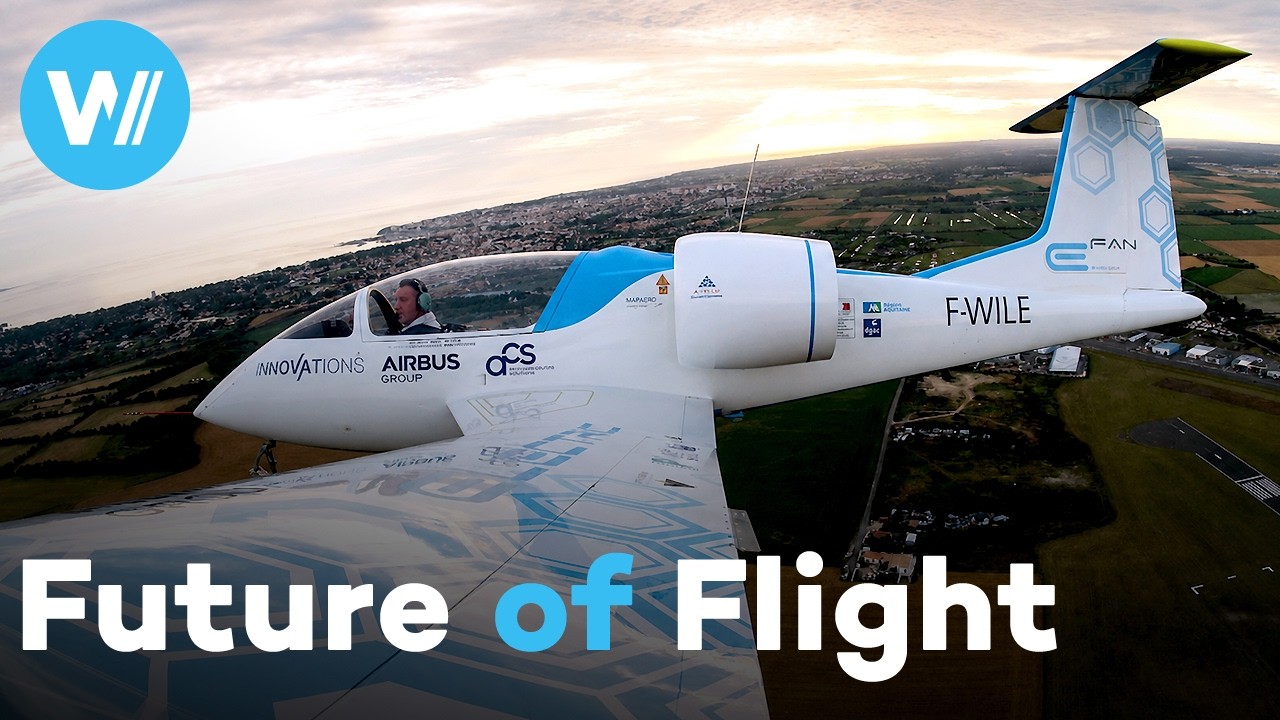
From Green Airplanes to Space Tourism: How We'll Travel in the Future | Shapers of Tomorrow (1/8)
Keywords
Summary
144 words
Critical Evaluation
The documentary provides a broad overview of emerging technologies in aviation and space tourism, with a strong focus on environmental sustainability. Its strength lies in featuring direct interviews with engineers and researchers from reputable organizations such as Airbus, Safran, and ONERA, lending credibility to the technical explanations. The visual demonstrations of prototypes, like the E-Fan and EGTS, help illustrate complex concepts. However, the documentary lacks rigorous scientific depth; it often presents claims without citing specific studies or data sources, relying instead on general statements. For instance, the comparison between electric and heat engines is simplified, omitting nuances like the energy mix for electricity generation. The section on noise reduction mentions the CFM LEAP engine and biomimicry but does not delve into the underlying physics or quantify the improvements beyond a few decibels. The segment on flying cars and space tourism feels more speculative and promotional, with less technical detail. The documentary’s structure is somewhat disjointed, jumping between topics without a clear narrative thread. The title accurately reflects the content, but the adéquation is not perfect as the space tourism part is relatively brief. Overall, the documentary serves as an accessible introduction for a general audience, but it lacks the rigor expected of a scientific analysis. It would benefit from more citations and a deeper exploration of the trade-offs and challenges of these technologies.
223 words
Title / Content Match
The title accurately reflects the content, which covers future aviation technologies and space tourism.
Quality & Reliability
7/10
The documentary features interviews with engineers and researchers from recognized institutions (Airbus, Safran, ONERA, Max Planck Institute) and presents concrete prototypes and data. However, it lacks citations for many claims and includes promotional elements for specific projects.
Key Moments
Markers derived by PSI from the transcript: the creator did not define chapters.
- Introduction to the documentary and its themes.
- Presentation of the Airbus E-Fan electric plane.
- Comparison of electric and heat engines.
- Green Taxiing System (EGTS) by Safran.
- Discussion on airplane noise and its reduction.
- CFM International LEAP engine presentation.
- Noise scattering techniques in Amsterdam.
- Biomimicry: learning from barn owls for silent flight.
- Introduction to flying cars.
- Terrafugia Transition flying car.
- PAL-V flying car.
- Max Planck Institute research on noise.
- Space tourism and its challenges.
- Reusable rocket launchers.
- XCOR Aerospace and the Lynx spaceplane.
Cited Sources
- wocomoCOOK — Related channel mentioned in the description.
- wocomoHISTORY — Related channel mentioned in the description.
- wocomoHUMANITY — Related channel mentioned in the description.
- wocomoTRAVEL — Related channel mentioned in the description.
- wocomoWILDLIFE — Related channel mentioned in the description.
Concurring Sources
- Airbus E-Fan — The documentary features the E-Fan electric aircraft; this source provides technical details and history.
- Safran Green Taxiing — Official Safran page on the Green Taxiing System, corroborating the documentary's description.
- CFM LEAP engine — Official CFM page for the LEAP engine, confirming its environmental benefits.
Dissenting Sources
- Energy density of batteries vs. jet fuel — The documentary claims electric engines are 25 times heavier for the same energy storage, but this is a simplification; the comparison depends on the specific battery technology and mission profile.
Contribution & Novelties
The documentary provides a comprehensive overview of current and near-future innovations in sustainable aviation and space tourism, featuring interviews with key engineers and researchers. It highlights specific projects like the Airbus E-Fan, Safran’s Green Taxiing System, and the CFM LEAP engine, offering insights into the technological approaches being pursued. The inclusion of biomimicry (barn owl feathers) and noise reduction strategies adds an interdisciplinary perspective. However, the documentary does not present original research but rather synthesizes existing developments.
Pour aller plus loin :
- Electric aircraft — Overview of electric aircraft technology and challenges.
- Green taxiing — Explanation of the concept and its benefits.
- CFM International LEAP — Details on the LEAP engine’s design and efficiency.
- Barn owl silent flight — Scientific basis for noise reduction inspired by owl feathers.
- Space tourism — Overview of commercial space travel initiatives.
137 words
Radar Profile
The radar profile shows a balanced performance across most criteria, with slightly lower scores in technical depth and reliability, reflecting the documentary's accessible but not deeply rigorous approach.
💬 No comments were provided for analysis.