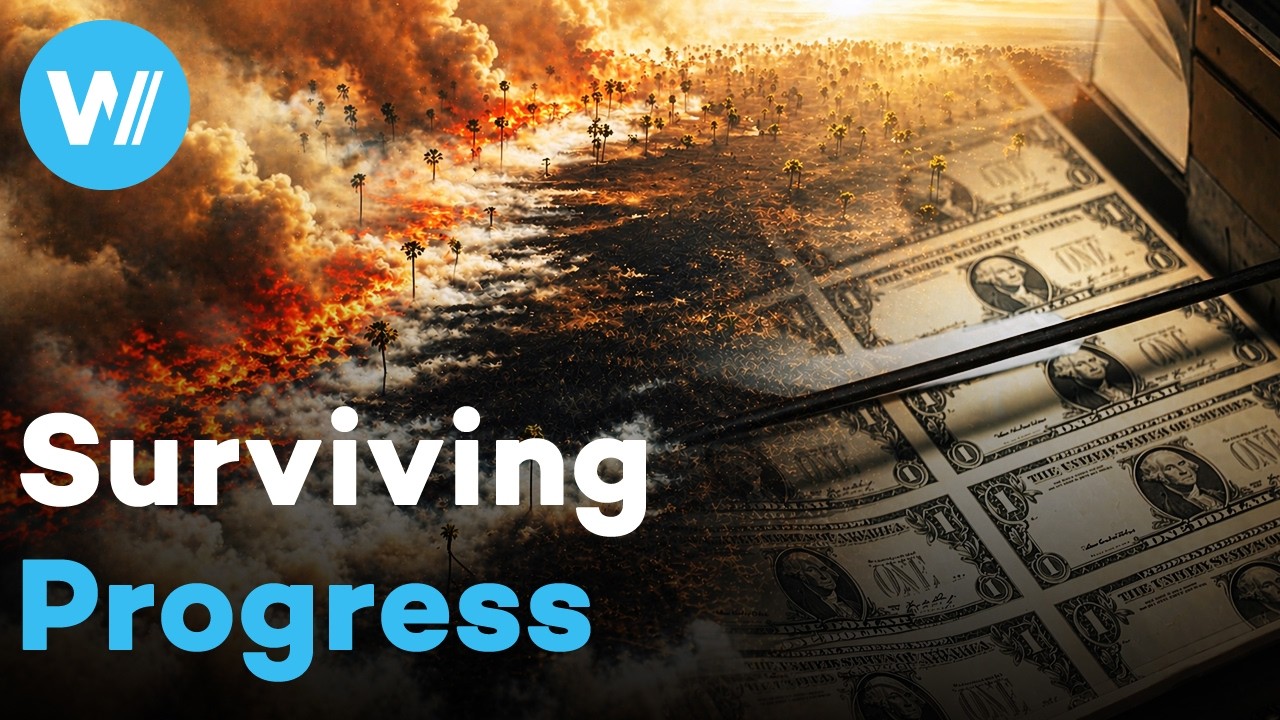
A Short History of Progress and Why It’s Failing Us | Surviving Progress (Full Documentary)
Keywords
Summary
137 words
Critical Evaluation
The documentary ‘Surviving Progress’ offers a compelling and visually engaging critique of the concept of progress. It successfully synthesizes ideas from various disciplines, including anthropology, economics, and environmental science, to argue that our current trajectory is unsustainable. The film’s strength lies in its ability to present complex ideas in an accessible manner, using interviews with experts and historical examples to illustrate its points. However, the documentary has several weaknesses. It often relies on broad generalizations and does not provide specific data or citations to support its claims. For instance, the assertion that we are consuming natural capital at an unsustainable rate is presented without concrete evidence. Additionally, the film’s narrative can be overly pessimistic, potentially oversimplifying the challenges and ignoring potential solutions. The inclusion of diverse voices, such as Jane Goodall and Ronald Wright, adds credibility, but the lack of opposing viewpoints weakens the overall argument. The documentary’s production quality is high, with stunning visuals and a compelling soundtrack, which enhances its emotional impact. However, the scientific rigor is moderate, as it prioritizes storytelling over detailed analysis. The title accurately reflects the content, and the film effectively conveys its message about the dangers of unchecked progress. Overall, ‘Surviving Progress’ is a thought-provoking documentary that raises important questions, but it would benefit from more rigorous evidence and a more balanced perspective.
220 words
Title / Content Match
The title accurately reflects the content, which explores the concept of progress and its potential negative consequences.
Quality & Reliability
7/10
The documentary features credible experts and is based on Ronald Wright's book, but it lacks direct citations and includes some speculative claims. Overall, it provides a thought-provoking but not fully rigorous analysis.
Key Moments
Markers derived by PSI from the transcript: the creator did not define chapters.
- Introduction to the concept of progress and its hidden contradictions.
- Definition of the 'progress trap' and examples from history.
- Discussion on Stone Age brains in a technological age.
- Key differences between humans and other species, featuring Jane Goodall.
- Innovation, science, and unintended consequences.
- Growth, inequality, and rising global demand.
- Natural capital, limits, and environmental strain.
- Civilizations rise, expand, and fall.
- Oligarchies, financial systems, and economic control.
- Debt, exploitation, and environmental damage.
Cited Sources
- wocomoCOOK — Channel link in description
- wocomoHISTORY — Channel link in description
- wocomoHUMANITY — Channel link in description
- wocomoTRAVEL — Channel link in description
- wocomoWILDLIFE — Channel link in description
Concurring Sources
- Ronald Wright - A Short History of Progress — The documentary is based on this book, which argues that progress often leads to collapse.
- Jane Goodall - Research on chimpanzees — Her insights on human nature and animal behavior support the film's arguments.
Dissenting Sources
- The Limits to Growth — While the documentary aligns with some of its predictions, critics argue that technological innovation can overcome resource limits.
Contribution & Novelties
The documentary provides a comprehensive overview of the concept of ‘progress traps’ and applies it to modern civilization, offering a compelling narrative that connects historical patterns to current global challenges. It synthesizes ideas from multiple disciplines, making it accessible to a broad audience.
Pour aller plus loin :
- Progress trap - Wikipedia — Relevant concept discussed in the documentary.
- Collapse: How Societies Choose to Fail or Succeed — Book by Jared Diamond that explores similar themes.
- Ecological footprint - Global Footprint Network — Provides data on resource consumption and sustainability.
90 words
Radar Profile
The radar profile shows high scores in quantity of information and technical level, indicating a dense and informative documentary. However, the quality of information and reliability are slightly lower, reflecting the lack of rigorous citations and potential bias.