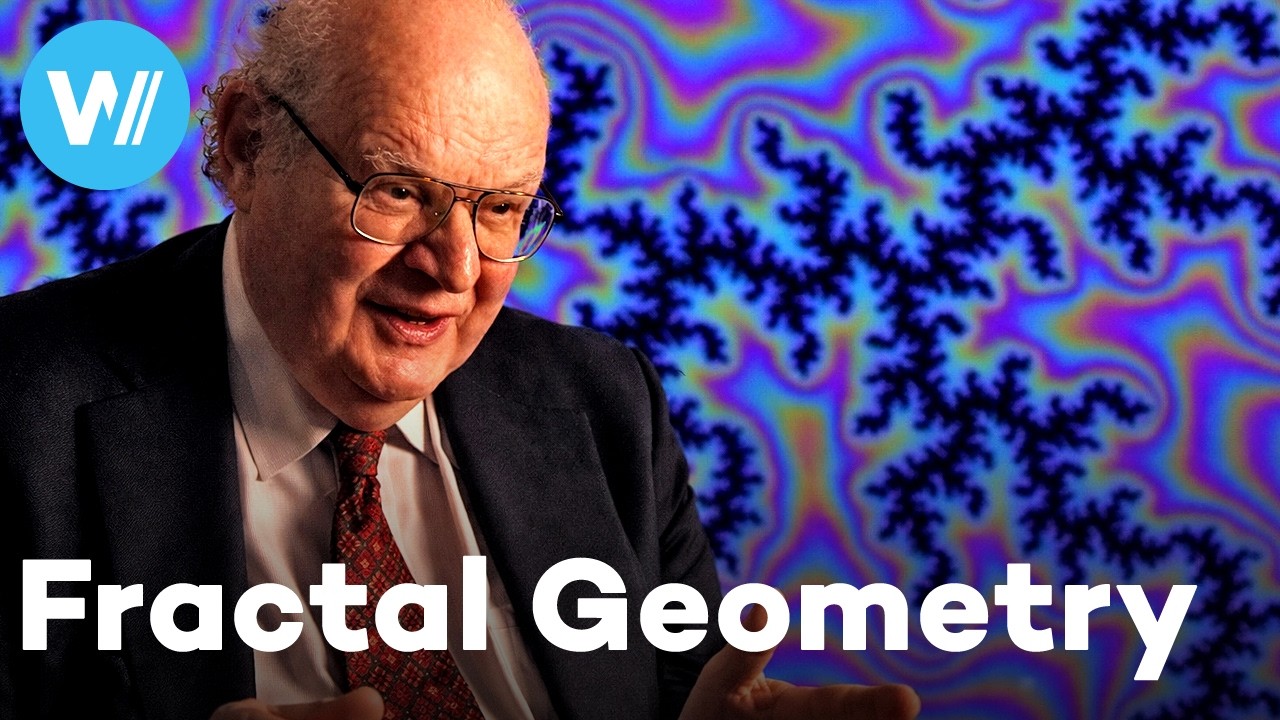
The man who changed the way mathematics is perceived forever (Full Documentary) | Benoit Mandelbrot
Keywords
Summary
147 words
Critical Evaluation
The documentary provides a comprehensive and engaging overview of Benoit Mandelbrot’s life and contributions to mathematics. It successfully conveys the significance of fractal geometry in describing natural phenomena, which was a paradigm shift from Euclidean geometry. The inclusion of interviews with Mandelbrot himself adds authenticity and personal insight, allowing viewers to understand his motivations and thought processes. The film also features commentary from colleagues and experts, which helps contextualize his work within the broader scientific community.
One of the strengths of the documentary is its clear explanation of complex mathematical concepts. The use of visualizations and animations to illustrate fractals is particularly effective, making the subject accessible to a general audience. The historical narrative is well-structured, tracing Mandelbrot’s journey from his early education to his time at IBM and his eventual recognition as a pioneer in his field.
However, the documentary is a product of 1995, and some information may be dated. For instance, it does not cover the later applications of fractal geometry in fields like computer graphics or the development of the Mandelbrot set’s computational exploration. Additionally, the film tends to focus on Mandelbrot’s personal story rather than providing a deep mathematical analysis, which might leave some viewers wanting more technical detail.
The sources cited are primarily interviews and archival footage, which are reliable for biographical information. The documentary does not include references to specific publications, but it does mention Mandelbrot’s books, which are well-known. Overall, the documentary is a valuable resource for understanding the impact of Mandelbrot’s work, though it should be supplemented with more recent sources for a complete picture.
264 words
Title / Content Match
The title accurately reflects the content, focusing on Mandelbrot's impact on mathematics.
Quality & Reliability
8/10
Documentary produced by a reputable channel (wocomoDOCS), featuring interviews with Mandelbrot and colleagues, and covering historical and mathematical content accurately. However, it is a 1995 production and may not reflect the latest developments.
Key Moments
Markers derived by PSI from the transcript: the creator did not define chapters.
- Introduction to fractal geometry and Mandelbrot's significance.
- Mandelbrot's early life and university years.
- Working at the IBM Research Centre.
- Mandelbrot's first major discovery.
- Discussion of the Cantor Set, Sierpiński triangle, and Koch Snowflake.
- Geometric models for the real world.
- The question 'How long is the British coastline?' and fractal dimension.
- Mandelbrot's first book and its impact.
- The Fractal Geometry of Nature and its significance.
- Practical applications of fractal geometry.
Cited Sources
- wocomoCOOK — Channel link in description, not directly related to content.
- wocomoHISTORY — Channel link in description, not directly related to content.
- wocomoHUMANITY — Channel link in description, not directly related to content.
- wocomoTRAVEL — Channel link in description, not directly related to content.
- wocomoWILDLIFE — Channel link in description, not directly related to content.
Concurring Sources
- Fractal — Wikipedia article on fractals, consistent with the documentary's content.
- Mandelbrot set — Wikipedia article on the Mandelbrot set, mentioned in the documentary.
Contribution & Novelties
The documentary provides a biographical account of Benoit Mandelbrot and the development of fractal geometry, highlighting its revolutionary impact on mathematics and science. It offers insights into Mandelbrot’s unique visual approach and his persistence in pursuing unconventional ideas.
Pour aller plus loin :
- Fractal geometry — Overview of fractals and their properties.
- Mandelbrot set — Detailed explanation of the famous set.
- Benoit Mandelbrot — Biography and contributions.
- The Fractal Geometry of Nature — Information about Mandelbrot’s influential book.
78 words
Radar Profile
The radar profile shows high scores in quantity and quality of information, with a slightly lower score in technical level, indicating that the documentary is informative and reliable but not highly technical. The overall reliability is high, making it a good resource for general audiences.