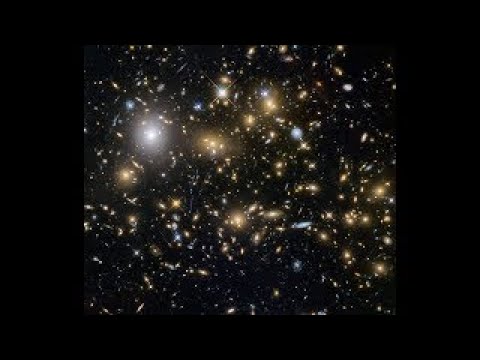
Reticulum II
Keywords
Summary
145 words
Critical Evaluation
Value of the Information & Strength of the Argument
The talk provides valuable insights into the r-process and its astrophysical site, presenting a compelling case for neutron star mergers based on observations of Reticulum II. The argumentation is solid, built on a clear logical progression from fundamental concepts to specific evidence. Frebel effectively combines theoretical models with observational data, and she acknowledges uncertainties, making the argument more credible. The presentation is well-structured, with clear explanations of complex topics, making it accessible to a scientific audience.
Scientific Rigor, Source Quality, Title Accuracy
The talk is scientifically rigorous, referencing published research in Nature and other peer-reviewed work. The speaker is a recognized expert, and the content aligns with current understanding in the field. The title accurately reflects the content, focusing on Reticulum II and its significance. The sources cited are appropriate and credible, and the talk includes a balanced discussion of competing hypotheses.
151 words
Title / Content Match
The title accurately reflects the main subject of the talk, which focuses on the dwarf galaxy Reticulum II and its significance for understanding r-process nucleosynthesis.
Quality & Reliability
8/10
Talk by a leading expert in stellar archaeology, presenting peer-reviewed research published in Nature. The content is well-structured, based on observational data and theoretical models, and includes appropriate caveats. The speaker is transparent about uncertainties and the need for further research.
Key Moments
Markers derived by PSI from the transcript: the creator did not define chapters.
- Introduction to the talk and the speaker's background.
- Overview of chemical evolution and the formation of heavy elements.
- Explanation of the r-process and its importance.
- Introduction to stellar archaeology and metal-poor stars.
- Discussion of the r-process in core-collapse supernovae.
- Comparison with neutron star mergers as potential r-process sites.
- Presentation of the discovery of r-process enhancement in Reticulum II.
- Implications for nuclear astrophysics and galaxy formation.
- Summary and future research directions.
Cited Sources
- Nature paper on Reticulum II — The speaker mentions a paper published in Nature by her student Alex Ji, which is the basis of the talk.
Concurring Sources
- R-process in neutron star mergers — The paper by Ji et al. (2017) on Reticulum II, which is the primary source for the talk.
Dissenting Sources
- Core-collapse supernovae as r-process site — Some theoretical models still consider core-collapse supernovae as potential r-process sites, though with difficulties in producing heavy elements beyond barium.
Contribution & Novelties
The talk presents the discovery of a significant r-process enhancement in the ultrafaint dwarf galaxy Reticulum II, providing strong evidence for neutron star mergers as the astrophysical site of the r-process. This finding is a major contribution to the field, as it helps resolve a long-standing question. The talk also emphasizes the importance of combining nuclear astrophysics, stellar archaeology, and galaxy formation studies.
Pour aller plus loin :
- R-process nucleosynthesis — Overview of the rapid neutron-capture process.
- Neutron star merger — Explanation of the merger event and its role in producing heavy elements.
- Ultra-faint dwarf galaxies — Background on these galaxies and their significance in studying early universe conditions.
109 words
Radar Profile
The radar profile shows high scores in information quality and reliability, indicating a well-researched and credible presentation. The technical level is moderately high, suitable for an academic audience. The overall balance suggests a strong scientific contribution with clear communication.
💬 Sur les 0 commentaires analysés, aucune tendance n'est disponible.