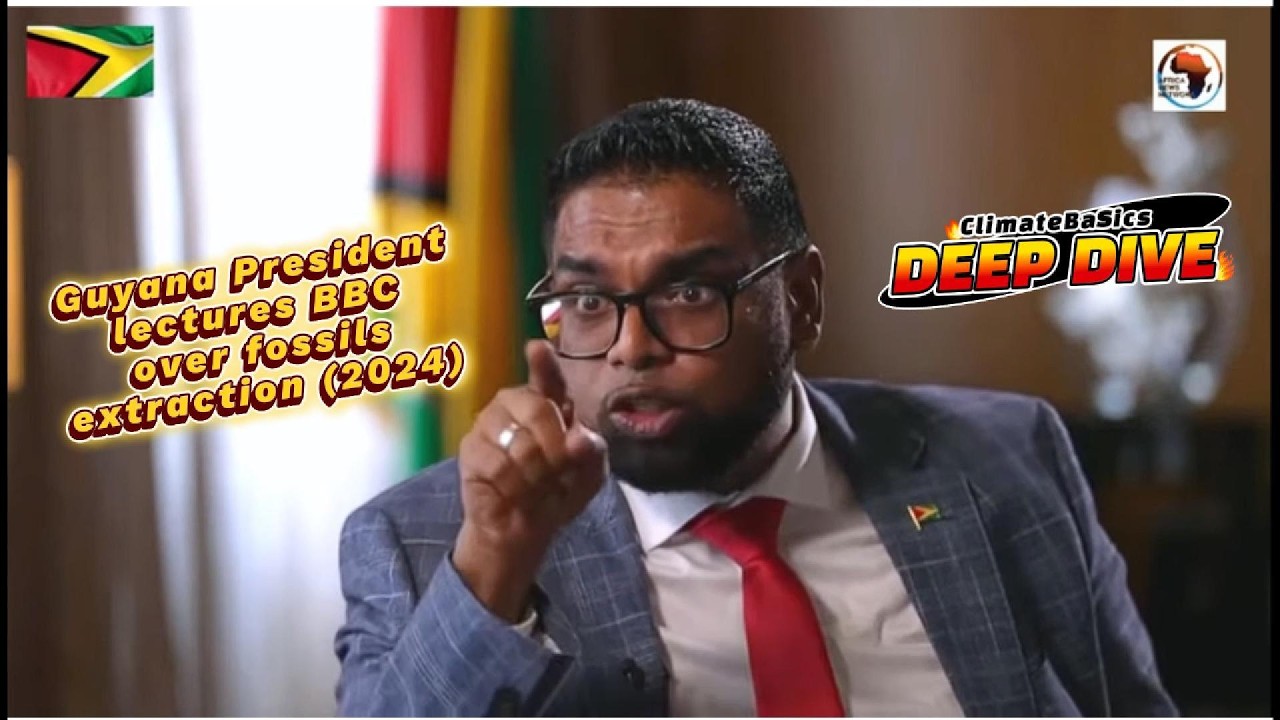
Deep Dive: Do Fossil Fuel Producers Owe the World Anything? Guyana President Lectures BBC. Ep17
Keywords
Summary
168 words
Critical Evaluation
Value of the Information & Strength of the Argument
The value of the information lies in its balanced presentation of a complex issue, using a real interview to illustrate the arguments. The hosts provide context from other countries (Norway, Venezuela, India) and raise important questions about responsibility and fairness. The argumentation is solid, as they acknowledge both sides: the president’s practical stance and the environmental concerns. They avoid oversimplification and highlight the circular nature of such debates.
Scientific Rigor, Source Quality, Title Accuracy
The scientific rigor is moderate: the hosts reference specific figures and agreements (e.g., REDD+ fund, Hess carbon credit deal) but do not provide direct citations or links. The title accurately reflects the content. The discussion is well-informed but relies on general knowledge rather than primary sources. The hosts do not mention any comments, so no analysis of public trends is provided.
144 words
Title / Content Match
The title accurately reflects the content: a deep dive into the ethical and practical questions raised by Guyana's oil development, centered on the president's confrontation with the BBC.
Quality & Reliability
7/10
The hosts provide a balanced discussion of a real interview, referencing specific data (e.g., 19.5 gigatons of carbon stored, $6 billion sovereign fund, Norway's $1.3 trillion fund) and contextualize with examples from other countries. However, they do not cite primary sources directly, and some figures may be approximate.
Key Moments
Markers derived by PSI from the transcript: the creator did not define chapters.
- Introduction to the topic and the BBC interview clip.
- BBC interviewer confronts Guyana's president about 2 billion tons of carbon emissions.
- President responds by citing Guyana's forest storing 19.5 gigatons of carbon.
- President argues Guyana will remain net zero despite oil extraction.
- Discussion on the vice president's quote about getting oil out quickly.
- Hosts analyze the president's rhetoric and compare to arguments from Africa.
- Comparison with Norway and the concept of petrostates.
- Details on Guyana's oil discovery in 2015 and sovereign fund of $6 billion.
- Discussion on Guyana's vulnerability to climate change and infrastructure investments.
- Mention of Norway's REDD+ payments and Hess carbon credit deal.
- Reflection on the circular nature of climate arguments and Canada's situation.
- Comparison with India and Indonesia, and the temptation of oil money.
- Conclusion on who is responsible and the future of Guyana.
Cited Sources
- BBC interview with Guyana's president — The interview discussed in the episode, where the president responds to climate questions.
- Norway's sovereign wealth fund — Mentioned as an example of a petrostate with a large fund ($1.3 trillion).
- Hess Corporation carbon credit agreement — Guyana signed an off-take agreement for carbon credits worth $750 million over 10 years.
- REDD+ fund — Norway contributes to a global fund for forest preservation; Guyana received $200 million over five years.
Concurring Sources
- BBC interview — The primary source of the discussion, providing the president's arguments.
Contribution & Novelties
The episode provides a nuanced discussion of the ethical dilemmas faced by developing countries with fossil fuel resources, using Guyana as a case study. It highlights the tension between economic development and climate responsibility, and questions the fairness of international climate policies. The hosts bring in comparative examples from other regions, offering a global perspective.
Pour aller plus loin :
- Climate justice — Explores the ethical and political dimensions of climate change impacts and policies.
- Resource curse — Discusses the paradox that countries with abundant natural resources often have less economic growth and worse development outcomes.
- REDD+ — A framework for reducing emissions from deforestation and forest degradation, relevant to Guyana’s forest conservation efforts.
114 words
Radar Profile
The radar profile shows moderate scores across all dimensions, with slightly higher scores in information quantity and quality, indicating a balanced but not deeply technical discussion. The low technical level suggests the content is accessible to a general audience.