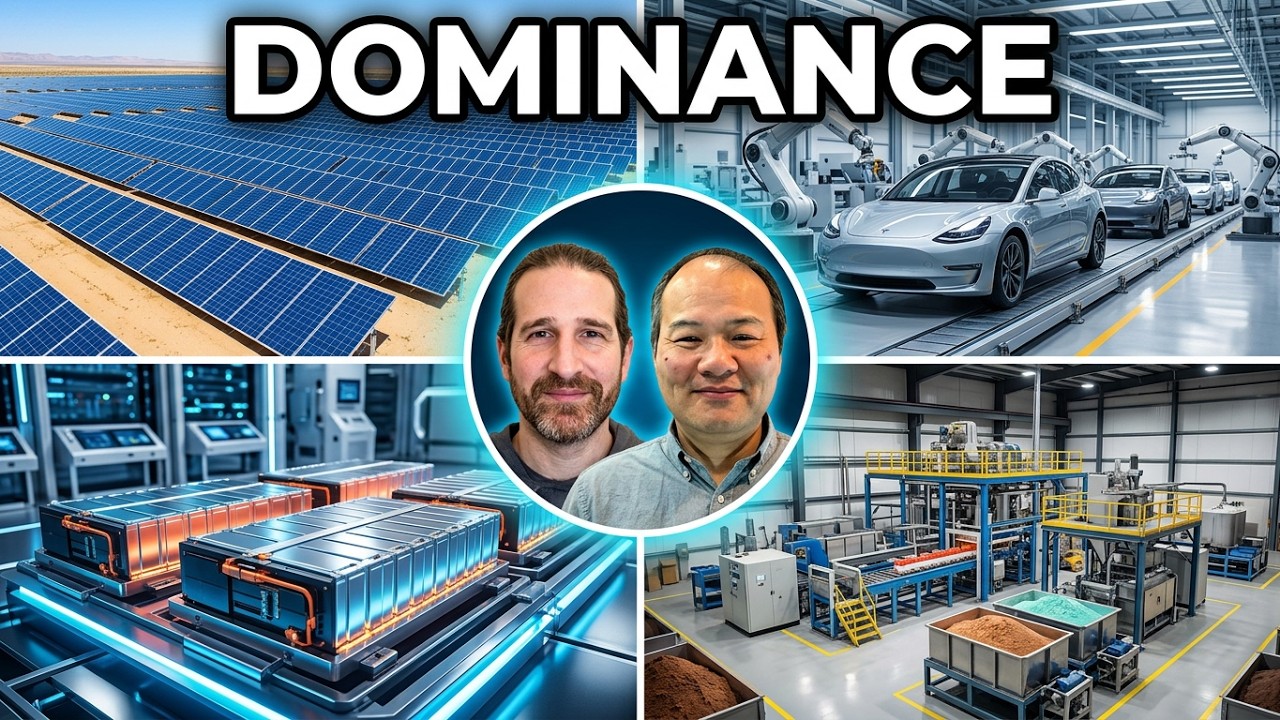
Understanding the EV and Solar DOMINANCE of China...How Did We Get Here? - Ep. 9
Keywords
Summary
166 words
Critical Evaluation
Value of the Information & Strength of the Argument
The podcast offers valuable insights into the strategic factors behind China’s clean energy dominance, including resource control, central planning, and vertical integration. The argumentation is coherent and well-structured, using concrete examples like the 277 GW solar installation and the $8,000-$13,000 price range for Chinese EVs. However, the hosts occasionally rely on anecdotal evidence and oversimplify complex economic dynamics, such as the role of subsidies and market distortions. The discussion is persuasive but lacks rigorous data analysis or counterarguments, making it more of an expert opinion than a balanced scientific review.
Scientific Rigor, Source Quality, Title Accuracy
The podcast demonstrates moderate scientific rigor. While it cites specific figures and references policy mechanisms, it does not provide formal citations or links to primary sources within the episode. The show notes link (https://www.zeroby2050.ca/post/climate-basics-podcast-ep-9-show-notes-solar-ev-dominance-china ) is mentioned but not elaborated. The title accurately reflects the content, which focuses on explaining China’s rise in solar and EV sectors. The hosts’ expertise is evident, but the lack of verifiable sources and occasional reliance on general knowledge reduce the overall reliability.
183 words
Title / Content Match
The title accurately reflects the content, which focuses on explaining China's rise in solar and EV sectors.
Quality & Reliability
7/10
The podcast provides a reasoned, expert discussion of China's solar and EV dominance, with specific figures (e.g., 277 GW installed in 2024, 12.4M EVs produced) and references to policy mechanisms. However, it lacks formal citations, relies on anecdotal evidence, and presents some claims without direct sources, reducing its scientific rigor.
Key Moments
Markers derived by PSI from the transcript: the creator did not define chapters.
- Introduction to the episode's topic: China's dominance in solar and EV markets.
- Good news segment: vortex hydro generators and China's solar installation record.
- Discussion of China's solar installation numbers: 277 GW in 2024, equivalent to 45 million US homes.
- Exploration of China's strategic use of rare earth minerals and central planning.
- Comparison of China's five-year plans with Western venture capital approaches.
- Analysis of China's vertical integration in the solar and EV supply chains.
- Discussion of the impact of Chinese EVs on global auto markets and traditional automakers.
- Examination of the US Inflation Reduction Act and its role in boosting domestic solar production.
- Conclusion: the significance of China's clean energy dominance for global energy transition.
Cited Sources
- Climate Basics Podcast Ep. 9 Show Notes — Referenced in the video description as the show notes for this episode, likely containing additional data and references.
Concurring Sources
- IEA – Solar PV — The International Energy Agency provides data on global solar PV deployment, which aligns with the podcast's claims about China's leading role.
- IEA – Global EV Outlook 2024 — The IEA's report on electric vehicles supports the podcast's statements about China's EV production and market share.
Dissenting Sources
- Critiques of China's industrial policy — Some economists argue that China's subsidies and state-led planning distort markets and may lead to overcapacity, a perspective not fully addressed in the podcast.
Contribution & Novelties
The podcast provides a clear, accessible explanation of China’s strategic approach to dominating solar and EV industries, emphasizing the role of central planning and vertical integration. It offers a useful comparison with Western models, highlighting the challenges faced by traditional automakers. The episode is particularly valuable for listeners seeking to understand the geopolitical and economic dimensions of the energy transition.
Pour aller plus loin :
- Five-year plans of China — Provides background on China’s central planning mechanism.
- Vertical integration — Explains the concept of controlling the supply chain.
- Rare-earth element — Details the minerals central to China’s advantage.
- Inflation Reduction Act — Context on US climate policy mentioned in the episode.
111 words
Radar Profile
The radar profile shows balanced scores across information quantity, quality, technical level, and reliability, with a slight dip in reliability due to lack of formal citations. This suggests a well-rounded but not deeply rigorous discussion.
💬 No comments were provided for analysis, so this field is left empty.