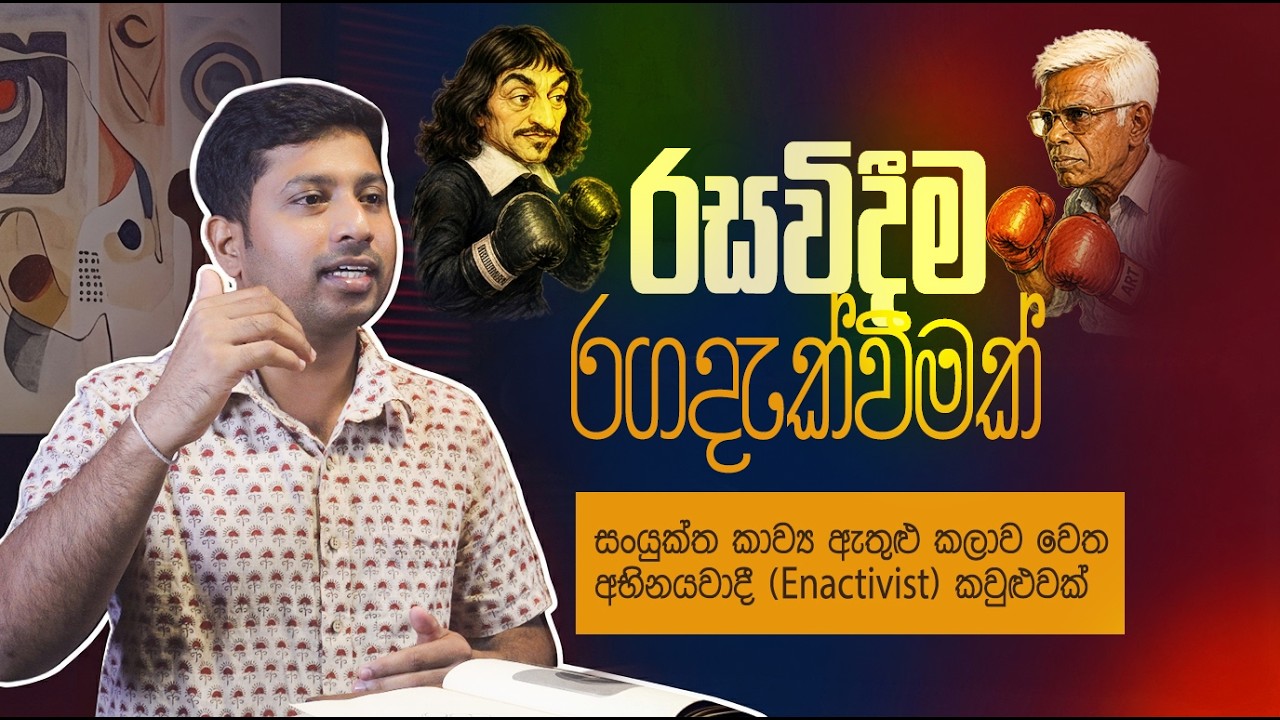
රසවිදීම රගදැක්වීමක්: සංයුක්ත කාව්ය ඇතුළු කලාව වෙත අභිනයවාදී (Enactivist) කවුළුවක් | Zey TV
Keywords
Summary
155 words
Critical Evaluation
Value of the Information & Strength of the Argument
The value of the information lies in its insightful synthesis of concrete poetry, art theory, and enactivist philosophy, offering a fresh perspective on how we engage with visual and textual art. The argumentation is coherent and well-supported by references to specific artists and philosophical concepts. The speakers build a compelling case for the idea that meaning is not inherent in the artwork but is co-created through the viewer’s active, embodied participation. They effectively use examples like optical illusions and the duck-rabbit figure to illustrate the ambiguity and multiplicity of interpretations. The discussion is intellectually stimulating and provides a nuanced understanding of the relationship between language, perception, and art.
Scientific Rigor, Source Quality, Title Accuracy
The scientific rigor is moderate: the speakers reference real artists and philosophers (Apollinaire, Mallarmé, Mahagamasekara, Ajith Thilakasena, Max Ernst, Descartes) and concepts (Dadaism, enactivism), but they do not provide formal citations or empirical evidence. The sources are mentioned anecdotally, and the discussion is more conversational than scholarly. The title accurately reflects the content, focusing on concrete poetry and an enactivist approach. The adequacy between title and content is strong, as the video indeed explores these themes in depth.
201 words
Title / Content Match
The title accurately reflects the content: a discussion on concrete poetry and art through an enactivist lens.
Quality & Reliability
7/10
The discussion is erudite and references specific artists and poets (Apollinaire, Mallarmé, Mahagamasekara, Ajith Thilakasena) and philosophical concepts (Cartesian universal language, enactivism). However, it is a conversational debate without formal citations or peer-reviewed sources, and the transcript is in Sinhala, limiting verifiability.
Key Moments
Markers derived by PSI from the transcript: the creator did not define chapters.
- Introduction to concrete poetry and its historical context.
- Discussion of Apollinaire and Mallarmé's concrete poetry.
- Examples from Sinhala literature: Mahagamasekara and Ajith Thilakasena.
- Explanation of optical illusions and ambiguous figures in art.
- Critique of Cartesian universal language and introduction of enactivism.
- Discussion of Dadaism and Max Ernst's view of the artist as a diver.
- The performative nature of art appreciation and the role of the body.
- Conclusion and thanks.
Cited Sources
- Zey TV Facebook page — Official Facebook page of the channel, mentioned in the video description.
Concurring Sources
- Enactivism (Stanford Encyclopedia of Philosophy) — Supports the philosophical framework discussed in the video.
- Concrete poetry (Wikipedia) — Provides historical and theoretical background on the genre.
Dissenting Sources
- Cartesian universal language — The video critiques the Cartesian idea of a universal language, which is a philosophical position that some may argue is still relevant in computational linguistics.
Contribution & Novelties
The video offers a unique perspective by applying enactivist philosophy to the appreciation of concrete poetry, particularly within the context of Sinhala literature. It highlights the works of Ajith Thilakasena and Mahagamasekara, which may be less known internationally. The discussion challenges traditional views of meaning as fixed and emphasizes the active role of the viewer in creating meaning, which is a valuable contribution to art theory.
Pour aller plus loin :
- Enactivism (Stanford Encyclopedia of Philosophy) — Relevant for understanding the philosophical framework used in the discussion.
- Concrete poetry (Wikipedia) — Provides background on the genre and its history.
- Max Ernst (Wikipedia) — Relevant for the reference to the artist and his approach to creation.
115 words
Radar Profile
The radar profile shows a balanced performance across all dimensions, with slightly higher scores in information quantity and quality, reflecting the depth of the discussion. The technical level is moderate, indicating that the content is accessible to a general audience but still intellectually engaging.