GIF E&T Webinar 105: Science for the Safe Disposal of Nuclear Waste - A German Perspective
Keywords
Summary
239 words
Critical Evaluation
Value of the Information & Strength of the Argument
The webinar provides valuable information on the German approach to nuclear waste disposal, including the regulatory framework and scientific research. The argumentation is solid, based on the expertise of the speakers and their involvement in national and international projects. The presentation is well-structured, starting with the inventory and site selection process, then moving to specific research examples. The speakers effectively argue for the importance of understanding radionuclide migration in different host rocks to ensure long-term safety. They also highlight the multi-barrier concept and the need for interdisciplinary research. The value is enhanced by the inclusion of specific data, such as the volume of waste and the timeline for site selection, which adds credibility. However, the webinar is more of an overview than a detailed scientific presentation, and some topics are only briefly touched upon.
Scientific Rigor, Source Quality, Title Accuracy
The scientific rigor is high, as the speakers are experts from a renowned institute and the content is based on ongoing research and established scientific methods. The sources cited are primarily the speakers’ own research and the German regulatory framework, which are appropriate for the topic. The title accurately reflects the content, which focuses on the science for safe disposal from a German perspective. The webinar is part of a series by the Generation IV International Forum, which adds credibility. The presentation includes references to international collaborations and underground laboratories, but specific publications are not mentioned in detail. The adequacy between title and content is good, as the webinar indeed covers the science and the German perspective. Overall, the rigor is good, but the lack of explicit citations to peer-reviewed literature is a minor weakness.
284 words
Title / Content Match
The title accurately reflects the content, which focuses on the science behind safe nuclear waste disposal from a German perspective, including site selection and research on host rocks.
Quality & Reliability
8/10
The webinar is presented by experts from KIT-INE, a leading research institute, and covers well-established scientific methods and regulatory frameworks. The content is technical and specific, with references to ongoing research and international collaborations. However, as a webinar, it lacks peer review and some claims are not fully detailed.
Key Moments
Markers derived by PSI from the transcript: the creator did not define chapters.
- Introduction and housekeeping by Alex, then introduction of moderator Dr. Patricia Paviet.
- Dr. Paviet introduces the speakers and the topic, emphasizing the importance of waste disposal for the nuclear fuel cycle.
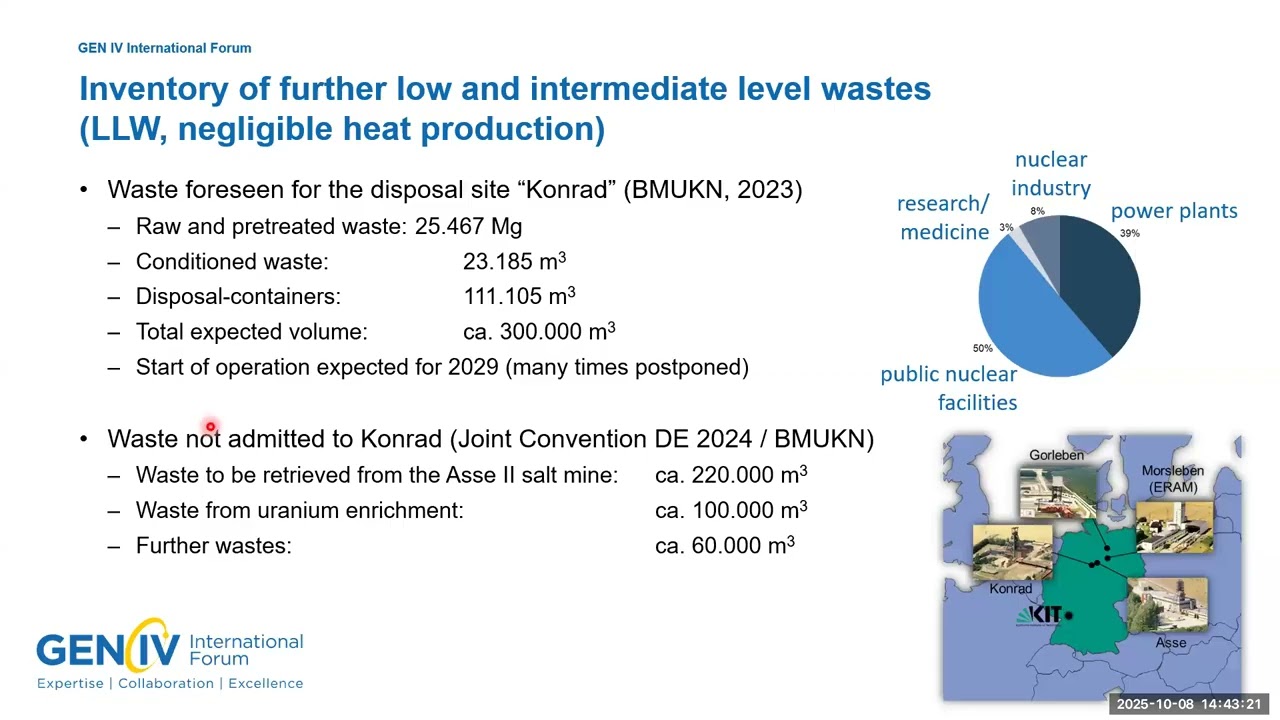
- Dr. Heberling begins the presentation with an overview of Germany's nuclear waste inventory and the site selection process.
- Explanation of the Site Selection Act and the three-phase process, including the timeline and public involvement.
- Introduction to KIT-INE, its facilities, and research mission in nuclear waste management.
- Dr. Heberling presents research on radionuclide diffusion and retention in clay rocks, including multi-scale studies.
- Dr. Quinto presents research on radionuclide migration in crystalline rocks and the role of colloids.
- Discussion of large-scale experiments in underground laboratories (Grimsel and Mont-Terri) and their relevance to site selection.
- Q&A session with the audience, addressing questions on the research and the German site selection process.
- Closing remarks and information on accessing the recording and slides.
Cited Sources
- GIF ETWG Activities — Mentioned as a resource for GIF ETWG activities.
- Full list of GIF ETWG webinars — Mentioned as a list of past webinars.
- Education and Training Series 105 - Science for Safe Disposal of Nuclear Waste - German — Mentioned as the page for recordings and slide decks.
Concurring Sources
- Grimsel Test Site — Mentioned as a site for large-scale experiments on radionuclide migration.
- Mont Terri Rock Laboratory — Mentioned as a site for clay rock research.
Contribution & Novelties
The webinar provides an up-to-date overview of Germany’s nuclear waste disposal program, including the regulatory framework and recent research from KIT-INE. It highlights the multi-barrier concept and the importance of understanding radionuclide migration in different host rocks. The presentation offers insights into the ongoing site selection process and the scientific challenges involved. It also showcases the capabilities of KIT-INE in radiochemical analysis and large-scale experiments.
Pour aller plus loin :
- Deep geological repository — Provides background on the concept of deep geological disposal.
- Radionuclide migration — Explains the processes of radionuclide transport in the environment.
- Grimsel Test Site — Official website of the Grimsel Test Site, an underground research laboratory in Switzerland.
- Mont Terri Rock Laboratory — Official website of the Mont Terri Rock Laboratory, another underground research facility.
- Site Selection Act (Germany) — Information on the German site selection process from the Federal Office for the Safety of Nuclear Waste Management (BASE).
153 words
Radar Profile
The radar profile shows high scores in information quantity, quality, and reliability, with a slightly lower technical level. This indicates a well-balanced presentation that is both informative and credible, though it may require some background knowledge to fully appreciate the technical details.