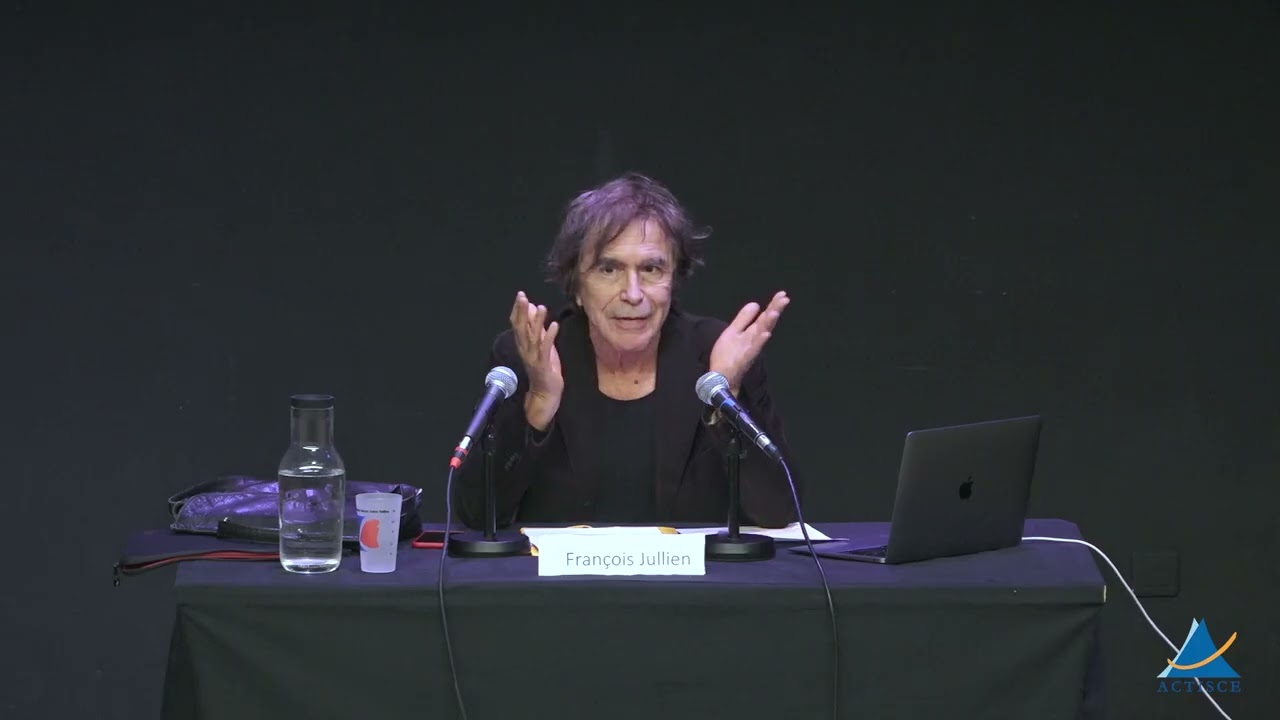
Compromis, com-possibles | François Jullien
Keywords
Summary
153 words
Critical Evaluation
Value of the Information & Strength of the Argument
The value of this talk lies in its original conceptual framework that challenges common assumptions about compromise and mediation. Jullien offers a rich philosophical analysis, drawing on both Western and Chinese traditions, to propose a more profound approach to conflict resolution. His argument is well-structured: he first critiques compromise, then introduces the concept of co-possibility, and finally elaborates on practical concepts like ‘potential of situation’ and ‘obliquity’. The argumentation is solid, though it relies on conceptual reasoning rather than empirical evidence. He effectively uses historical examples to illustrate his points, but the lack of concrete case studies or data weakens the practical applicability. Overall, the talk provides valuable intellectual insights but remains at a theoretical level.
Scientific Rigor, Source Quality, Title Accuracy
The scientific rigor is moderate: Jullien is a respected philosopher, and his reasoning is coherent, but he does not cite specific sources or studies. He references concepts from Chinese classics like Sun Tzu and Western philosophy (e.g., Clausewitz, Sartre) without providing precise citations. The title accurately reflects the content, focusing on the distinction between compromise and co-possibility. The talk is an opinion piece, so the lack of empirical data is expected, but for a scientific evaluation, the absence of verifiable sources limits its rigor. The video description mentions the Edict of Nantes and post-WWII Europe as examples, but these are not detailed. Overall, the title is appropriate, but the sourcing is weak.
243 words
Title / Content Match
The title accurately reflects the content, which focuses on the distinction between compromise and co-possibility, a central theme of the talk.
Quality & Reliability
8/10
The speaker is a renowned philosopher with deep expertise in Chinese and Western thought. The argument is coherent, well-structured, and grounded in philosophical concepts. However, it is an opinion piece without empirical data or peer-reviewed sources, and the video lacks citations.
Key Moments
Markers derived by PSI from the transcript: the creator did not define chapters.
- Introduction: critique of compromise as a political solution.
- Distinction between compromise and consensus.
- Introduction of the concept of co-possibility.
- Discussion of the potential of situation vs. planning.
- Contrast between frontal and oblique approaches.
- Examples of co-possibility: Edict of Nantes and European integration.
- Application to contemporary conflicts like Israeli-Palestinian.
- Conclusion: the need for mediation to open new possibilities.
Cited Sources
- Sun Tzu, The Art of War — Referenced as a Chinese strategic classic emphasizing evaluation of potential rather than planning.
- Clausewitz, On War — Mentioned as a Western strategic thinker who acknowledges the gap between theory and practice.
Concurring Sources
- The Art of War — Supports the idea of evaluating potential rather than planning.
Dissenting Sources
- Compromise - Wikipedia — Provides a more positive view of compromise as a practical solution, contrasting with Jullien's critique.
Contribution & Novelties
This talk offers a novel philosophical perspective on conflict resolution by introducing the concept of ‘co-possibility’ as a deeper alternative to compromise. It bridges Western and Chinese philosophical traditions, providing a framework for mediation that goes beyond mere negotiation. The concepts of ‘potential of situation’ and ‘obliquity’ offer practical tools for mediators and policymakers. The talk challenges the dominant frontal logic in Western democracy and suggests a more process-oriented approach.
Pour aller plus loin :
- François Jullien - Wikipedia — Background on the philosopher and his work.
- Sun Tzu - The Art of War — The classic text referenced for strategic thinking.
- Mediation - Wikipedia — Overview of mediation as a conflict resolution method.
114 words
Radar Profile
The radar profile shows high scores in quality of information and technical level, reflecting the depth of philosophical analysis. However, the quantity of information is moderate, and the global reliability is slightly lower due to the lack of citations. The overall shape indicates a well-argued but theoretical talk.
💬 No comments were provided for analysis.