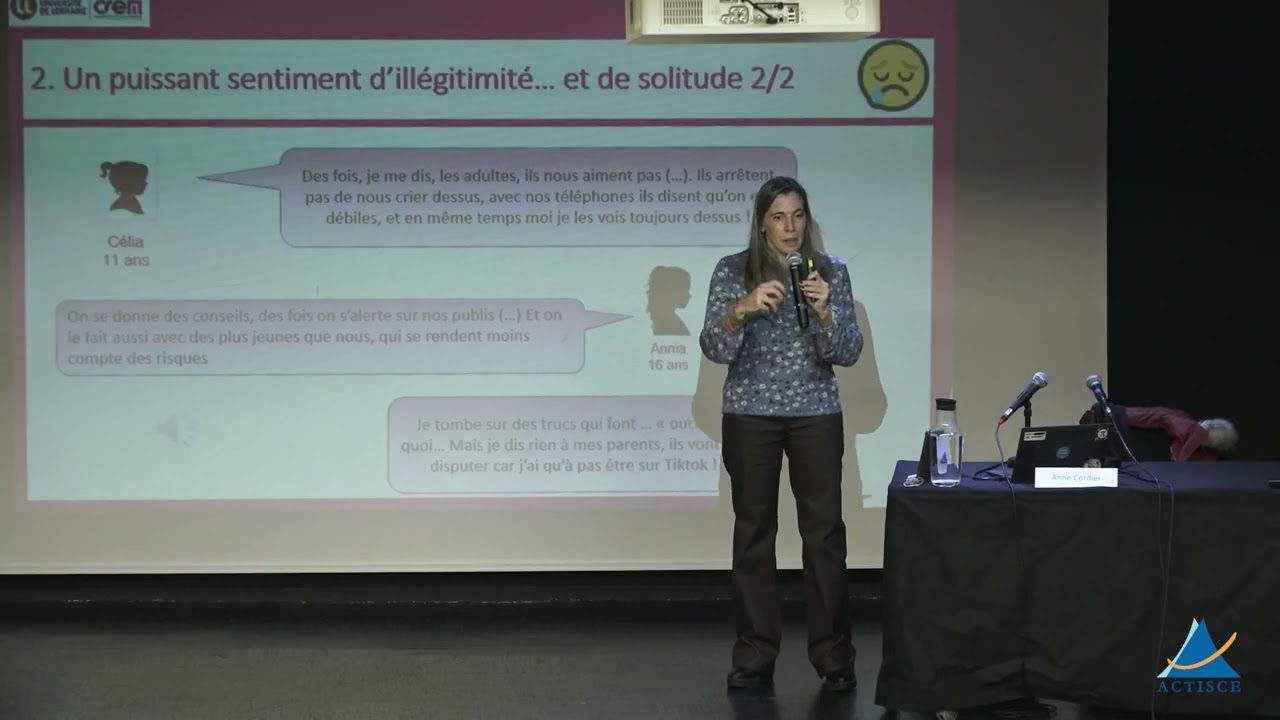
Nos enfants/ados et le numérique : quelle histoire !
Keywords
Summary
145 words
Critical Evaluation
Value of the Information & Strength of the Argument
The talk provides valuable insights from original research, offering a nuanced perspective often missing in public debates. The argumentation is solid, based on qualitative data and academic references. Cordier effectively deconstructs common misconceptions and highlights the complexity of youth digital practices. She argues against moral panic and for a more empathetic and informed approach. The strength lies in the authentic voices of children and adolescents, which ground her claims. However, the argumentation is primarily qualitative and may not be generalizable, but it is compelling and well-structured.
Scientific Rigor, Source Quality, Title Accuracy
The speaker demonstrates scientific rigor by referencing her own long-term studies and academic concepts (e.g., Bourdieu’s ‘La jeunesse n’est qu’un mot’, Pasquier’s ’tyrannie de la majorité’). She cites specific examples and data from her fieldwork. The title accurately reflects the content. The talk is well-sourced in terms of academic literature, though specific citations are not provided in the description. The adequacy between title and content is high.
168 words
Title / Content Match
The title accurately reflects the content, which explores children's and adolescents' relationship with digital media through a historical and sociological lens.
Quality & Reliability
8/10
The speaker is a university researcher in information and communication sciences, presenting findings from long-term field studies (since 2012) with children and adolescents. The talk is grounded in empirical research, references academic concepts (Bourdieu, Pasquier), and avoids sensationalism. However, it is a conference talk without peer-reviewed publication details, and some claims are based on qualitative interviews.
Key Moments
Markers derived by PSI from the transcript: the creator did not define chapters.
- Introduction: presentation of the conference and the researcher's fieldwork.
- Critique of contemptuous discourse: 'La fabrique du crétin digital' and karate federation campaign.
- Children's feeling of illegitimacy: quotes from children about their online activities.
- Case of Nelia: exposure to violent TikTok videos and fear of telling parents.
- Collectif Stop Fisha: teenage girls fighting revenge porn without adult support.
- Diversity of youth: examples of Anastasia (gamer) and Jonathan (phone as lifeline).
- Discussion of Bourdieu's 'La jeunesse n'est qu'un mot' and age-based domination.
- Importance of content creators like Squeezie and Camille (Je m'en balcito) for youth information.
- Call for rational debate and adult support, moving beyond bans.
Contribution & Novelties
The talk offers original insights from long-term ethnographic research, giving voice to children and adolescents often unheard in public debates. It challenges common assumptions and provides a nuanced understanding of digital practices. The longitudinal aspect (13 years) is particularly valuable.
Pour aller plus loin :
- Pierre Bourdieu - La jeunesse n’est qu’un mot — Key concept on age-based domination.
- Dominique Pasquier - Cultures lycéennes — Study on youth culture and peer pressure.
- Stop Fisha — Collective against revenge porn, relevant to the case discussed.
84 words
Radar Profile
The radar profile shows high scores in information quantity, quality, and reliability, with a moderate technical level. This indicates a well-researched, accessible talk that balances depth with clarity, suitable for a general audience.