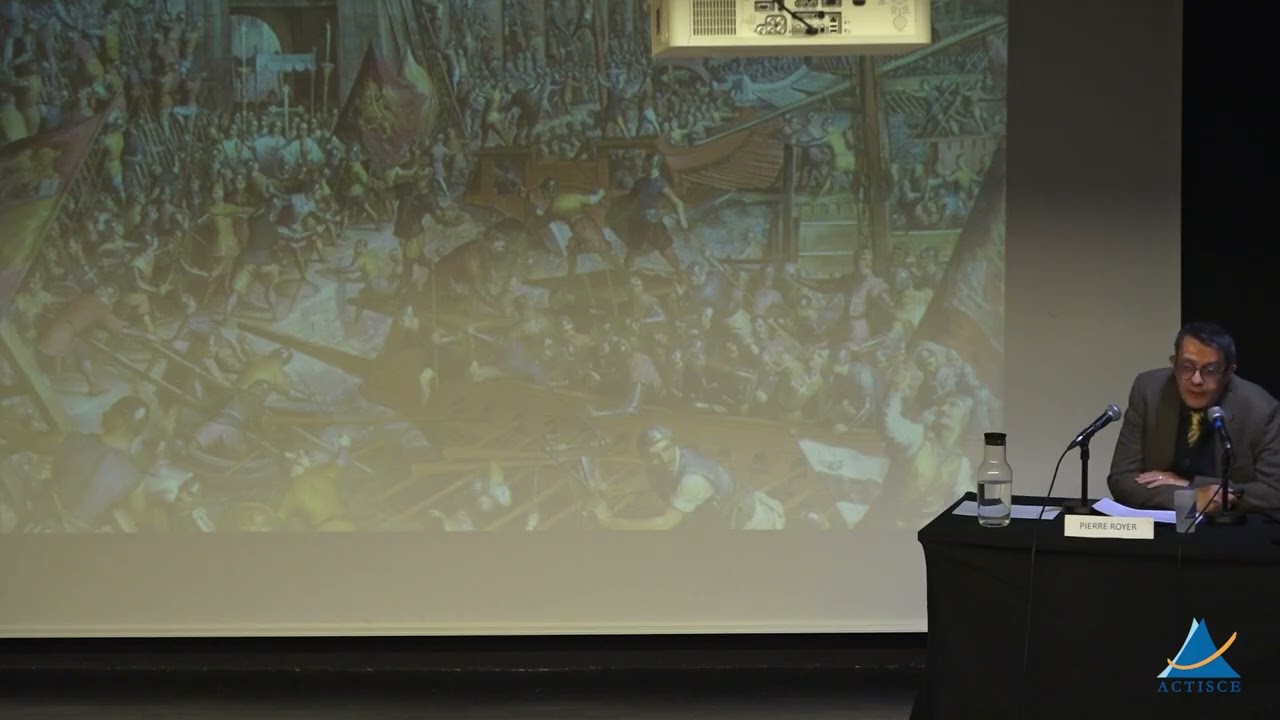
Vers une revanche des maîtres de la terre | Pierre Royer
Keywords
Summary
164 words
Critical Evaluation
Value of the Information & Strength of the Argument
The lecture provides a comprehensive overview of the historical evolution of sea power and its theoretical foundations. Royer effectively uses historical examples, such as the Peloponnesian War, the rise of Venice, and the British Empire, to illustrate his points. He also introduces key thinkers like Mahan and Mackinder, explaining their ideas clearly. The argumentation is coherent and persuasive, though it relies heavily on narrative and historical interpretation rather than empirical data. The speaker’s expertise is evident, and he offers a nuanced perspective on the ongoing relevance of maritime power in a changing world.
102 words
Title / Content Match
The title accurately reflects the content, which discusses the historical and contemporary balance between land and sea powers.
Quality & Reliability
7/10
The speaker is a recognized expert in geopolitics, and the lecture is well-structured with historical references and theoretical frameworks. However, it is an opinion-based presentation without peer-reviewed sources or empirical data, and the YouTube channel is not a scientific institution.
Key Moments
Markers derived by PSI from the transcript: the creator did not define chapters.
- Introduction: the speaker acknowledges the volatile geopolitical context and proposes to examine the long-term dynamics of sea and land power.
- Definition of thalassocracy and its historical usage, from ancient Greece to the modern era.
- Advantages of land powers: space, population, and attrition, with examples from Russia and France.
- Emergence of true thalassocracies with the Dutch and British, and the role of private commerce and state support.
- Theoretical foundations: Alfred Mahan's influence and the new navalisme, and the rise of the US Navy.
- Mackinder's heartland theory and the challenge to maritime dominance.
- Contemporary analysis: potential alliance of continental powers and the future of ocean governance.
- Conclusion: the enduring importance of maritime power and future challenges.
Cited Sources
- The Influence of Sea Power upon History, 1660-1783 — Mentioned as a foundational work by Alfred Mahan.
- The Geographical Pivot of History — Mentioned as Mackinder's 1904 paper.
Concurring Sources
- The Influence of Sea Power upon History — Supports the importance of naval power in historical dominance.
- The Geographical Pivot of History — Provides the counterargument of land power.
Dissenting Sources
- The Rise and Fall of the Great Powers — Paul Kennedy's work offers a more economic and industrial perspective on power transitions, potentially challenging the primacy of naval power.
Contribution & Novelties
The lecture offers a synthesis of historical and theoretical perspectives on sea power, emphasizing the cyclical nature of land and sea dominance. It provides a clear framework for understanding contemporary geopolitical shifts, such as the rise of China and Russia. The speaker’s expertise adds depth, but the content is largely derivative of existing geopolitical thought.
Pour aller plus loin :
- Alfred Thayer Mahan — Key theorist of sea power.
- Halford Mackinder — Proponent of the heartland theory.
- Thalassocracy — Historical concept of maritime dominance.
84 words
Radar Profile
The radar profile shows high scores in information quantity and reliability, reflecting the speaker's expertise and the lecture's depth. The technical level is moderate, indicating accessibility to a general audience. The overall balance suggests a well-informed but not highly technical presentation.
💬 No comments were provided for analysis.