Dialogue avec Mana Neyestani | La révolution Femme, Vie, Liberté, Dessins de presse
Keywords
Summary
216 words
Critical Evaluation
Value of the Information & Strength of the Argument
The video provides valuable firsthand insight into the work of an Iranian press cartoonist in exile, offering a unique perspective on the intersection of art, journalism, and political resistance. Neyestani’s explanations of his creative process and the context behind specific cartoons enrich the viewer’s understanding of the ‘Woman, Life, Freedom’ movement. The argumentation is coherent and grounded in personal experience, though it lacks external references or data to support broader claims. The discussion is more descriptive than analytical, focusing on individual artworks rather than systemic analysis.
Scientific Rigor, Source Quality, Title Accuracy
The video does not cite specific sources, but it references real events and artworks, such as the downing of PS752 and Picasso’s Guernica. The title accurately reflects the content, as it is indeed a dialogue with Mana Neyestani about the revolution and press cartoons. The scientific rigor is moderate: the information is presented as personal testimony and artistic interpretation, not as peer-reviewed research. The adequacy between title and content is high, with no misleading elements.
176 words
Title / Content Match
The title accurately reflects the content: a dialogue with Mana Neyestani about the 'Woman, Life, Freedom' revolution and press cartoons.
Quality & Reliability
7/10
The video is a recorded dialogue with an expert cartoonist, providing firsthand testimony and contextual explanations. The discussion is grounded in specific events and artworks, but lacks formal citations or verifiable sources. The reliability is moderate, relying on the speaker's expertise and personal experience.
Key Moments
Markers derived by PSI from the transcript: the creator did not define chapters.
- Introduction and thanks to Mana Neyestani; mention of Chaharshanbe Suri.
- Discussion on Neyestani's daily work as a cartoonist covering Iranian news from exile.
- Neyestani explains his book 'Shahid PS752' and the collaborative process with his brother and another cartoonist.
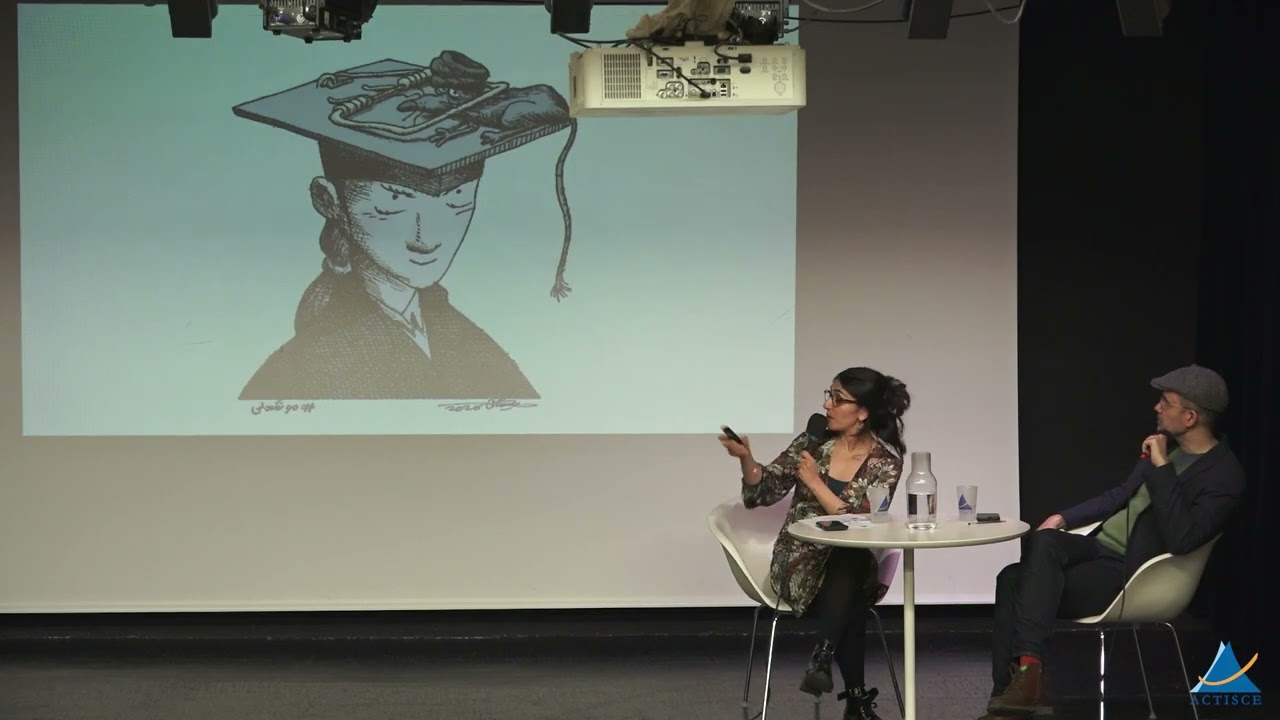
- Analysis of a cartoon depicting the new supreme leader as a mouse, inspired by student protests.
- Reflection on the enduring relevance of his cartoons despite Khamenei's death.
- Discussion of a cartoon inspired by a real photo of a man facing police; Neyestani explains his artistic choice to invert sizes.
- Neyestani talks about using Picasso's Guernica as inspiration for a piece about a massacre.
- Discussion of a cartoon about Iranians avoiding stepping on Israeli flags, interpreted as opposition to regime's foreign policy.
- Curators explain the exhibition's approach: presenting cartoons as journalistic work, not just caricature.
- Closing remarks and invitation for audience questions.
Cited Sources
- Shahid PS752 — Mana Neyestani's book about the downed Ukrainian plane, co-authored with his brother and another cartoonist.
- Tout va bien: une métamorphose iranienne — A collection of Neyestani's cartoons, mentioned as being close to the exhibition's content.
- Le petit manuel du parfait réfugié politique — An autobiographical work by Neyestani, mentioned in the discussion.
- Les oiseaux de papier — A book by Neyestani about the colb, porters in Kurdistan.
- Femme, Vie, Liberté — Collective work initiated by Marjane Satrapi, mentioned as a previous collaborative project.
Concurring Sources
- Woman, Life, Freedom movement — The movement is the central theme of the exhibition and the cartoons discussed.
- Guernica (Picasso) — Neyestani explicitly mentions being inspired by this painting for one of his works.
Contribution & Novelties
The video offers a unique insider perspective on the role of press cartoons in documenting and resisting political oppression in Iran. It highlights the creative process behind specific cartoons, providing context that is often missing from the images alone. The discussion also touches on the distinction between caricature and press cartoon, and the ethical considerations of artistic representation in times of crisis.
Pour aller plus loin :
- Woman, Life, Freedom movement — Provides background on the protest movement that inspired many of the discussed cartoons.
- Guernica (Picasso) — The famous anti-war painting that Neyestani referenced as inspiration for his work on the massacre.
- Press cartoon — Explains the genre and its role in journalism, relevant to the discussion on the distinction between caricature and press cartoon.
126 words
Radar Profile
The radar profile shows high scores in information quality and reliability, reflecting the expert testimony and contextual explanations. The lower score in technical level indicates that the content is accessible to a general audience, focusing on artistic and political commentary rather than technical analysis.