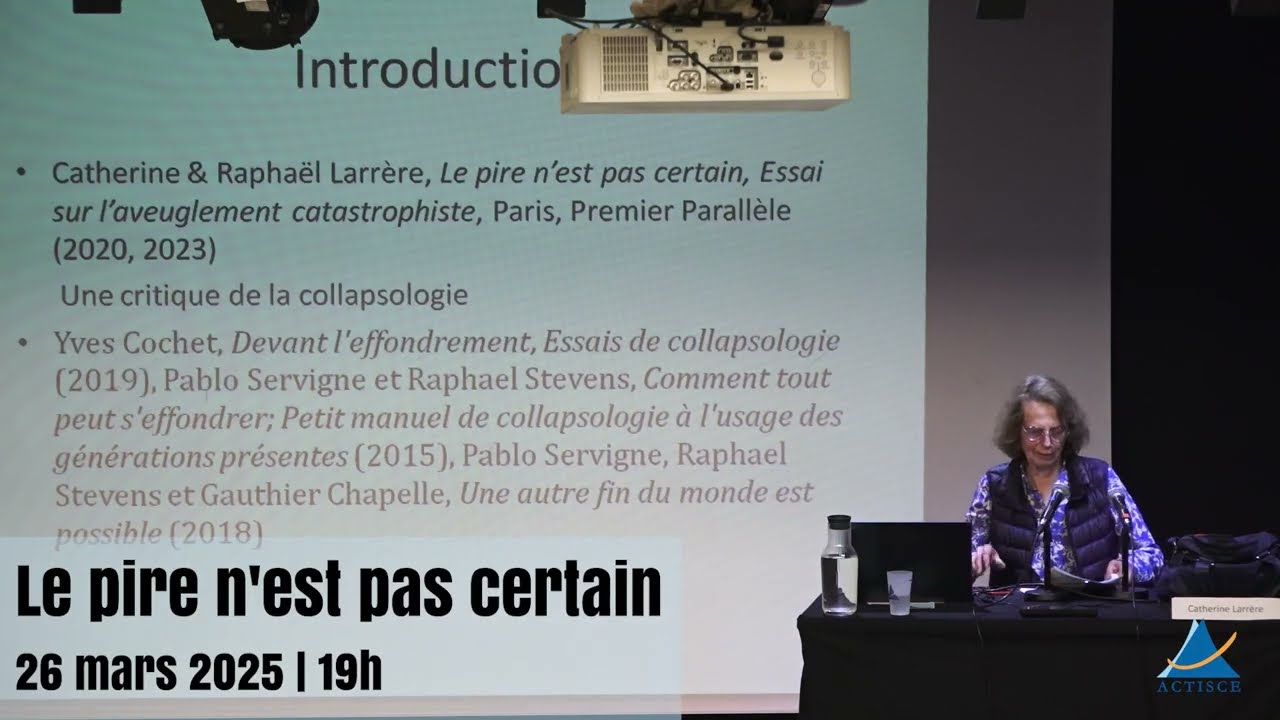
Le pire n'est pas certain | Catherine Larrère
Keywords
Summary
147 words
Critical Evaluation
Value of the Information & Strength of the Argument
The lecture provides a valuable philosophical critique of collapsology, offering a clear taxonomy of different forms of catastrophism. Larrère’s argument is well-structured and logically sound, drawing on distinctions between rhetorical, methodological, and ontological uses of catastrophe. She effectively challenges the deterministic and depoliticizing aspects of collapsology, advocating for a more engaged and pluralistic approach to environmental action. The argumentation is nuanced, acknowledging the seriousness of environmental crises while rejecting fatalism.
Scientific Rigor, Source Quality, Title Accuracy
Larrère demonstrates intellectual rigor by referencing key figures such as Jean-Pierre Dupuy, Pablo Servigne, and Edgar Morin, and by situating her critique within a broader philosophical tradition. However, the lecture is primarily an opinion piece rather than a systematic review of scientific literature, and specific sources are not always cited with precision. The title accurately reflects the content, which focuses on challenging the certainty of collapse. The lecture maintains a high level of coherence and avoids oversimplification.
162 words
Title / Content Match
The title accurately reflects the central thesis of the lecture, which argues against the inevitability of collapse.
Quality & Reliability
8/10
The speaker is a recognized philosopher with decades of work on environmental ethics. The argument is well-structured, references key authors and concepts, and is presented with nuance. However, it is an opinion-based lecture without systematic citation of sources, and some claims are not empirically verified.
Key Moments
Markers derived by PSI from the transcript: the creator did not define chapters.
- Introduction: Larrère dedicates the lecture to her late husband and explains the origin of the title.
- Larrère distinguishes three forms of catastrophism: pedagogical, enlightened, and ontological.
- Discussion of the collapsology thesis: complexity leads to fragility and inevitable collapse.
- Critique of the deterministic reasoning in collapsology, referencing Edgar Morin's emphasis on unpredictability.
- Larrère argues that collapsology relies on fictional narratives and cannot be considered a science.
- Exploration of the distinction between 'a world without humans' and 'humans without a world'.
- Conclusion: emphasis on political action and local perspectives as alternatives to fatalism.
Cited Sources
- Comment tout peut s'effondrer — Referenced as a key collapsology book by Pablo Servigne and Raphaël Stevens.
- Pour un catastrophisme éclairé — Referenced as the work of Jean-Pierre Dupuy, which Larrère distinguishes from collapsology.
- Penser et agir avec la nature — Mentioned as a previous book by Larrère and her husband.
- Le pire n'est pas certain — The book by Catherine Larrère and Raphaël Larrère, which this lecture is based on.
Concurring Sources
- Comment tout peut s'effondrer — The book by Servigne and Stevens, which Larrère critiques but also acknowledges as a major reference.
Dissenting Sources
- Comment tout peut s'effondrer — Larrère disagrees with the deterministic and inevitable collapse thesis presented in this book.
Contribution & Novelties
The lecture offers a clear philosophical framework for understanding different forms of catastrophism and critiques the deterministic and depoliticizing nature of collapsology. It emphasizes the importance of political engagement and local action, providing a counter-narrative to fatalism.
Pour aller plus loin :
- Anthropocene — The concept of the current geological epoch, central to discussions of environmental crisis.
- Collapsology — The movement and ideas critiqued in the lecture.
- Jean-Pierre Dupuy — Philosopher known for ’enlightened catastrophism’, whose work is discussed in the lecture.
82 words
Radar Profile
The radar profile shows high scores in quality of information and reliability, reflecting the speaker's expertise and coherent argumentation. The lower score in quantity of information suggests the lecture is more focused on conceptual analysis than on presenting a large volume of empirical data.