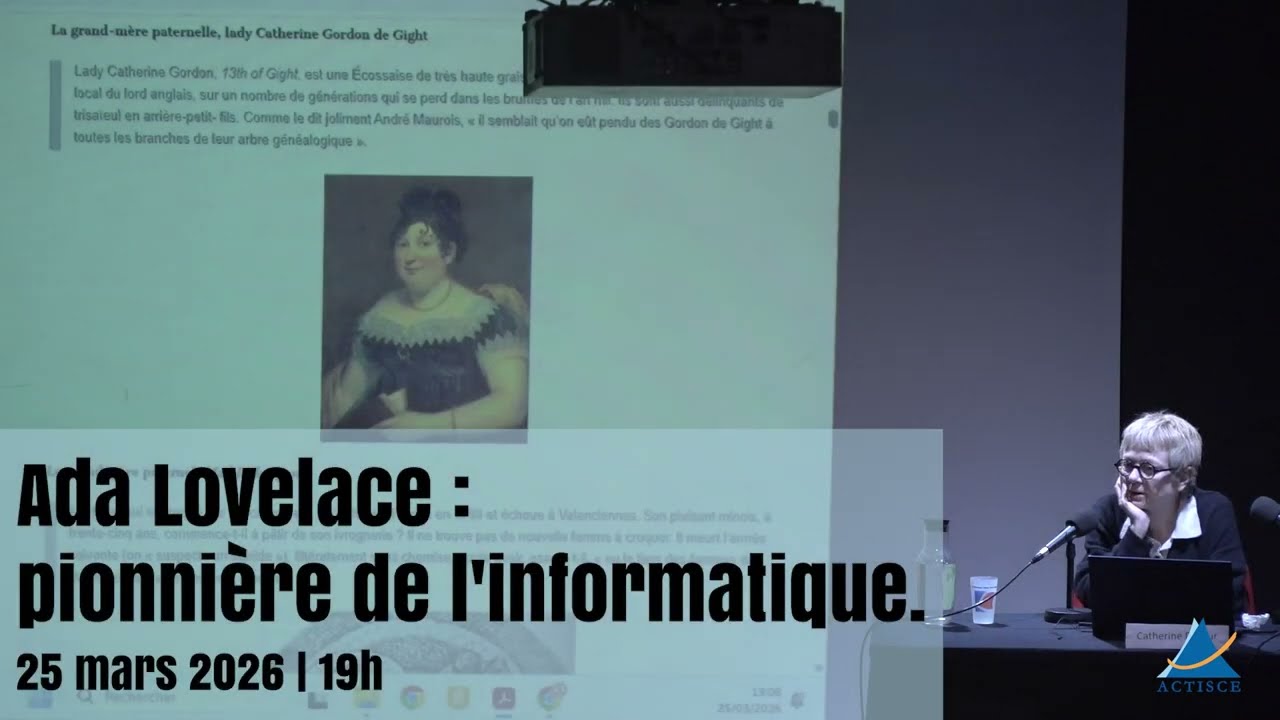
Ada Lovelace, pionnière de l'informatique | Catherine Dufour
Keywords
Summary
156 words
Critical Evaluation
Value of the Information & Strength of the Argument
The talk provides valuable insights into Ada Lovelace’s life and contributions, correcting common misconceptions and highlighting her role as a pioneer. Dufour’s argumentation is based on her biographical research, but she presents it in a conversational and sometimes humorous style. She supports her claims with historical details and anecdotes, but she does not provide formal citations during the talk. The value lies in the synthesis of historical facts and the emphasis on Ada’s intellectual achievements. The argumentation is solid in terms of historical accuracy, but it is not a critical analysis of sources.
102 words
Title / Content Match
The title accurately reflects the content, which focuses on Ada Lovelace's life and contributions to computing.
Quality & Reliability
7/10
The talk is based on the author's biographical research, but it is presented as a personal narrative with some informal and anecdotal elements. The historical facts are generally accurate, but the presentation is subjective and not peer-reviewed.
Key Moments
Markers derived by PSI from the transcript: the creator did not define chapters.
- Introduction: Why write a biography of Ada Lovelace?
- Ada's birth and parents' separation.
- Ada's education and the 'black pedagogy'.
- Meeting with Charles Babbage and the analytical engine.
- Ada's work on the Note G and her vision.
- Babbage's character and the failure to build the machine.
- Ada's later life and legacy.
- Recognition of Ada's work in the 20th century.
Cited Sources
- Ada Lovelace: The Making of a Computer Scientist — Mentioned as a general reference for Ada's life.
- Charles Babbage — Mentioned as a general reference for Babbage.
Concurring Sources
- Ada Lovelace - Wikipedia — Provides factual information consistent with the talk.
Dissenting Sources
- Ada Lovelace: The Making of a Computer Scientist — Some historians argue that Ada's contributions were overestimated, but the talk presents a more favorable view.
Contribution & Novelties
The talk provides a personal and engaging perspective on Ada Lovelace’s life, emphasizing her role as a pioneer in computing. It highlights her visionary ideas and the challenges she faced as a woman in the 19th century. The talk also corrects common misconceptions, such as the idea that Ada was merely a scribe for Babbage. It offers a fresh narrative that combines historical facts with the author’s own insights.
Pour aller plus loin :
- Ada Lovelace - Wikipedia — Comprehensive overview of her life and work.
- Analytical Engine - Wikipedia — Detailed description of Babbage’s machine.
- Ada (programming language) - Wikipedia — The programming language named after her.
108 words
Radar Profile
The radar profile shows high scores in quantity of information and global reliability, but lower in technical level, reflecting the talk's focus on historical narrative rather than technical details.
💬 No comments provided.