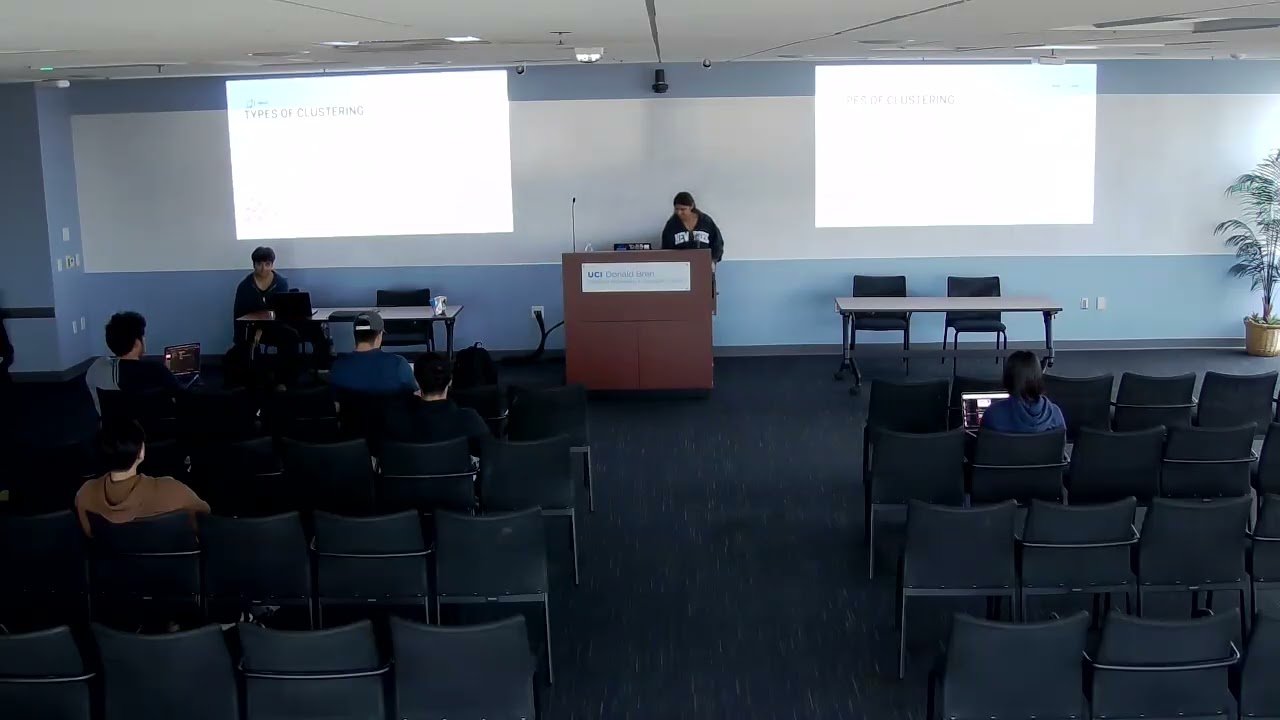
AI@UCI Workshop 1/21/26
Keywords
Summary
156 words
Critical Evaluation
Value of the Information & Strength of the Argument
The video provides a solid conceptual foundation for clustering, particularly K-means. The instructor’s use of visual demonstrations and interactive examples effectively conveys the iterative nature of the algorithm. The argumentation is clear and logical, building from simple definitions to more complex ideas. The discussion on initialization and choosing K is valuable, though it could be more detailed. The explanation of the EM algorithm is brief and lacks mathematical rigor, but it serves as a good high-level introduction. Overall, the content is valuable for beginners seeking an intuitive understanding of clustering, but it does not delve into advanced topics or provide formal proofs.
Scientific Rigor, Source Quality, Title Accuracy
The video is an informal workshop, so it does not cite external sources. The instructor relies on his own explanations and visual aids. The title accurately reflects the content, and the workshop is well-structured. However, the lack of citations and the informal nature limit its scientific rigor. The instructor does not mention any specific papers or textbooks, so the sources cited are nonexistent. The content is accurate but not deeply rigorous.
188 words
Title / Content Match
The title accurately reflects the content: a workshop on AI, specifically covering clustering, held at UCI on the given date.
Quality & Reliability
7/10
The workshop provides a clear, intuitive explanation of clustering algorithms (K-means, GMM, hierarchical) and the EM algorithm, with visual demonstrations and interactive examples. The content is accurate and well-structured, though it lacks formal mathematical depth and citations. The instructor demonstrates good pedagogical skill, but the video is an informal workshop, not a peer-reviewed source.
Key Moments
Markers derived by PSI from the transcript: the creator did not define chapters.
- Introduction to the workshop and overview of clustering as unsupervised learning.
- Discussion on the three types of clustering: location, density, and shape based.
- Example of clustering for image compression.
- Introduction to K-means clustering and its iterative steps.
- Visual demonstration of K-means convergence with moving centroids.
- Step-by-step whiteboard example of K-means with two clusters.
- Discussion on initialization methods and choosing the number of clusters K.
- Introduction to Gaussian Mixture Models and the EM algorithm.
- Brief mention of hierarchical clustering and its differences.
- Q&A session and wrap-up.
Contribution & Novelties
The video offers a clear, intuitive introduction to clustering, particularly K-means, with visual demonstrations that help solidify understanding. It bridges the gap between theoretical concepts and practical application, such as image compression. The instructor’s interactive teaching style encourages engagement and clarifies common misconceptions.
Pour aller plus loin :
- K-means clustering — Provides a detailed mathematical explanation and variations of the algorithm.
- Expectation–maximization algorithm — Explains the EM algorithm used in Gaussian Mixture Models.
- Gaussian mixture model — Overview of mixture models and their applications.
- Hierarchical clustering — Discusses agglomerative and divisive approaches.
92 words
Radar Profile
The radar profile shows high scores in quantity of information and technical level, indicating a content-rich tutorial. The quality and reliability scores are moderate, reflecting the informal nature and lack of citations. The overall balance suggests a useful educational resource for beginners.