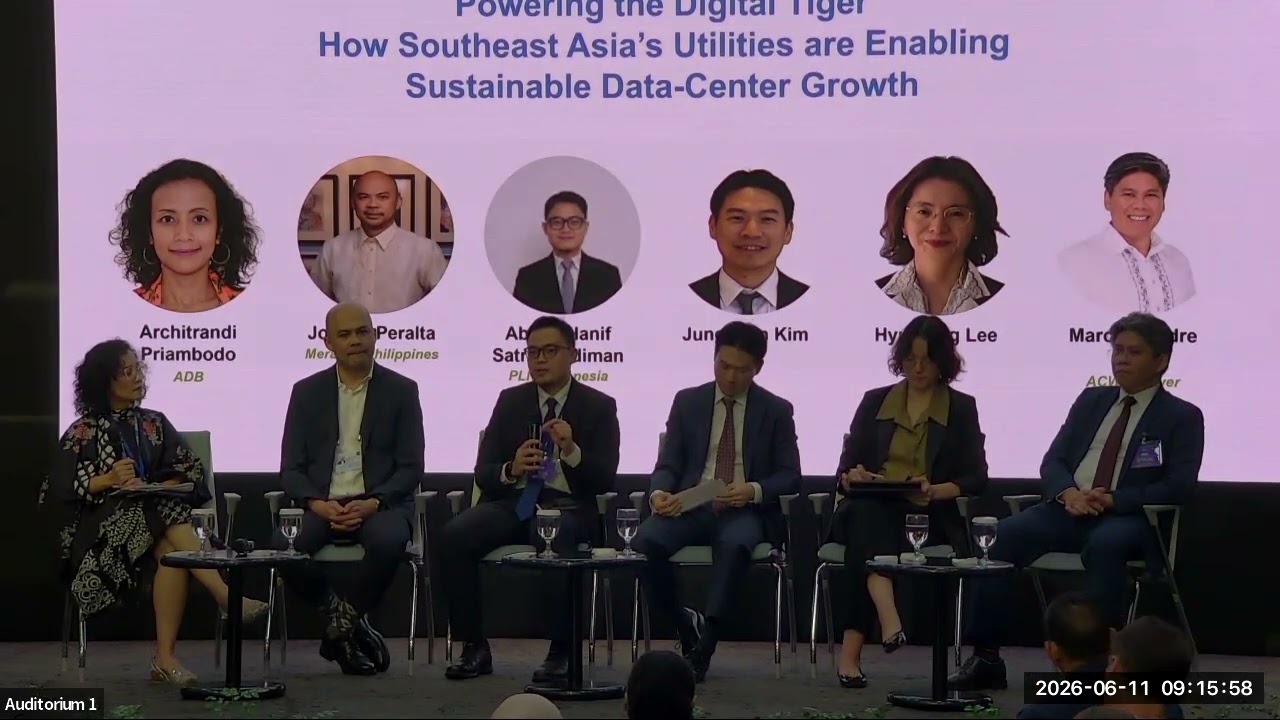
Sector/Thematic Session: Southeast Asia's Dual Transformation
Keywords
Summary
131 words
Critical Evaluation
Value of the Information & Strength of the Argument
The session provides valuable insights from key stakeholders in Southeast Asia’s energy sector, offering practical perspectives on the challenges of integrating large data center loads. The utility perspective from Meralco and PLN highlights concrete issues such as transmission congestion, permitting delays, and the need for proactive planning. The developer perspective from Aboitiz Power emphasizes the importance of renewable energy access and price stability, referencing specific government programs like the Green Energy Auction Program. ADB representatives discuss innovative financing mechanisms, including blended finance and risk mitigation for cross-border projects. The argumentation is coherent and grounded in real-world examples, though it lacks quantitative data and detailed technical analysis. The discussion is more strategic than technical, focusing on policy, investment, and coordination rather than engineering solutions.
Scientific Rigor, Source Quality, Title Accuracy
The session demonstrates a high level of expertise from the panelists, who are directly involved in energy planning and investment in the region. The information is based on institutional knowledge and practical experience, but no formal sources are cited. The title accurately reflects the content, which centers on Southeast Asia’s dual transformation of digital growth and energy transition. The discussion is well-structured, with clear moderation and relevant questions from the audience. However, the lack of specific data and references limits the scientific rigor. The panelists’ statements are credible but not independently verifiable. The session would benefit from more detailed case studies and quantitative evidence to support the claims.
246 words
Title / Content Match
The title accurately reflects the session's focus on Southeast Asia's dual transformation of digital growth and energy transition.
Quality & Reliability
7/10
The session features expert panelists from major utilities, developers, and ADB, providing practical insights and specific examples. However, it is a panel discussion with limited depth on technical details and no formal citations, relying on institutional knowledge.
Key Moments
Markers derived by PSI from the transcript: the creator did not define chapters.
- Introduction by Lan, setting the context of Southeast Asia's digital transformation and its impact on power systems.
- Panelists introduced; discussion begins on utility perspective with Meralco's Joseph Peralta.
- Meralco discusses load forecasting and network planning for data centers, mentioning 1,000 MW of load.
- PLN's Abdan Hanif highlights transmission constraints in Java and the need for co-investment.
- Aboitiz Power's Marcus Ong discusses renewable energy auctions and price stability for data centers.
- ADB's Jun Hyun Kim explains blended finance and the Monsoon Wind project as an example.
- ADB's Hyunjong Lee discusses the ASEAN Power Grid as a solution to the energy paradox.
- Audience Q&A on reliability vs. speed, and New Clark City development.
- Closing remarks: panelists give one-sentence must-do actions for 2026.
Contribution & Novelties
The session provides a multi-stakeholder perspective on the data center energy challenge in Southeast Asia, highlighting the need for coordinated planning between utilities, developers, and financiers. It underscores the importance of grid interconnection and innovative financing mechanisms. The discussion offers practical insights into the challenges of load forecasting, transmission constraints, and renewable energy procurement.
Pour aller plus loin :
- ASEAN Power Grid — Overview of the regional interconnection initiative.
- Green Energy Auction Program (Philippines) — Official information on the Philippines’ renewable energy auction mechanism.
- Monsoon Wind Power Project — ADB’s flagship cross-border wind project in Laos and Vietnam.
- Blended Finance — Explanation of the financing approach discussed by ADB.
109 words
Radar Profile
The radar profile shows balanced scores across information quantity, quality, technical level, and reliability, indicating a well-rounded but not deeply technical session. The high scores in information and reliability reflect the expertise of the panelists, while the moderate technical level suggests the content is accessible to a broad audience.