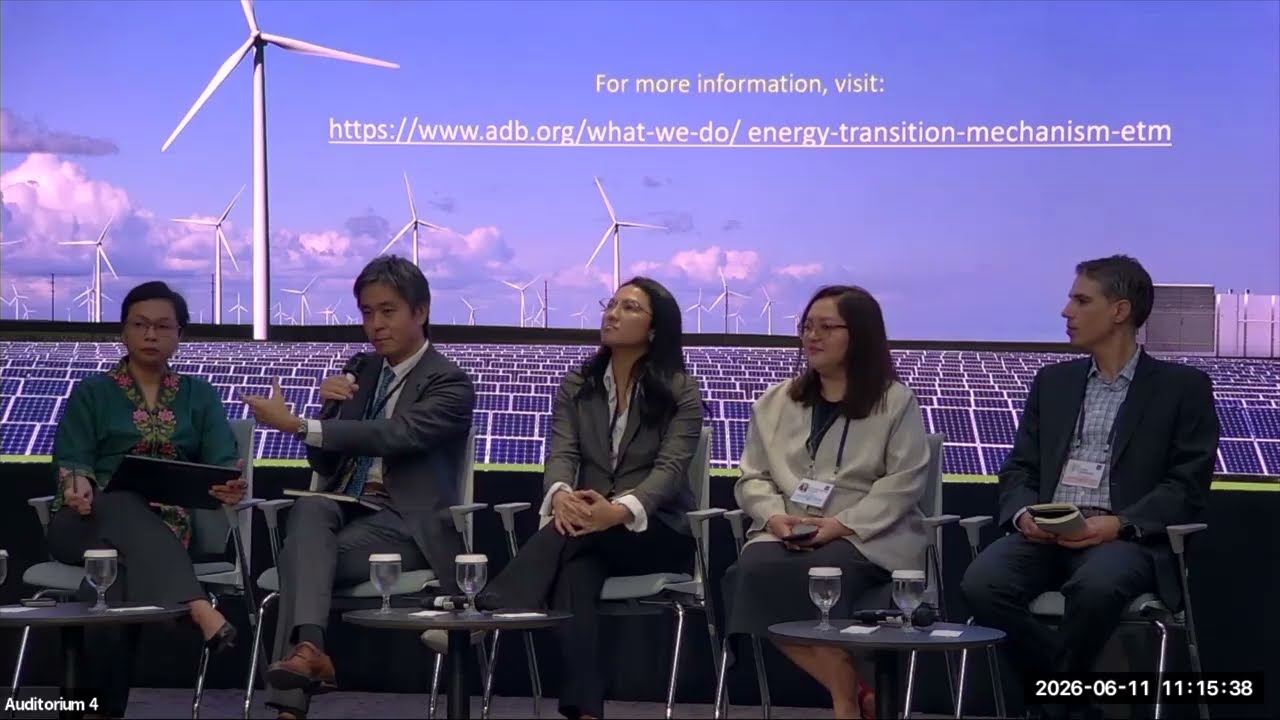
Sector/Thematic Session: Lessons from ADB's ETM to Industrial Decarbonization
Keywords
Summary
177 words
Critical Evaluation
Value of the Information & Strength of the Argument
The session provides valuable insights into the practical challenges and innovative financial mechanisms for coal retirement and industrial decarbonization. The argumentation is grounded in real-world experiences, particularly the Cirebon-1 case, which illustrates the technical feasibility but political hurdles. The discussion on transition credits offers a concrete tool to bridge financial gaps, supported by a pilot project. The Kazakhstan case highlights the unique complexities of heating systems and the potential for green district heating. The argumentation is coherent and persuasive, though it relies heavily on expert opinion rather than quantitative data.
Scientific Rigor, Source Quality, Title Accuracy
The session demonstrates a reasonable level of scientific rigor, with speakers from ADB, government, and research institutions. However, specific sources are not cited in the transcript, and the discussion is largely based on professional experience. The title accurately reflects the content, focusing on ETM lessons and industrial decarbonization. The session does not include formal citations, but the expertise of the panelists lends credibility. The adequacy between title and content is high, as the session directly addresses the stated theme.
184 words
Title / Content Match
The title accurately reflects the session's focus on lessons from ADB's ETM and its application to industrial decarbonization.
Quality & Reliability
7/10
The session features expert practitioners from ADB, government, and research institutions discussing real-world experiences and lessons from the Energy Transition Mechanism. While it is largely a panel discussion with expert opinions and case studies, it lacks detailed data or peer-reviewed sources, and some claims are anecdotal.
Key Moments
Markers derived by PSI from the transcript: the creator did not define chapters.
- Introduction by Ayat Kurokawa and opening remarks by Praep Tarakan on the need for integrated power and industry decarbonization.
- Rani Cherani explains the ETM concept and its evolution since 2021.
- Yuichiro Yoi discusses the Cirebon-1 transaction, highlighting financial engineering and political challenges.
- Jessel Agno explains transition credits and their role in coal retirement, citing a pilot in the Philippines.
- Baltugan Tashmakina outlines Kazakhstan's heating sector challenges and new heat energy law.
- James Sherwood discusses the importance of reassessing planned coal plants and the economic case for alternatives.
- Panel discussion on lessons learned and the path ahead for ETM and industrial decarbonization.
Contribution & Novelties
The session provides a comprehensive overview of the ETM’s practical implementation, highlighting both successes and challenges. It introduces transition credits as a novel financing mechanism and discusses the extension of ETM to industrial decarbonization. The Kazakhstan case offers insights into integrating heating and power decarbonization. The discussion on reassessing coal pipelines is particularly forward-looking.
Pour aller plus loin :
- Energy Transition Mechanism - ADB — Official ADB page on ETM.
- Transition Credits - Climate Smart Ventures — Information on transition credits.
- RMI’s Coal Pipeline Analysis — RMI’s work on coal plants.
- Kazakhstan’s Heat Energy Law — Official energy ministry website (may not have specific law details).
106 words
Radar Profile
The radar profile shows high scores in quantity and quality of information, reflecting the depth of expert discussion. The technical level is moderate, suitable for a professional audience. The overall reliability is strong due to the credibility of the speakers, though the lack of formal citations slightly reduces the score.