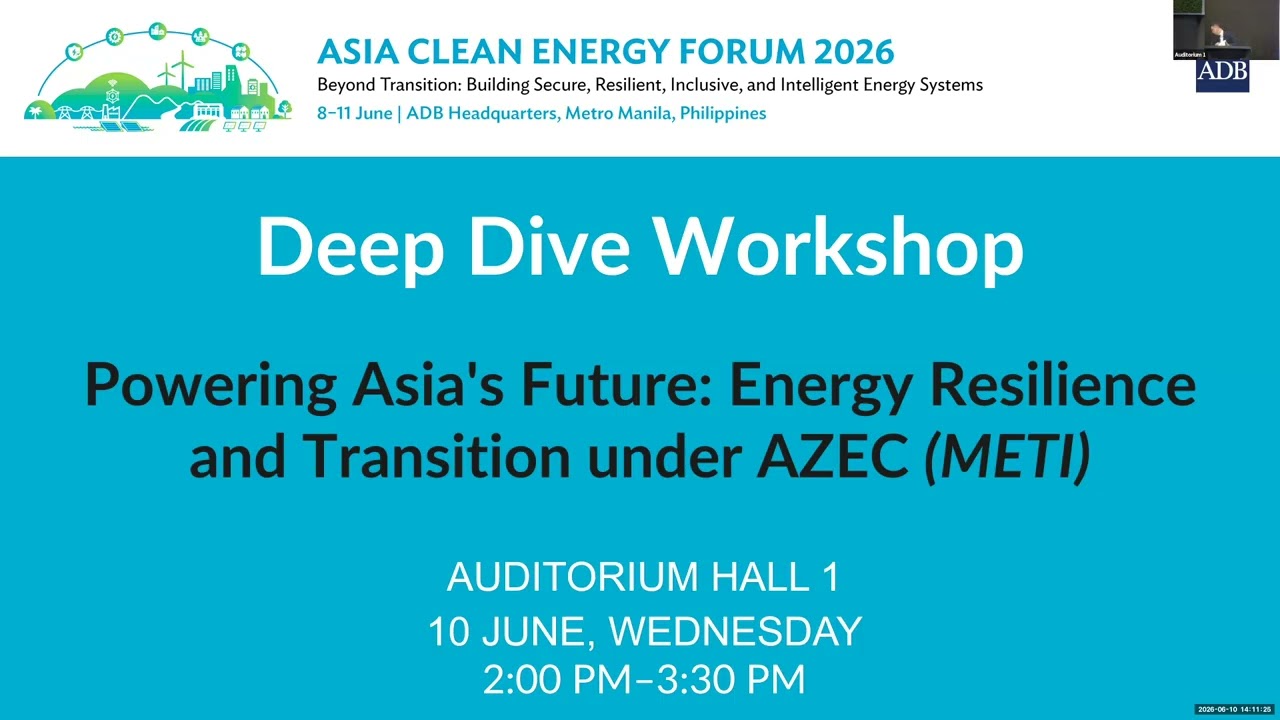
Deep Dive Workshop: Powering Asia's Future: Energy Resilience and Transition under AZEC
Keywords
Summary
163 words
Critical Evaluation
Value of the Information & Strength of the Argument
The panel provides valuable insights into the immediate policy responses and long-term strategies for energy resilience in Asia. The argumentation is strong, drawing on real-world examples like Japan’s stockpile release and Saudi Arabia’s use of the East-West pipeline. The speakers effectively argue that energy security must be integrated with transition efforts, and that regional cooperation is essential. However, the discussion is largely qualitative, with limited data or evidence presented to support claims, and the perspectives are primarily from government and think tank officials, which may introduce bias.
Scientific Rigor, Source Quality, Title Accuracy
The panel features authoritative speakers from government and think tanks, lending credibility. However, no specific sources or publications are cited during the discussion, and the description provides no links. The title accurately reflects the content, which focuses on energy resilience and transition under the AZEC framework. The discussion is policy-oriented rather than scientific, with limited technical depth. No comments were provided for analysis.
165 words
Title / Content Match
The title accurately reflects the content, which focuses on energy resilience and transition in Asia under the AZEC framework.
Quality & Reliability
7/10
The panel features high-level officials from METI, Saudi Arabia's deputy minister, and an energy think tank expert, providing authoritative perspectives. However, the discussion is largely policy-oriented with limited quantitative data and no peer-reviewed sources cited, reducing the scientific rigor.
Key Moments
Markers derived by PSI from the transcript: the creator did not define chapters.
- Opening remarks by Tashi Kyama, ADB, introducing the session.
- Shinichi Kihara (METI) begins keynote on Japan's response to the Strait of Hormuz closure.
- Kihara details Japan's oil stockpile release and the Power Asia initiative.
- Panel discussion begins with Rafael Abasov moderating; Saudi Deputy Minister Majid speaks on the crisis's impact.
- Majid discusses Saudi Arabia's resilience measures and the importance of supply chain reliability.
- Kihara provides examples of Japan's cooperation with Vietnam and the Philippines.
- Dr. Grabat (ERA) presents on ASEAN's need for structural preparedness and practical stockpiling.
- Discussion on diversifying energy sources and protecting the energy transition.
- Majid emphasizes the need for strategic petroleum reserves in Asia.
Contribution & Novelties
The panel provides a timely and high-level overview of the energy crisis’s impact on Asia and the policy responses, particularly the Power Asia initiative. It highlights the need to integrate energy security with transition efforts, a perspective often underrepresented. The discussion offers practical examples of cooperation, such as Japan’s support for stockpiling in the Philippines.
Pour aller plus loin :
- Strategic Petroleum Reserve (Wikipedia) — Relevant to the discussion on stockpiling as a resilience tool.
- ASEAN Plan of Action for Energy Cooperation (APAEC) — Relevant to regional energy cooperation in ASEAN.
- International Energy Agency (IEA) oil stock release — Relevant to coordinated stockpile releases mentioned in the discussion.
108 words
Radar Profile
The radar profile shows high scores in information quantity and quality, reflecting the panel's rich content and authoritative speakers. The technical level is moderate, indicating a policy-oriented discussion rather than a deep technical analysis. The overall reliability is solid, though the lack of cited sources and the political nature of the discussion slightly reduce the score.