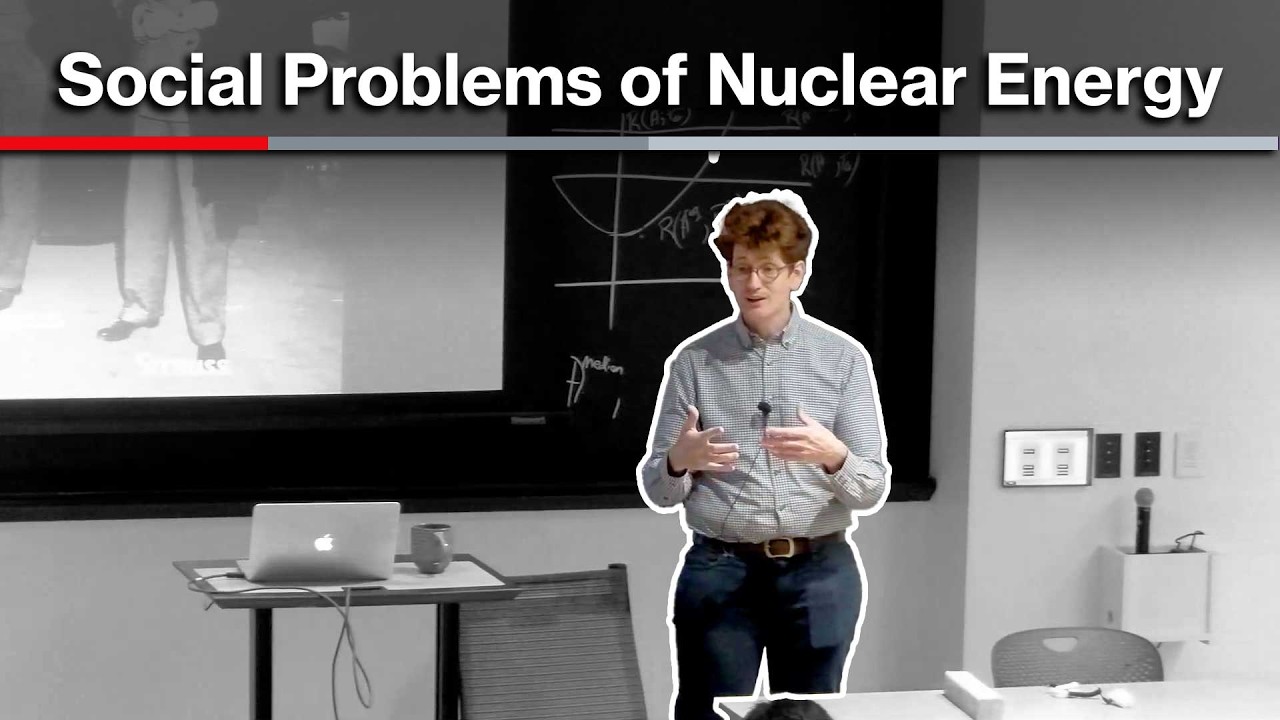
Lecture 1: Introduction to 22.04 and the History of Nuclear Power
Keywords
Summary
163 words
Critical Evaluation
The lecture provides a solid introduction to the social and historical context of nuclear energy. Professor Kemp’s expertise is evident, and he effectively connects historical events to contemporary debates. The administrative portion, while necessary, takes up a significant portion of the lecture, which may be less relevant for external viewers. The historical narrative is engaging and well-structured, but it remains at an introductory level, lacking deep technical or policy analysis. The discussion of AI in grading is interesting and reflects current academic challenges. The sources mentioned (e.g., Manhattan Project, AEC) are credible, but no specific citations are provided in the lecture itself. The title accurately reflects the content, and the lecture fulfills its purpose as an introductory session. Overall, it is a valuable resource for those new to the topic, but it does not offer novel insights for experts.
139 words
Title / Content Match
The title accurately reflects the content: the lecture introduces the course and provides a historical overview of nuclear power.
Quality & Reliability
8/10
Lecture by MIT professor R. Scott Kemp, part of an accredited course. Content is well-structured, historically grounded, and includes references to primary sources (e.g., Manhattan Project, AEC). However, it is an introductory lecture with limited depth on specific technical details.
Key Moments
Markers derived by PSI from the transcript: the creator did not define chapters.
- Introduction to the course and its history.
- Explanation of homework and AI-based grading system.
- Discussion of the final paper and oral exam.
- Start of the historical overview: stellar origins of nuclear energy.
- Discovery of fission and the Manhattan Project.
- Post-WWII development and the role of the Atomic Energy Commission.
- Cold War context and dual-use technology.
- Technology lock-in and the dominance of light-water reactors.
Cited Sources
- MIT OpenCourseWare Course Page — Course materials and syllabus.
- MIT OpenCourseWare — General OCW platform.
- MIT OCW Terms — License and usage terms.
- MIT OCW Comments Policy — Guidelines for comments.
- YouTube Playlist — Full course playlist.
Concurring Sources
- MIT OpenCourseWare Course Page — Official course materials align with lecture content.
External References
Contribution & Novelties
The lecture provides a comprehensive historical narrative of nuclear power, emphasizing the interplay between science, politics, and technology. It introduces the concept of ’technology lock-in’ and the dual-use dilemma, offering a framework for understanding nuclear energy’s challenges. The discussion on AI in education is a contemporary addition.
Pour aller plus loin :
- Manhattan Project — Historical context of the first nuclear weapons.
- Atomic Energy Commission — Key regulatory body in early US nuclear history.
- Light-water reactor — The dominant reactor technology discussed.
- Leo Szilard — Physicist who conceived the nuclear chain reaction.
- Dual-use technology — Concept of technologies with both civilian and military applications.
104 words
Radar Profile
The radar profile shows high scores in quality and reliability, moderate in quantity and technical depth, reflecting a well-produced introductory lecture that is credible but not highly technical.
💬 No comments were provided for analysis.