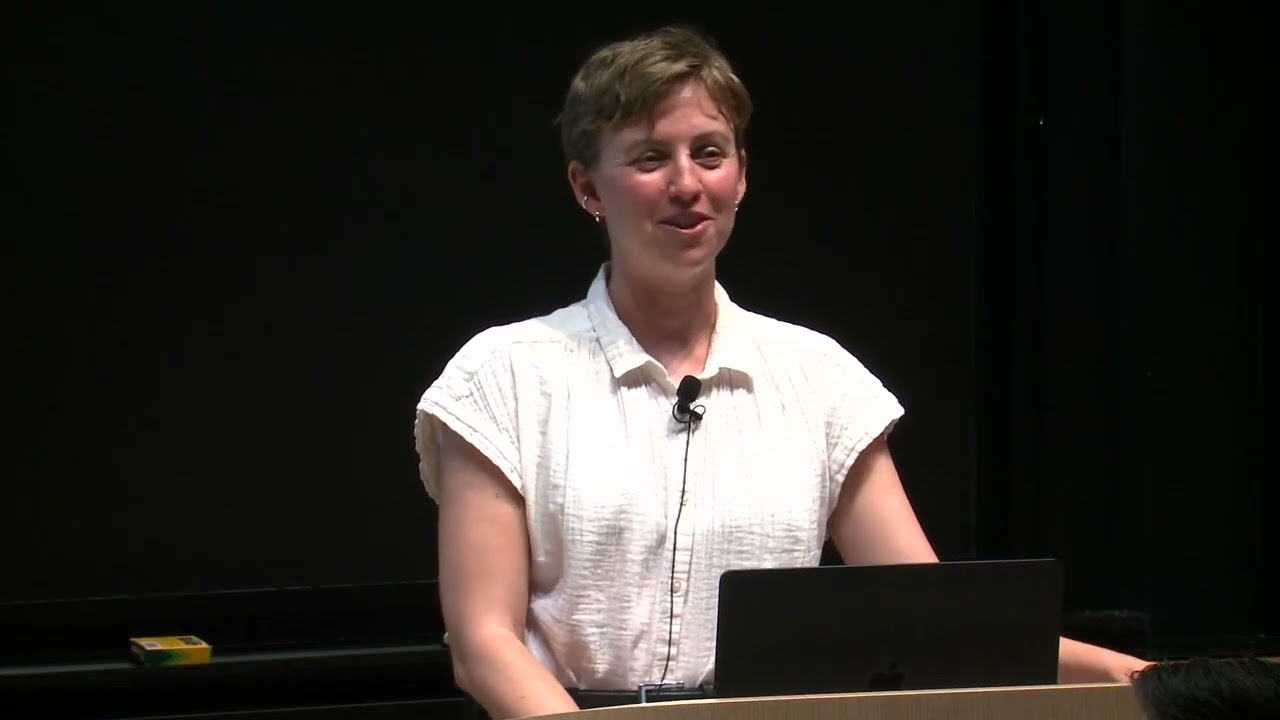
Lec 02. How to Train a Neural Net
Keywords
Summary
133 words
Critical Evaluation
The lecture provides a solid and rigorous introduction to training neural networks, suitable for an advanced undergraduate or graduate-level audience. The content is accurate and aligns with established knowledge in the field. The instructor, Sara Beery, demonstrates deep expertise and communicates complex ideas clearly. The use of visual examples of loss landscapes helps build intuition about optimization challenges. The lecture is well-structured, progressing logically from basic concepts to more advanced topics. The sources cited are institutional and reliable, primarily MIT OpenCourseWare. The title accurately reflects the content. The lecture does not include any advertising or sponsored content. The main strength is the clear explanation of backpropagation and automatic differentiation, which are often challenging for learners. The lecture could be improved by including more concrete examples or code demonstrations, but given the time constraints, it covers the essential material effectively. Overall, this is an excellent educational resource.
146 words
Title / Content Match
The title accurately reflects the content, which focuses on training neural networks.
Quality & Reliability
9/10
Lecture from MIT OpenCourseWare, part of a formal course, presented by an expert instructor. Content is well-structured, accurate, and aligns with established deep learning principles. Sources are institutional and reliable.
Key Moments
Markers derived by PSI from the transcript: the creator did not define chapters.
- Introduction and overview of the lecture topics.
- Review of gradient descent and stochastic gradient descent.
- Discussion of momentum and its effects on optimization.
- Introduction to computational graphs and backpropagation.
- Backpropagation through chains and multi-layer perceptrons.
- Backpropagation through directed acyclic graphs (DAGs).
- Introduction to differentiable programming and automatic differentiation.
- Examples of loss landscapes and optimization challenges.
- Conclusion and summary of key takeaways.
Cited Sources
- MIT OpenCourseWare - Deep Learning Course — Course page for the lecture series.
- MIT OpenCourseWare — Main OCW website.
- YouTube Playlist for the course — Playlist containing all lectures.
- MIT OCW Terms — Terms of use for OCW content.
- MIT OCW Comments Policy — Policy for comments on OCW platforms.
Concurring Sources
- Deep Learning Book (Goodfellow et al.) — Standard reference for deep learning concepts, including backpropagation and optimization.
- PyTorch Documentation — Official documentation for PyTorch, which includes autograd and optimization modules.
External References
Contribution & Novelties
This lecture provides a clear and comprehensive introduction to training neural networks, with a focus on the underlying mathematical and computational principles. It bridges the gap between theoretical optimization and practical implementation, emphasizing the role of automatic differentiation in modern deep learning frameworks. The lecture is particularly valuable for its explanation of backpropagation through computational graphs and its discussion of differentiable programming as a broader paradigm.
Pour aller plus loin :
- Backpropagation — Essential algorithm for training neural networks.
- Automatic differentiation — Core technique enabling gradient computation in frameworks like PyTorch.
- Stochastic gradient descent — Optimization algorithm central to training.
- Momentum (optimization) — Technique to accelerate convergence.
- Adam optimizer — Popular variant of SGD with adaptive learning rates.
118 words
Radar Profile
The radar profile shows high scores across all dimensions, indicating a well-rounded and reliable educational resource. The lecture excels in information quality and reliability, with strong technical depth and adequate information quantity.