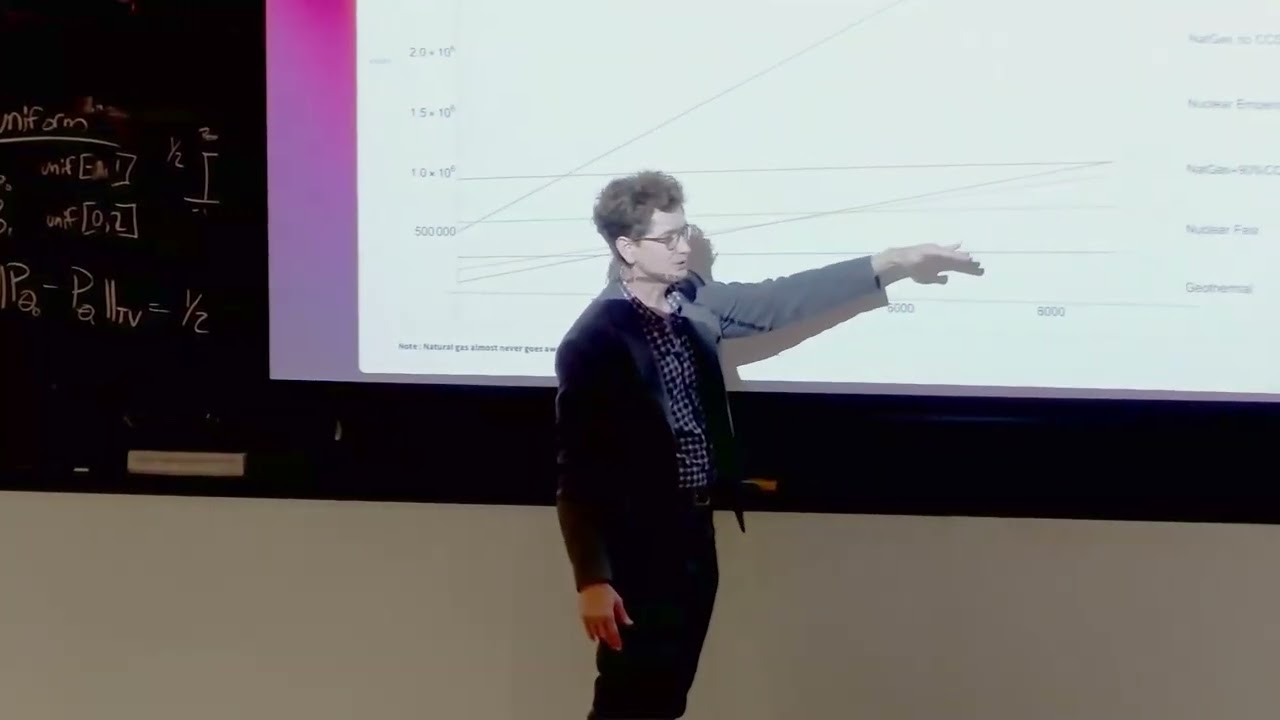
Lecture 6: Nuclear Reactor Cost Around the World and the Potential for Cost Reduction
Keywords
Summary
221 words
Critical Evaluation
The lecture provides a comprehensive and nuanced analysis of nuclear reactor costs, drawing on international comparisons and economic principles. The instructor, R. Scott Kemp, is a credible expert, and the content is well-structured, building from screening curves to specific country examples. The use of construction duration as a comparable metric is insightful, as it avoids the confounding factors of currency and accounting differences. The discussion of France is particularly valuable, illustrating how standardization can reduce costs but also how reliability may suffer, as evidenced by the lower availability factor. The lecture also honestly addresses the limitations of cost estimates, such as the optimistic projections from vendors like Oklo and TerraPower, and the uncertainty in DOE estimates. However, the lecture could benefit from more explicit citations for some claims, such as the specific cost figures and availability data. The instructor acknowledges this by saying ‘we should go look this up’ for the social cost of carbon, but in a lecture setting, this is acceptable. The argumentation is solid, but the lecture does not delve deeply into the potential for cost reduction through advanced reactor designs or policy interventions, which could be a limitation. Overall, the lecture is rigorous and informative, suitable for an academic audience, and provides a balanced view of the challenges facing nuclear power.
215 words
Title / Content Match
The title accurately reflects the content, which focuses on nuclear reactor costs globally and potential cost reductions.
Quality & Reliability
8/10
The lecture is part of MIT OpenCourseWare, a reputable academic source. The instructor, R. Scott Kemp, is a professor at MIT, and the content is based on established economic and engineering principles. The lecture includes references to specific reports and data, and the instructor acknowledges uncertainties and limitations. However, some claims lack explicit citations, and the lecture is a single perspective.
Key Moments
Markers derived by PSI from the transcript: the creator did not define chapters.
- Introduction and review of screening curves for dispatchable technologies.
- Discussion of the impact of solar and wind on nuclear's competitiveness.
- Introduction of overnight cost concept and its limitations.
- Comparison of construction durations across countries as a better metric.
- Analysis of French nuclear program: early cost success and later increases.
- Discussion of Flamanville reactor's high cost and reasons behind it.
- Examination of French reactor availability and its implications.
- Potential for learning-based cost reductions and challenges.
- Conclusion and implications for nuclear's role in decarbonization.
Cited Sources
- MIT OpenCourseWare course page — Course materials and lecture notes.
- MIT OCW support page — Link to support OCW.
- MIT OCW terms — Terms of use for OCW content.
- MIT OCW comments policy — Guidelines for comments on OCW platforms.
- MIT OCW main site — General OCW website.
- YouTube playlist for the course — Playlist of lectures for the course.
Concurring Sources
- MIT OpenCourseWare course page — Course materials and lecture notes.
Contribution & Novelties
This lecture provides a comparative analysis of nuclear reactor costs across countries, emphasizing construction duration as a more reliable metric than cost figures. It highlights the French experience as a case study, showing that standardization can reduce costs but may lead to lower reliability. The lecture also discusses the potential for learning-based cost reductions, but notes that the nuclear industry has not achieved significant learning due to lack of standardization and regulatory changes. This contributes to the ongoing debate on nuclear energy’s economic viability.
Pour aller plus loin :
- Nuclear power cost data from IAEA — Overview of nuclear power costs and climate change.
- Learning curve theory — Explanation of learning curves and their application to technology costs.
- Flamanville EPR — Details on the Flamanville reactor project and its cost overruns.
131 words
Radar Profile
The radar profile shows strong scores in quantity and quality of information, with a moderate technical level and high reliability. This indicates a well-balanced lecture that is both informative and credible, suitable for an academic audience.