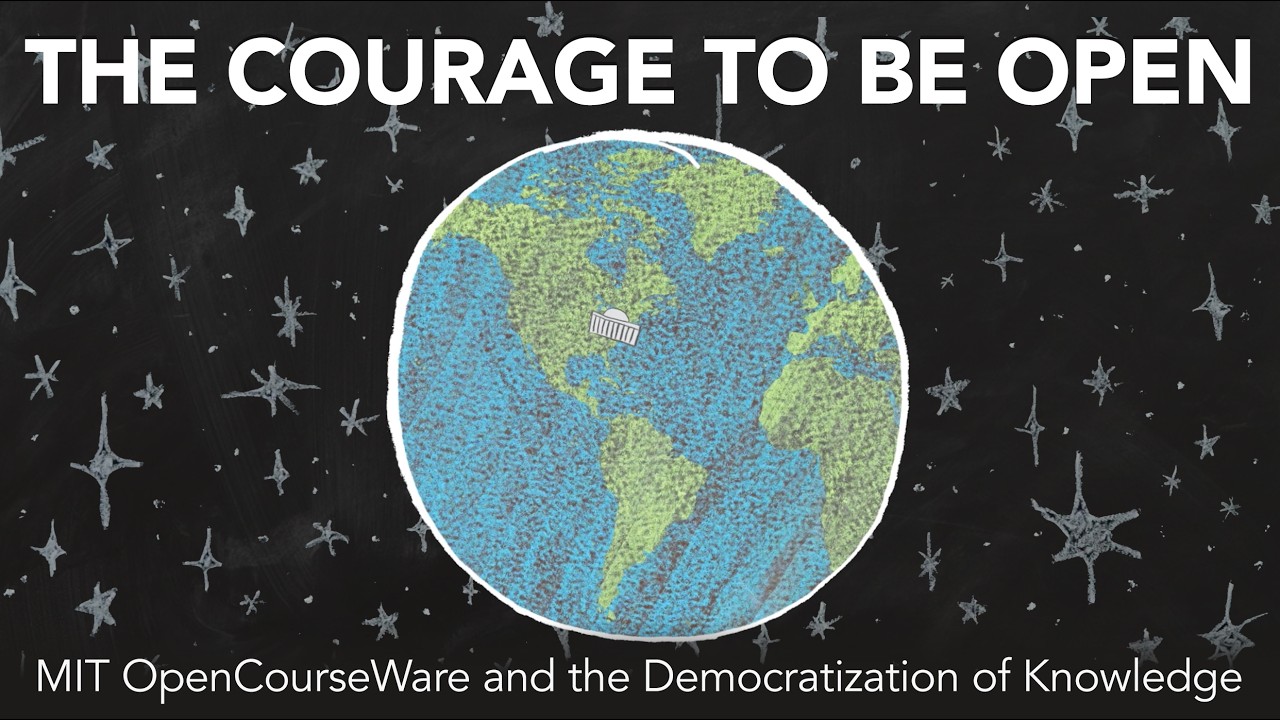
Documentary: “The Courage to Be Open: MIT OpenCourseWare and the Democratization of Knowledge”
Keywords
Summary
135 words
Critical Evaluation
The documentary provides a compelling and well-produced narrative of MIT OpenCourseWare’s history and impact. Its primary strength lies in the firsthand accounts from key figures such as former MIT President Charles Vest, faculty members, and students, which lend authenticity and personal insight. The story is presented chronologically, from the initial idea in 1999-2000 to the present, effectively illustrating the evolution of the initiative. The inclusion of diverse perspectives, including a student from Ukraine and educators who use OCW materials, demonstrates the global reach and practical applications of the resources. The documentary also acknowledges initial skepticism and challenges, such as faculty concerns about giving away content, which adds a layer of credibility. However, as a production by MIT itself, it inherently serves as a promotional piece, potentially omitting critical perspectives or failures. The narrative focuses on successes and positive outcomes, without delving into potential criticisms of the open education model, such as issues of quality control, sustainability, or the digital divide. The technical level is accessible, making it suitable for a general audience, but it lacks in-depth analysis of the pedagogical or economic implications. The sources cited are limited to the MIT Stories playlist, and while the documentary references the impact on Khan Academy and the broader OER movement, it does not provide external references or data to substantiate claims. Overall, the documentary is informative and inspiring, but it should be viewed as an institutional narrative rather than an objective analysis. The adéquation between title and content is strong, as the title accurately captures the theme of courage and democratization. The documentary’s value lies in its historical documentation and inspirational message, but for a rigorous scientific evaluation, additional independent sources would be necessary.
282 words
Title / Content Match
The title accurately reflects the documentary's focus on the courage behind MIT's decision to openly share its course materials and the resulting democratization of knowledge.
Quality & Reliability
8/10
The documentary is produced by MIT OpenCourseWare, a reputable institution, and features interviews with key figures involved in the creation and evolution of OCW, including former MIT president Charles Vest. The content is based on firsthand accounts and historical records, providing a reliable narrative. However, it is a promotional piece, so it may present a favorable perspective without critical analysis.
Key Moments
Markers derived by PSI from the transcript: the creator did not define chapters.
- Introduction to the documentary's theme and MIT's mission.
- Discussion of the internet's potential and the initial ideas for MIT's response.
- Dick Yue's 'eureka' moment of giving away course materials.
- Announcement of OpenCourseWare and initial reactions.
- Faculty skepticism and the philosophical defense of sharing knowledge.
- Impact on students and educators, including the Ukrainian student's story.
- Translation efforts and the global reach of OCW.
- Influence on other platforms like Khan Academy and the OER movement.
- Reflections on the future of OCW and the importance of courage.
Cited Sources
- MIT Stories video playlist — The documentary is part of this series, and the playlist contains other related stories.
Concurring Sources
- MIT OpenCourseWare official site — The official OCW website provides access to the courses and supports the documentary's claims about the availability of materials.
- Khan Academy — Khan Academy's existence and mission align with the documentary's narrative of democratizing education.
Contribution & Novelties
The documentary provides a unique insider perspective on the origins and evolution of MIT OpenCourseWare, highlighting the courage and vision of its founders. It underscores the transformative impact of open education on individuals worldwide, as exemplified by the Ukrainian student’s journey. The film also emphasizes the role of OCW in inspiring subsequent open education initiatives like Khan Academy.
Pour aller plus loin :
- Open Educational Resources (Wikipedia) — Overview of the OER movement and its principles.
- MIT OpenCourseWare official site — Access to the actual course materials and further information.
- Khan Academy — A platform directly inspired by OCW, offering free educational content.
- UNESCO OER Recommendation — International policy framework supporting OER.
112 words
Radar Profile
The radar profile shows high scores in quality of information and reliability, reflecting the documentary's authoritative sources and production quality. The lower score in technical level indicates that the content is accessible to a general audience, which is appropriate for a documentary. The quantity of information is moderate, as the film focuses on narrative rather than exhaustive detail.