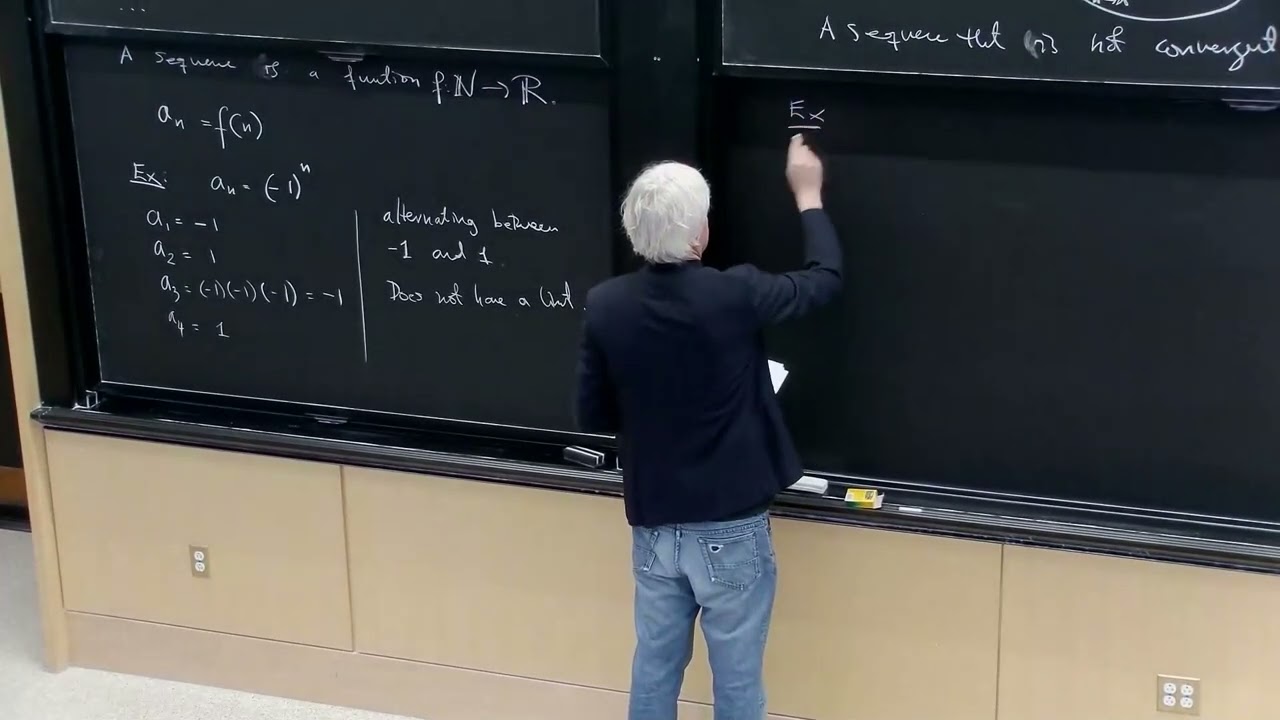
Lecture 4: Sequences; Convergence
Keywords
Summary
165 words
Critical Evaluation
The lecture is an exemplary introduction to sequences and convergence in real analysis. The instructor, Tobias Holck Colding, demonstrates deep expertise and pedagogical clarity. The content is mathematically rigorous, with formal definitions, proofs, and illustrative examples. The definition of convergence is presented with the standard epsilon-N formulation, which is fundamental to analysis. The proof that convergent sequences are bounded is carefully constructed, addressing potential student questions and clarifying the use of the supremum. The algebraic properties of limits are stated clearly, and the proofs of the first two are detailed, setting a solid foundation for later material. The lecture’s strength lies in its balance between intuition and rigor: the instructor uses geometric intuition (e.g., intervals around the limit) while ensuring that all arguments are formally valid. The examples chosen (sqrt(2), alternating sequence, 1/n, 0.999…) effectively illustrate the concepts. The only minor weakness is that the lecture does not cover all four algebraic properties in full detail, but this is acceptable given time constraints and the fact that the remaining proofs are outlined. The adéquation between title and content is perfect. Overall, this is a high-quality educational resource that would benefit any student of real analysis.
195 words
Title / Content Match
The title accurately reflects the content, which focuses on sequences and their convergence.
Quality & Reliability
9/10
The lecture is part of MIT OpenCourseWare's 18.100B Real Analysis course, taught by a professor at a top institution. The content is mathematically rigorous, with formal definitions, proofs, and examples. The presentation is clear and pedagogically effective.
Key Moments
Markers derived by PSI from the transcript: the creator did not define chapters.
- Introduction and recap of sequences from previous lecture
- Examples of sequences: sqrt(2) decimal expansion, alternating sequence, 1/n
- Formal definition of convergence with epsilon-N
- Example: 0.999... converges to 1, using Archimedean property
- Theorem: convergent sequences are bounded, with proof
- Algebraic properties of limits: constant multiple and sum
- Proof of constant multiple property
- Proof of sum property
Cited Sources
- MIT OpenCourseWare 18.100B Real Analysis — Course page for the lecture series
- YouTube Playlist for 18.100B — Playlist containing all lectures
- MIT OCW Support — Link to support OCW
- MIT OCW Terms — Terms of use for OCW content
- MIT OCW Comments Policy — Policy for comments on OCW platforms
Concurring Sources
- MIT OpenCourseWare 18.100B Real Analysis — Course materials align with the lecture content.
External References
Contribution & Novelties
This lecture provides a rigorous introduction to sequences and convergence, a foundational topic in real analysis. It offers clear definitions, proofs, and examples that build intuition. The instructor’s approach emphasizes the epsilon-N definition and its application, which is essential for further study in analysis.
Pour aller plus loin :
- Convergent sequence (Wikipedia) — Provides a comprehensive overview of sequence limits, including definitions and properties.
- Archimedean property (Wikipedia) — Explains the property used to find N in the example.
- Bounded sequence (Wikipedia) — Discusses boundedness, a key concept in the theorem proved.
91 words
Radar Profile
The radar profile shows high scores in quality of information, technical level, and reliability, with a slightly lower score in quantity of information due to the focused scope of the lecture. This indicates a highly reliable and rigorous educational resource.