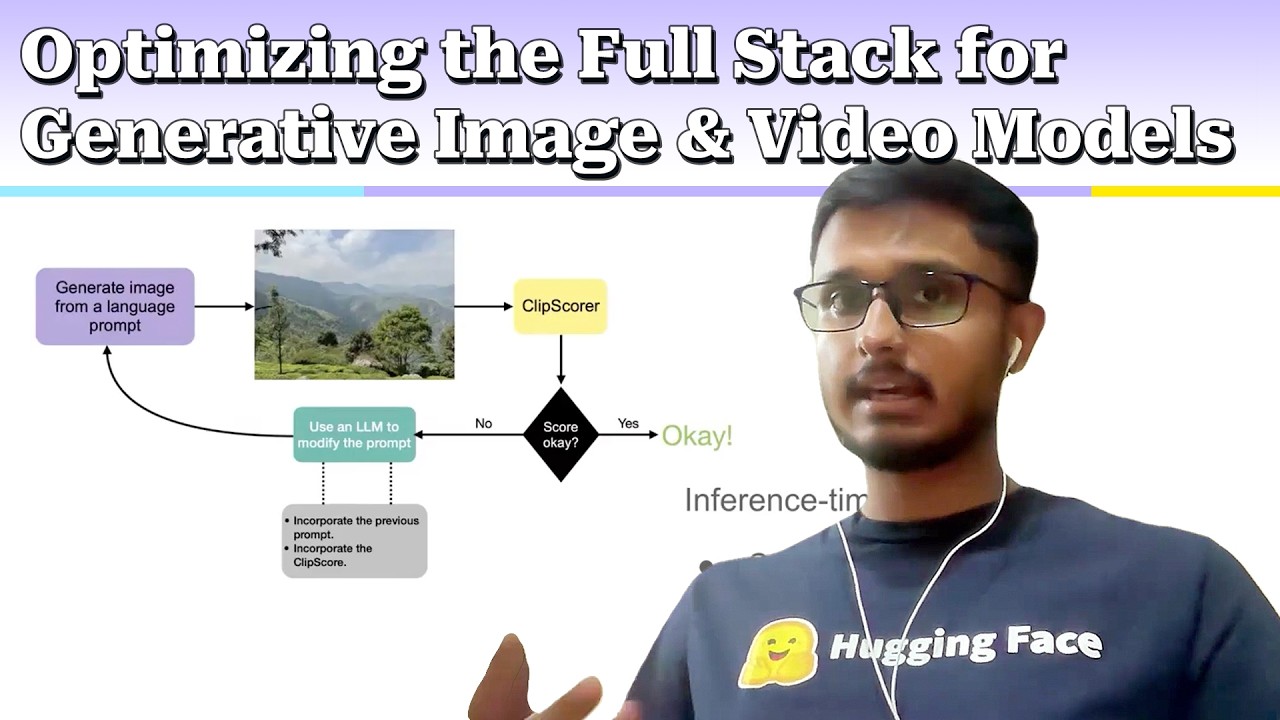
Optimizing the Full Stack for Generative Image and Video Models
Keywords
Summary
163 words
Critical Evaluation
The presentation offers a valuable overview of optimization challenges in diffusion models, drawing on the speaker’s practical experience at Hugging Face. The content is technically sound, with clear explanations of the components involved and the reasons for optimization. The speaker effectively communicates the complexity of the optimization landscape, emphasizing that speed is not the only metric to consider. The discussion of hardware-aware model shapes and the ’efficiency misnomer’ provides insightful perspectives. However, the talk lacks depth in specific techniques; it serves more as a motivation and framework than a detailed guide. The absence of citations or references to specific papers is a notable weakness, as it limits the ability to verify claims. The speaker’s expertise lends credibility, but the lack of formal sources reduces the overall rigor. The title accurately reflects the content, and the presentation is well-structured. The audience appears to be technical, but the talk remains accessible. The inclusion of examples from recent models like Flux and PixArt-Alpha helps illustrate the points. Overall, the talk is informative and thought-provoking, but it would benefit from more concrete details and references.
181 words
Title / Content Match
The title accurately reflects the content, which covers optimization strategies for diffusion models across the full stack.
Quality & Reliability
8/10
Presentation by a research engineer at Hugging Face, with practical experience in diffusion models. Content is technically accurate and well-structured, but lacks formal citations and peer review.
Key Moments
Markers derived by PSI from the transcript: the creator did not define chapters.
- Introduction and speaker self-introduction
- Examples of text-to-image and text-to-video outputs
- Explanation of diffusion models and latent space diffusion
- Components of a diffusion model and their connections
- Memory footprint of Flux model and inference times
- Motivation for optimization beyond speed
- Hardware-aware model shapes and throughput improvements
- Efficiency misnomer: smaller models not always faster
- Challenges of high-resolution generation and compute-bound transformers
Cited Sources
- MIT OpenCourseWare course page — Course materials and additional resources
- MIT OpenCourseWare — General OCW platform
- MIT OCW Terms — License and terms of use
- MIT OCW Comments Policy — Comment guidelines
- Support OCW — Donation link
Concurring Sources
- MIT OpenCourseWare course page — Official course page with additional materials
Contribution & Novelties
The talk provides a comprehensive overview of optimization strategies for diffusion models, emphasizing the need to consider factors beyond speed, such as hardware efficiency and application context. It highlights the importance of hardware-aware model design and specialized kernels, and challenges the common assumption that smaller models are always more efficient.
Pour aller plus loin :
- Diffusion Models — Background on diffusion models.
- Hugging Face Diffusers — Library for diffusion models.
- Flux Model — Example of a state-of-the-art text-to-image model.
79 words
Radar Profile
The radar profile shows high scores in information quantity, quality, and reliability, with a slightly lower technical depth. This indicates a well-balanced presentation that is informative and credible, though it could benefit from more detailed technical explanations.