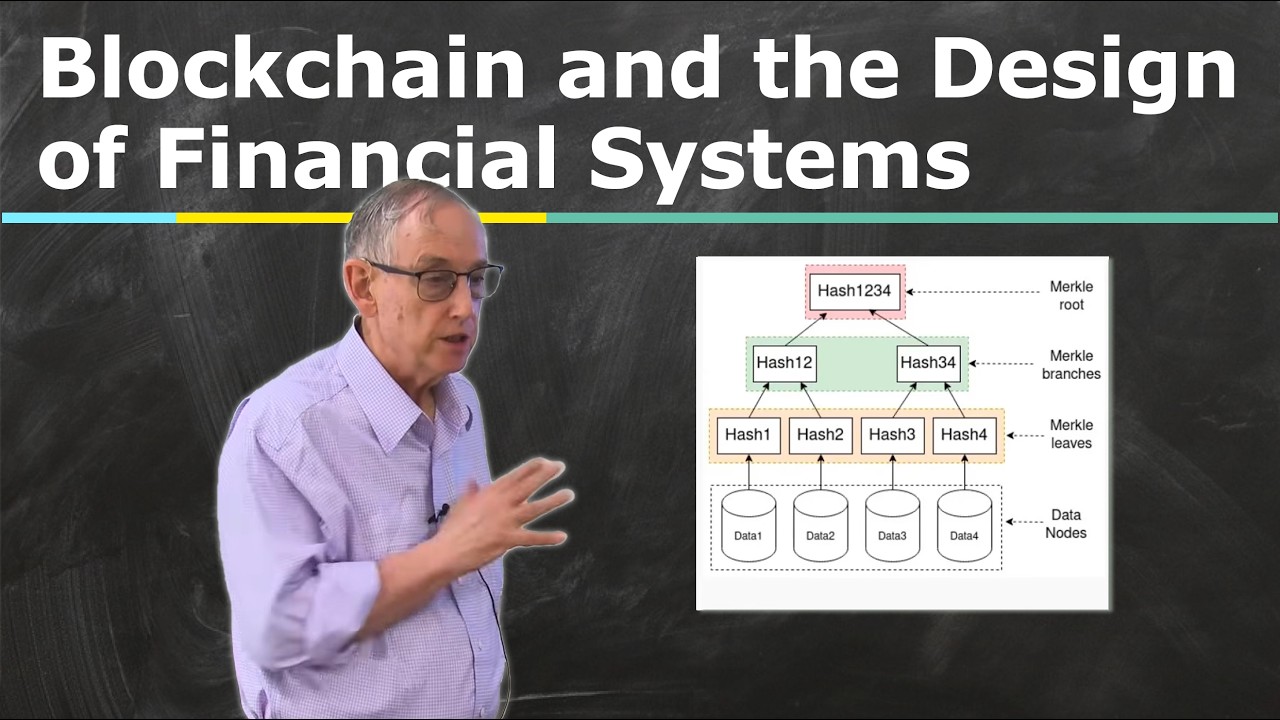
Lecture 1: Introduction to 14.129 Blockchain and Design of Financial Systems
Keywords
Summary
181 words
Critical Evaluation
The lecture provides a comprehensive and well-structured introduction to the course, effectively setting the stage for the interdisciplinary study of blockchain and financial systems. Professor Townsend’s expertise is evident in his ability to connect complex concepts from computer science and economics, presenting them in an accessible yet rigorous manner. The content is highly relevant and timely, addressing the hype and polarization surrounding blockchain technology while advocating for a balanced, objective analysis. The lecture’s strength lies in its clear articulation of the course’s goals and the logical progression of topics, which helps students understand the scope and depth of the material. However, as an introductory lecture, it lacks technical depth, and some concepts are only briefly mentioned, which may leave viewers wanting more detailed explanations. The sources cited are credible, including references to BIS publications and academic papers, though they are not thoroughly discussed. The lecture’s alignment with the title is strong, as it directly addresses the design of financial systems using blockchain. Overall, this is a valuable resource for anyone interested in the intersection of blockchain and economics, offering a solid foundation for further study.
185 words
Title / Content Match
The title accurately reflects the content: a lecture introducing the course on blockchain and financial systems design.
Quality & Reliability
8/10
The lecture is delivered by a renowned MIT professor, Robert M. Townsend, and is part of an official MIT OpenCourseWare course. It provides a structured overview of the course content, blending computer science and economics. The information is well-organized and presented with academic rigor, though it is introductory and lacks detailed technical depth.
Key Moments
Markers derived by PSI from the transcript: the creator did not define chapters.
- Introduction to the course and its objectives.
- Overview of the synthesis of computer science and economics.
- Discussion of the course's focus on distributed ledgers, smart contracts, and encryption.
- Preview of lecture topics including community currencies and financial crashes.
- Explanation of the CAP theorem and its relevance to financial systems.
- Introduction to the concept of Pareto optimality and market fragmentation.
- Discussion of liquidity-saving mechanisms and real-time gross settlement.
- Overview of the course structure and research focus.
Cited Sources
- MIT OpenCourseWare course page — Course materials and syllabus.
- YouTube Playlist — All lectures for the course.
- Support OCW — Donation link to support MIT OpenCourseWare.
- MIT OpenCourseWare — Main OCW website.
- OCW Comments Policy — Guidelines for comments on OCW platforms.
- OCW Terms — License and terms of use.
Concurring Sources
- MIT OpenCourseWare — The course is part of MIT's open educational resources, ensuring high academic standards.
Contribution & Novelties
This lecture provides a unique synthesis of computer science and economics, offering a structured framework for understanding blockchain technology in the context of financial system design. It emphasizes a balanced perspective, avoiding both hype and undue criticism, and introduces key concepts such as the CAP theorem and Pareto optimality as tools for analysis. The course’s focus on research projects rather than exams encourages deep exploration of topics.
Pour aller plus loin :
- CAP theorem — A fundamental concept in distributed systems, directly relevant to the trade-offs discussed in the lecture.
- Mechanism design — A key economic theory used in the course to analyze blockchain-based mechanisms.
- Real-time gross settlement — A payment system concept discussed in the lecture, with implications for liquidity and financial stability.
124 words
Radar Profile
The radar profile shows high scores in quality and reliability, reflecting the academic rigor and credibility of the source. The quantity of information is moderate, as it is an introductory lecture, and the technical level is moderate, suitable for a broad audience. The overall profile indicates a well-balanced and trustworthy educational resource.
💬 Sur les 0 commentaires analysés, aucune tendance n'a pu être dégagée.