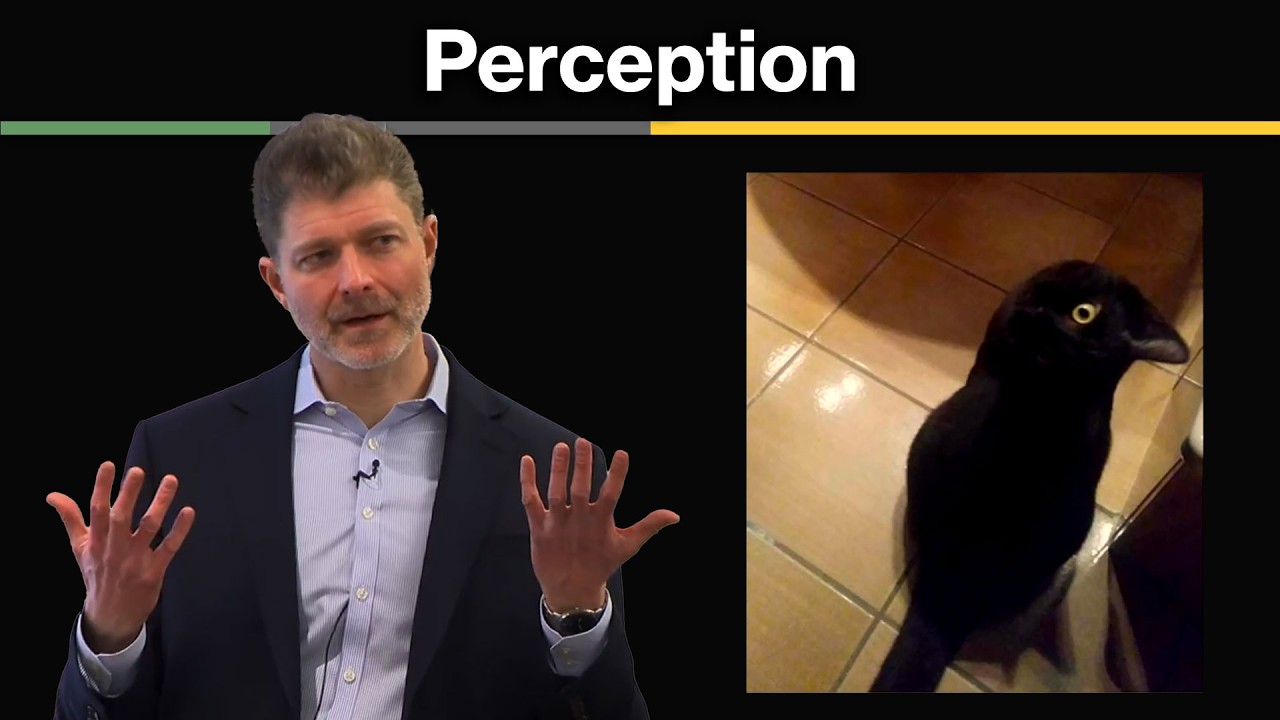
1: Introduction to Perception
Keywords
Summary
168 words
Critical Evaluation
The lecture is an excellent introduction to the field of perception, delivered by a renowned expert. The content is scientifically accurate and well-presented, with clear examples and demonstrations that effectively illustrate the key concepts. The argumentation is solid, building from the definition of perception to the challenges of sensory processing, and the ill-posed nature of perceptual problems is convincingly argued with multiple examples. The use of interactive demonstrations (e.g., the auditory scene) engages the audience and reinforces the points. The sources are not explicitly cited within the lecture, but the course materials and the instructor’s expertise lend credibility. The title accurately reflects the content, and the lecture fulfills its purpose as an introduction. The only minor weakness is that some concepts might be oversimplified for a general audience, but this is appropriate for an introductory lecture. Overall, this is a high-quality educational resource.
143 words
Title / Content Match
The title accurately reflects the content, which is an introductory lecture on perception.
Quality & Reliability
9/10
Lecture by a leading MIT professor, part of an accredited course, with clear explanations and demonstrations. Content is well-structured and based on established scientific knowledge.
Key Moments
Markers derived by PSI from the transcript: the creator did not define chapters.
- Introduction to the course and definition of perception.
- Explanation of sensory organs and how they detect clues from the world.
- Demonstration that perception is deceptively hard using an image as an array of numbers.
- Discussion of the eye and retina, and how light is transduced into neural signals.
- Auditory demonstration: identifying background noise and multiple speakers.
- Introduction to the concept of ill-posed problems in perception.
- Example of 3D vision from 2D retinal images and ambiguous figures.
- Cocktail party problem and the challenge of auditory scene analysis.
- Comparison of human vs. machine performance in speech recognition.
- Conclusion and preview of the course topics.
Cited Sources
- MIT OpenCourseWare - 9.35 Perception Spring 2024 — Course page with materials and additional resources.
- YouTube Playlist for 9.35 Perception — Playlist of all lectures in the course.
- MIT OpenCourseWare — General OCW site.
- MIT OpenCourseWare Terms — Terms of use for OCW content.
- MIT OpenCourseWare Comments Policy — Guidelines for comments on OCW platforms.
- Support OCW — Donation link to support MIT OpenCourseWare.
Concurring Sources
- MIT OpenCourseWare - 9.35 Perception Spring 2024 — Course materials align with the lecture content.
Contribution & Novelties
This lecture provides a clear and engaging introduction to the field of perception, emphasizing the ill-posed nature of perceptual problems and the complexity of sensory processing. It serves as a foundation for the course, highlighting key challenges and setting the stage for deeper exploration.
Pour aller plus loin :
- Visual perception — Overview of visual perception and its mechanisms.
- Auditory scene analysis — Concept related to the cocktail party problem.
- Ill-posed problem — Definition and examples of ill-posed problems in mathematics and science.
- Cocktail party effect — Specific phenomenon discussed in the lecture.
93 words
Radar Profile
The radar profile shows high scores in information quality and reliability, with slightly lower but still strong scores in information quantity and technical level. This indicates a well-balanced, authoritative introductory lecture that provides substantial content without being overly technical.
💬 Très positif. Sur les 30 commentaires analysés, la grande majorité exprime de l'enthousiasme et de la gratitude pour la disponibilité de ce cours, avec quelques commentaires techniques sur les démonstrations.