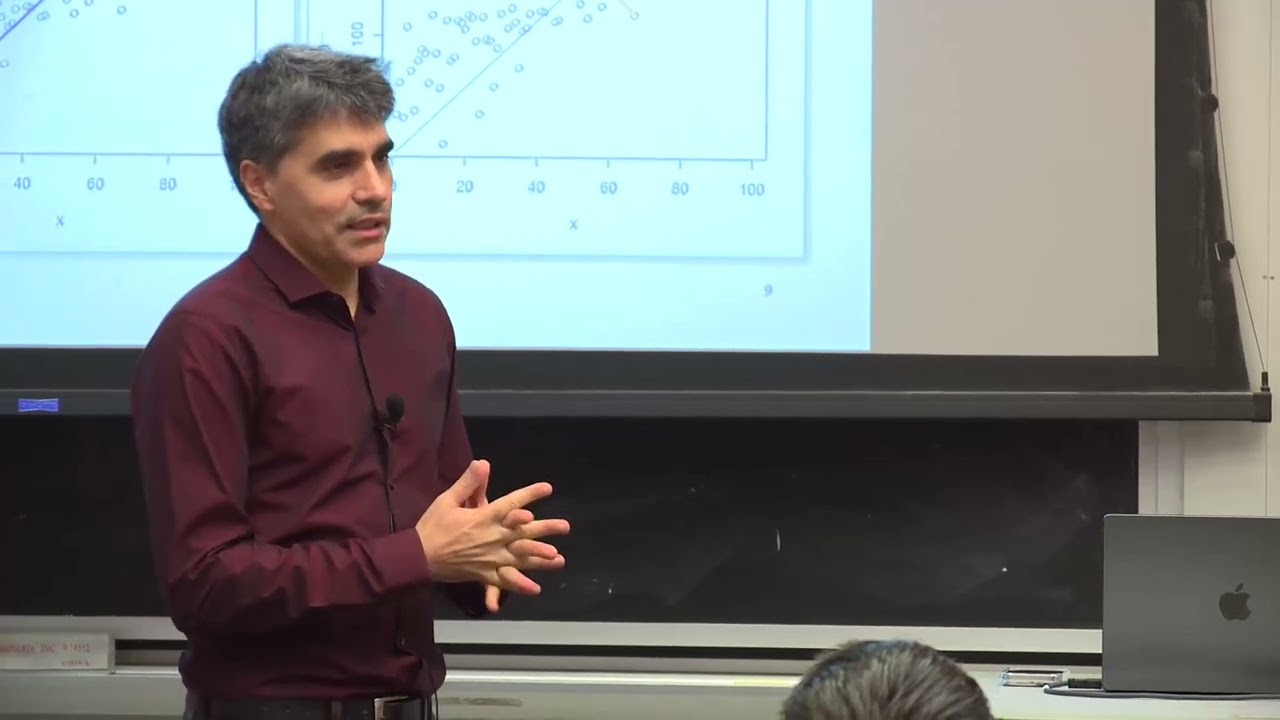
Lecture 9: Principal Component Analysis in Finance
Keywords
Summary
189 words
Critical Evaluation
The lecture provides a solid introduction to PCA with a clear focus on financial applications, particularly bond markets. Andreev’s pedagogical approach is effective: he starts with intuitive visual examples before moving to mathematical formalism, making the content accessible to students with some linear algebra background. The explanation of the difference between PCA and regression is particularly valuable, highlighting the unsupervised nature of PCA and its suitability for exploring correlation structures without assuming causality. The emphasis on examining eigenvalues rather than just eigenvectors is a crucial practical tip that is often overlooked in introductory treatments. The bond market example is well-chosen, as it demonstrates how PCA can reduce a high-dimensional problem (yield curve with many maturities) to a few interpretable factors (level, slope, curvature), which are widely used in finance. Andreev’s industry experience adds credibility, and he provides practical advice on implementation, such as using covariance matrices and SVD. However, the lecture lacks explicit citations to academic literature or specific sources, which would strengthen its scholarly rigor. The mathematical derivations are concise but sufficient for the target audience. The Q&A session addresses some concerns but could have been more extensive. Overall, the lecture is informative and well-structured, though it assumes prior knowledge of PCA basics, as it is part of a course. The title accurately reflects the content, and the presentation is clear and engaging. The main weakness is the absence of formal references, but the course materials and OCW resources partially compensate. The lecture’s practical orientation and real-world examples make it a valuable resource for students and practitioners alike.
259 words
Title / Content Match
The title accurately reflects the content: a lecture on PCA with applications in finance, focusing on bond markets and portfolio construction.
Quality & Reliability
8/10
Lecture by an experienced practitioner (PhD in Chemical Physics, Wall Street experience) with clear mathematical explanations and practical insights. Content is well-structured and aligns with standard PCA theory. Sources are not explicitly cited in the video, but the course materials and OCW resources are provided.
Key Moments
Markers derived by PSI from the transcript: the creator did not define chapters.
- Introduction by professor and guest lecturer Stefan Andreev
- Overview of PCA as unsupervised learning and its applications
- Visual example of PCA on 2D data with rotation and noise
- Difference between PCA and regression explained
- Importance of eigenvalues and robustness of PCA
- Mathematical formulation of PCA: covariance matrix, eigenvectors, projections
- Application to bond market: yield curve modeling with PCA
- Practical considerations: data preprocessing, missing data, stability over time
- Q&A session with students on robustness and implementation
- Concluding remarks and encouragement to use provided notebook
Cited Sources
- MIT OCW Course Page — Course materials and lecture slides
- MIT OCW YouTube Playlist — Playlist containing this lecture and others
- MIT OCW Support — Link to support OCW
- MIT OCW Home — General OCW resource
- MIT OCW Comments Policy — Guidelines for comments
- MIT OCW Terms — License and terms of use
Concurring Sources
- Principal Component Analysis (Wikipedia) — General PCA theory aligns with lecture content.
- Singular Value Decomposition (Wikipedia) — SVD is mentioned as an alternative method.
Contribution & Novelties
The lecture provides a practical, industry-oriented perspective on PCA in finance, emphasizing the importance of eigenvalue analysis and robustness. It bridges theory and application with a concrete bond market example, making it valuable for students and practitioners.
Pour aller plus loin :
- Principal Component Analysis (Wikipedia) — Foundational overview of PCA.
- Singular Value Decomposition (Wikipedia) — Mathematical technique used in PCA.
- Yield Curve (Wikipedia) — Background on yield curves and their modeling.
- Nelson-Siegel Model (Wikipedia) — Alternative yield curve model.
- MIT OpenCourseWare — Access to course materials and further resources.
90 words
Radar Profile
The radar profile shows high scores in quantity and quality of information, with slightly lower technical depth and reliability. This indicates a well-balanced lecture that is informative and credible, though not extremely technical or heavily referenced.