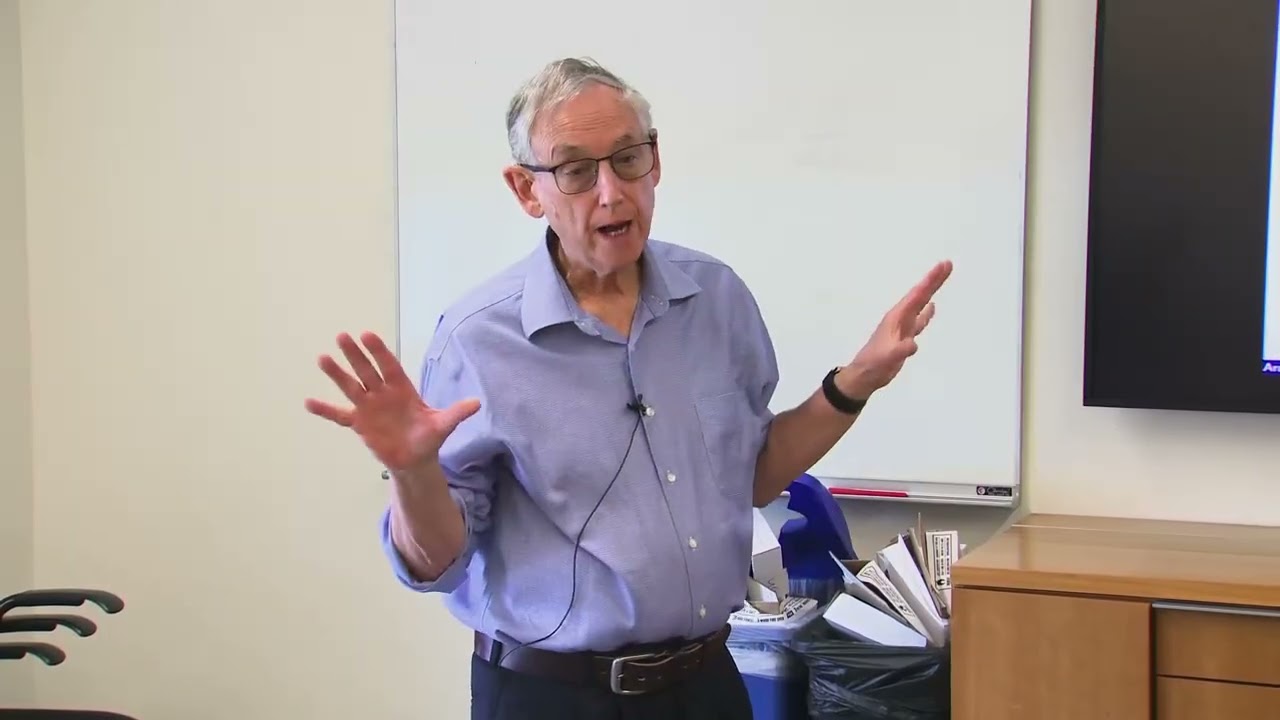
Lecture 7: Stochastic Financial Networks
Keywords
Summary
197 words
Critical Evaluation
The lecture provides a rigorous and insightful analysis of stochastic financial networks, blending theoretical modeling with empirical applications. The instructor, Robert Townsend, is a distinguished economist, and the content reflects deep expertise. The presentation is well-structured, starting with a clear introduction and outline, then building the model step by step, and finally discussing implications and empirical evidence.
The theoretical framework is solid: it incorporates risk-averse agents, random income shocks, and random market participation, leading to a rich analysis of liquidity provision. The concept of ’liquidity value’ is a valuable contribution, as it shifts focus from traditional centrality measures to the social value of liquidity injections. The lecture carefully distinguishes this measure from financial centrality used in contagion studies, addressing potential confusion.
The argumentation is logical and supported by examples, such as the interbank market and Thai village data. The use of Thai villages as an empirical test is particularly compelling, as it grounds the theory in real-world observations. However, the lecture is primarily theoretical, and the empirical evidence is presented at a high level, without detailed econometric analysis. This is appropriate for a lecture but limits the depth of empirical validation.
The sources cited are appropriate and include classic references like Duffie’s work on OTC markets and the monetary search literature. The lecture also references the Federal Reserve’s role in liquidity management, tying the theory to policy. However, specific citations are not always provided in the transcript, so the viewer would need to consult the course materials for full references.
The lecture’s strength lies in its clear exposition of complex ideas and its ability to connect theory to real-world financial systems. It also raises important policy questions about whether to enhance or limit markets, which is highly relevant. The main limitation is that it is a single lecture, so it cannot cover all aspects of the topic in depth, and some concepts are simplified for the classroom setting.
Overall, the lecture is of high quality, with a strong theoretical foundation and meaningful empirical connections. It is suitable for an advanced audience, but the core ideas are accessible to those with some background in economics. The adéquation between title and content is excellent, as the lecture indeed focuses on stochastic financial networks, liquidity, and contagion.
No comments were provided, so no analysis of public reception is included.
386 words
Title / Content Match
The title accurately reflects the content, which focuses on stochastic financial networks, liquidity, and contagion.
Quality & Reliability
8/10
Lecture by a renowned economist (MIT), based on rigorous theoretical models and empirical work. The content is well-structured and references established literature. However, it is a single lecture and not peer-reviewed, and some claims are simplified for teaching.
Key Moments
Markers derived by PSI from the transcript: the creator did not define chapters.
- Introduction: stochastic financial networks, liquidity, and value of key players vs contagion.
- Outline of the lecture: environment, stochastic network definition, liquidity injections, empirical work, and contagion.
- Discussion of disruptions to markets and related literature (Duffie, search models, monetary models).
- Definition of financial centrality/liquidity value as marginal social value of giving resources to an agent.
- Example of interbank market network showing variation over time.
- Underlying environment: risk-averse agents, random incomes, and market participation shocks.
- Formalization of stochastic financial network with host and invitations, probability of participation based on network distance.
- Example of network with host and invitations, illustrating market formation process.
- Discussion of ex-ante liquidity injections and identifying the most valued player.
- Empirical work in Thai villages to test the theory.
- Comparison with financial centrality and contagion, and policy implications.
Cited Sources
- MIT OpenCourseWare: 14.129 Blockchain and the Design of Financial Systems — Course page with materials and additional resources.
- YouTube Playlist for the course — Playlist containing all lectures of the course.
- MIT OpenCourseWare — General OCW platform.
- MIT OCW Terms — Terms of use for OCW content.
- MIT OCW Comments Policy — Policy for comments on OCW platforms.
- Support OCW — Link to support MIT OpenCourseWare.
Concurring Sources
- MIT OpenCourseWare: 14.129 Course Page — Course materials and lecture notes align with the content.
Contribution & Novelties
This lecture provides a novel framework for understanding liquidity provision in financial networks, emphasizing the social value of liquidity injections to key players. It introduces a measure of ’liquidity value’ that differs from traditional financial centrality, offering a new perspective on market design and policy. The empirical application to Thai villages adds a practical dimension, linking theory to real-world data.
Pour aller plus loin :
- Darrell Duffie’s work on OTC markets — Relevant for understanding search frictions in financial markets.
- Search and matching theory — Foundational for models of random matching in markets.
- Financial contagion — Key concept for systemic risk and policy.
- Risk sharing — Core concept in the lecture’s model.
112 words
Radar Profile
The radar profile shows high scores across all dimensions, indicating a well-rounded lecture with substantial information, high technical depth, and strong reliability. The balance between theoretical and empirical content is evident.