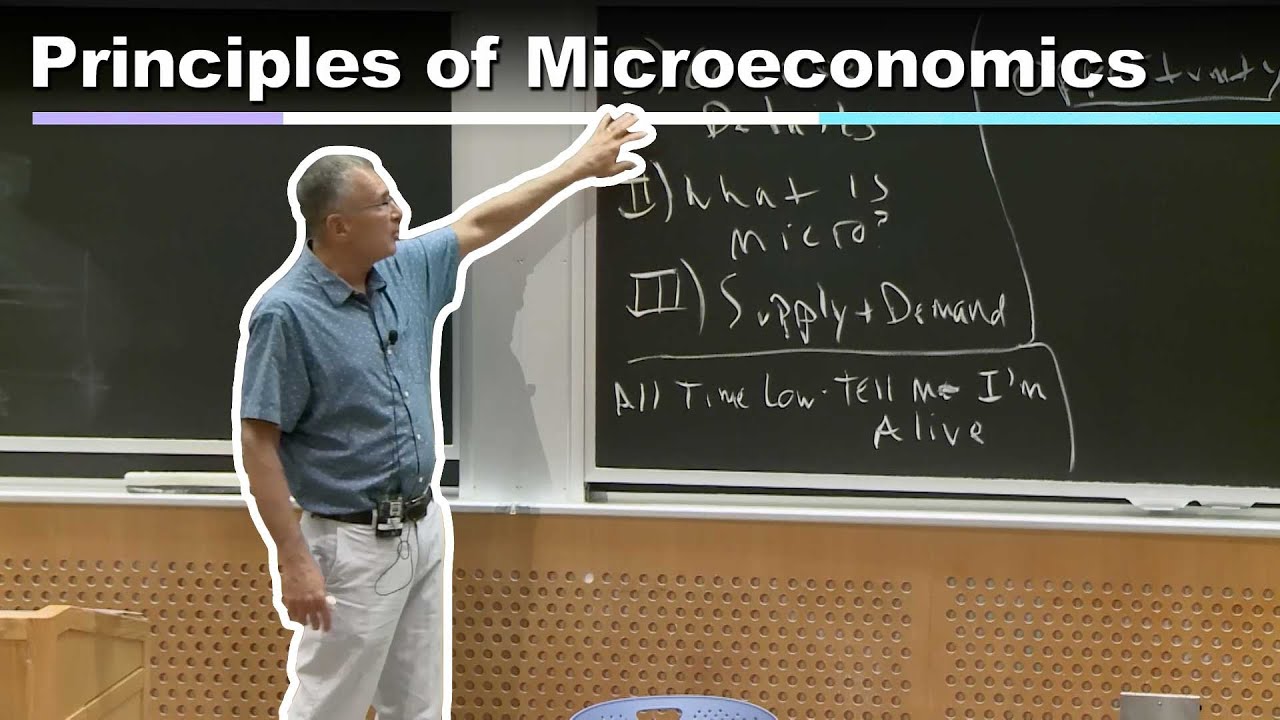
Lec 1: Introduction to Principles of Microeconomics and Supply & Demand
Keywords
Summary
163 words
Critical Evaluation
The lecture is an exemplary introduction to microeconomics, delivered with clarity and enthusiasm by Professor Jonathan Gruber. The content is accurate and well-structured, building from foundational concepts to a concrete model. Gruber effectively communicates the core idea of scarcity and constrained optimization, using relatable examples like the water-diamond paradox to illustrate the interplay of supply and demand. The pedagogical approach is strong: he emphasizes the importance of understanding concepts at mathematical, graphical, and intuitive levels, and encourages active participation. The lecture is part of MIT OpenCourseWare, a reputable source, and the content aligns with standard microeconomic theory. The professor’s passion for the subject is evident, making the material engaging. The only minor critique is that the lecture is introductory and does not delve deeply into any single topic, but that is appropriate for a first lecture. The use of a handout and board work is effective, though the handwriting is admittedly poor. Overall, this is a high-quality educational resource that provides a solid foundation for further study in microeconomics.
169 words
Title / Content Match
The title accurately reflects the content: an introductory lecture on microeconomics principles, focusing on supply and demand.
Quality & Reliability
9/10
Lecture by a renowned MIT professor, part of an official OpenCourseWare course, with clear pedagogical structure and references to foundational economic concepts. The content is well-established and presented with academic rigor.
Key Moments
Markers derived by PSI from the transcript: the creator did not define chapters.
- Introduction to the course and teaching style.
- Definition of microeconomics and scarcity.
- Explanation of opportunity cost.
- Discussion of models and simplifying assumptions.
- Introduction to supply and demand with water-diamond paradox.
- Graphical and mathematical example of the market for roses.
- Explanation of demand curve and its negative slope.
- Introduction of supply curve and its positive slope.
Cited Sources
- MIT OCW Course Page — Official course page with materials and syllabus.
- YouTube Playlist — Full playlist of lectures for the course.
- MIT OpenCourseWare — Platform hosting the course and other educational content.
- Support OCW — Link to support MIT OpenCourseWare.
- MIT OCW Terms — Terms of use for OCW content.
- MIT OCW Comments Policy — Policy for comments on OCW platforms.
Concurring Sources
- Principles of Microeconomics (MIT OCW) — Official course materials align with the lecture content.
- The Wealth of Nations — Adam Smith's work referenced in the lecture for the water-diamond paradox.
Contribution & Novelties
This lecture provides a clear and engaging introduction to microeconomics, emphasizing the foundational concepts of scarcity, opportunity cost, and constrained optimization. It effectively uses the water-diamond paradox to illustrate the importance of considering both supply and demand. The lecture is part of a comprehensive OpenCourseWare course, making high-quality education freely accessible.
Pour aller plus loin :
- Opportunity Cost — Core concept discussed in the lecture.
- Supply and Demand — Fundamental model introduced.
- Constrained Optimization — Mathematical framework underlying microeconomic decisions.
- Water-Diamond Paradox — Classic example used to explain value and price.
- Paul Samuelson — Economist who introduced mathematical tools to economics, mentioned in the lecture.
105 words
Radar Profile
The radar profile shows high scores in quality of information and reliability, with slightly lower scores in quantity and technical level, reflecting the introductory nature of the lecture. The overall balance indicates a solid educational resource.
💬 Très positif. Sur les 30 commentaires analysés, les spectateurs expriment une gratitude et une admiration massives pour la qualité de l'enseignement et la gratuité du cours, avec de nombreux témoignages internationaux.