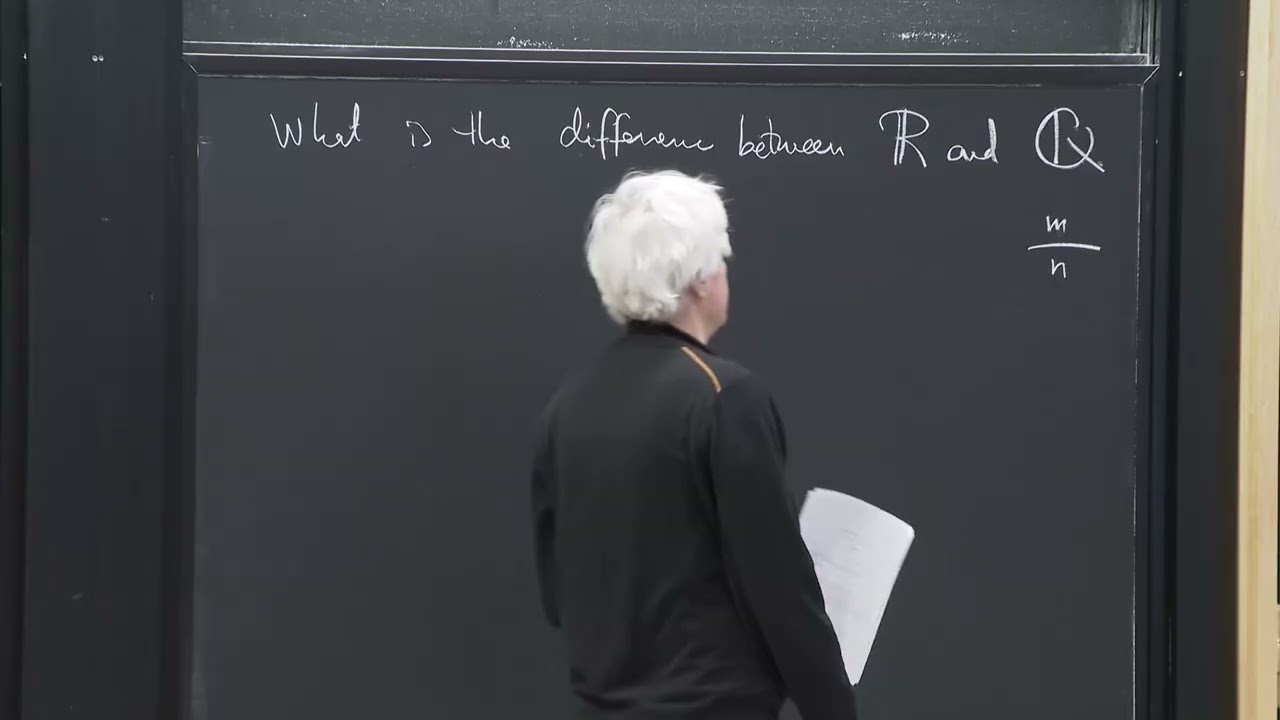
Lecture 2: Introduction to Real Numbers (cont.)
Keywords
Summary
208 words
Critical Evaluation
This lecture is a model of clarity and rigor in mathematical exposition. The instructor carefully builds on previous material, reviewing the definitions of fields and ordered sets before introducing the concept of completeness. The proof that sqrt(2) is irrational is a classic and is presented with sufficient detail, making it accessible to students new to rigorous mathematics. The transition to the least upper bound property is smooth, and the definition of a complete ordered field is clearly motivated by the need to prove the intermediate value theorem. The theorem asserting the existence of a smallest complete ordered field containing the rationals is stated without proof, which is appropriate for an introductory course, but the instructor is transparent about this. The subsequent proof that sqrt(2) exists in the reals using the least upper bound property is elegant and demonstrates the power of completeness. The argument by contradiction is well-structured, and the instructor takes care to explain each step. The lecture is well-paced, with appropriate pauses for emphasis. The use of the board is effective, and the instructor’s handwriting is legible. The content is accurate and aligns with standard treatments of real analysis. The only minor criticism is that the lecture could have benefited from a brief summary at the end, but this is a minor point. Overall, this is an excellent lecture that provides a solid foundation for understanding the real numbers.
231 words
Title / Content Match
The title accurately reflects the content: a continuation of an introduction to real numbers, covering completeness and the least upper bound property.
Quality & Reliability
9/10
Lecture from MIT OpenCourseWare, a reputable academic institution. The content is rigorous, well-structured, and presented by a professor. The proof of irrationality of sqrt(2) is classic and correct. The lecture is part of a formal course in real analysis.
Key Moments
Markers derived by PSI from the transcript: the creator did not define chapters.
- Introduction and review of fields and ordered sets.
- Definition of ordered field and its properties.
- Proof that sqrt(2) is not rational.
- Introduction to upper bounds and least upper bounds.
- Definition of complete ordered field and statement of existence theorem.
- Construction of set A and definition of sqrt(2) as its least upper bound.
- Proof that x^2 <= 2 by contradiction.
- Proof that x^2 >= 2 by contradiction.
- Conclusion and summary of the proof.
Cited Sources
- MIT OpenCourseWare — General platform hosting the course materials.
- Course page for 18.100B Real Analysis — Official course page with lecture notes, assignments, and additional resources.
- YouTube playlist for 18.100B — Playlist containing all lectures for the course.
- MIT OpenCourseWare terms of use — Terms and conditions for using OCW materials.
- MIT OpenCourseWare comments policy — Policy for comments on OCW platforms.
Concurring Sources
- MIT OpenCourseWare — The lecture is part of a reputable academic platform, and the content aligns with standard real analysis textbooks.
External References
Contribution & Novelties
This lecture provides a rigorous introduction to the completeness property of real numbers, which is fundamental to real analysis. It offers a clear proof of the irrationality of sqrt(2) and demonstrates how the least upper bound property guarantees the existence of sqrt(2) in the reals. The lecture is part of a structured course, making it a valuable resource for students.
Pour aller plus loin :
- Completeness of the real numbers — Wikipedia article explaining the concept and its importance.
- Least-upper-bound property — Wikipedia article on the least upper bound property.
- Construction of the real numbers — Wikipedia article discussing various constructions of the reals, including Dedekind cuts and Cauchy sequences.
110 words
Radar Profile
The radar chart shows high scores across all dimensions, indicating a well-rounded lecture with strong information content, quality, technical depth, and reliability. The lecture is particularly strong in quality and reliability, reflecting its academic origin.