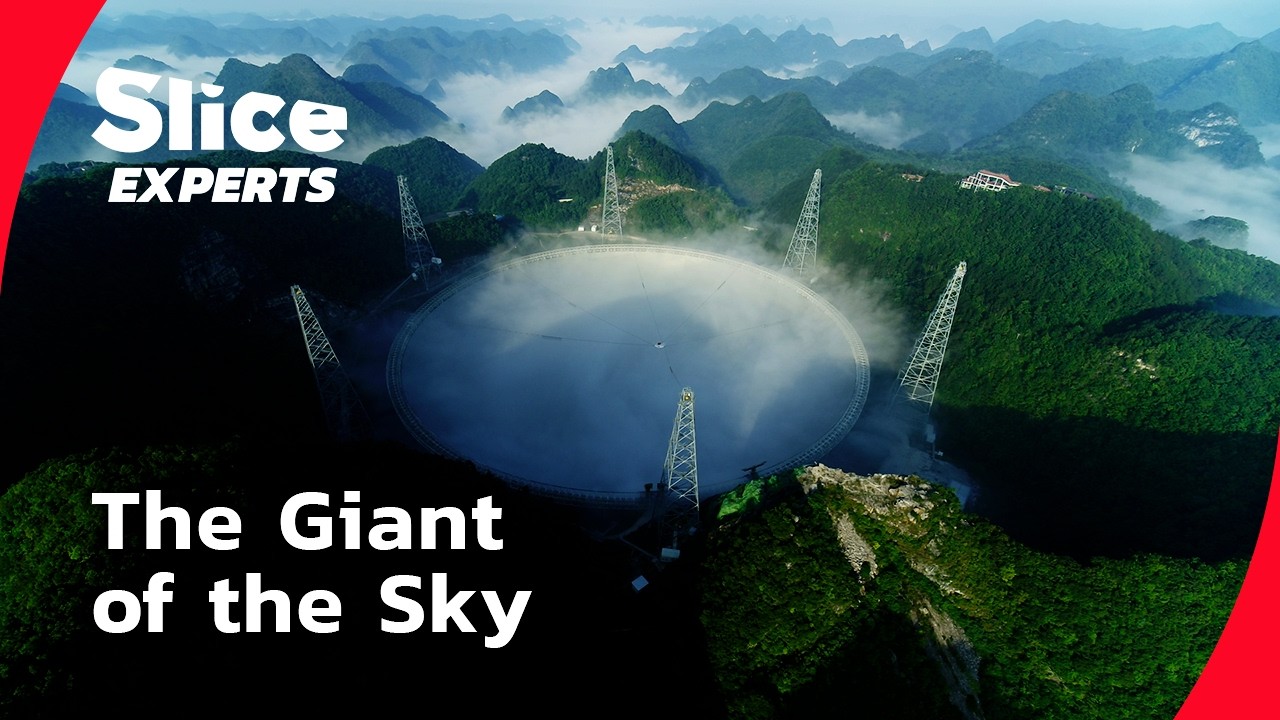
The Celestial Eye: The Machine That Listens to the Stars I FULL DOC | SLICE EXPERTS
Keywords
Summary
129 words
Critical Evaluation
The documentary offers a comprehensive and visually stunning overview of the FAST telescope’s construction, providing valuable insights into the engineering and scientific challenges involved. It excels in conveying the sheer scale of the project, with impressive footage of the construction site and detailed explanations of technical aspects such as the reflector’s precision and the feed cabin’s capabilities. The interviews with engineers and scientists lend credibility, and the narrative is well-structured, progressing from the initial concept to the final inauguration. However, the documentary lacks explicit citations to scientific literature or external sources, which limits its utility for viewers seeking to verify specific claims. Some aspects are dramatized for effect, such as the last-minute technical issue before the inauguration, which may overstate the tension. The scientific content is accurate but presented at a level accessible to a general audience, with some oversimplifications. The title accurately reflects the content, and the documentary does not mislead. Overall, it is a valuable resource for understanding the engineering marvel of FAST, though it could benefit from more rigorous sourcing.
173 words
Title / Content Match
The title accurately reflects the content, focusing on the FAST telescope as a 'celestial eye' that listens to the cosmos.
Quality & Reliability
7/10
The documentary provides a detailed account of the construction of FAST, featuring interviews with engineers and scientists. It is produced by a reputable documentary team and includes specific technical details. However, it lacks citations to peer-reviewed sources and may contain some dramatization.
Key Moments
Markers derived by PSI from the transcript: the creator did not define chapters.
- Introduction to FAST and its significance.
- The 1993 Kyoto meeting and the problem of electromagnetic pollution.
- Search for the ideal site, leading to Dawodang.
- Construction begins: digging shafts and building roads.
- Assembling the steel ring and the precision alignment.
- Installing the reflector panels.
- Building the feed cabin and its 19 antennas.
- Testing the feed cabin and the curtain cable.
- Inauguration day and the technical issue.
- FAST begins operations and its scientific goals.
Cited Sources
- FAST: The Celestial Eye (Documentary) — The documentary itself, produced by La Compagnie des Taxi-Brousse, is the primary source for the information presented.
Concurring Sources
- FAST: The World's Largest Radio Telescope — A Nature news article discussing FAST's capabilities and early scientific results.
Dissenting Sources
- Concerns over FAST's environmental impact — Some local residents and scientists raised concerns about the displacement of communities and environmental impact, which the documentary does not address.
Contribution & Novelties
The documentary provides an in-depth look at the construction of FAST, offering unique behind-the-scenes footage and interviews. It highlights the engineering innovations and challenges, such as the curtain cable and the precision assembly. This contributes to public understanding of large-scale scientific projects.
Pour aller plus loin :
- FAST telescope on Wikipedia — Provides a comprehensive overview of FAST’s specifications and scientific achievements.
- Radio astronomy on Wikipedia — Explains the principles of radio astronomy and its importance in observing the universe.
- Pulsar on Wikipedia — Details the nature of pulsars, a key target for FAST’s observations.
95 words
Radar Profile
The radar profile shows high scores in quantity and quality of information, with moderate technical depth and reliability. This indicates a well-produced documentary that is informative but may not delve deeply into technical details or provide extensive scientific references.
💬 Sur les 0 commentaires analysés, aucune tendance n'est disponible.